By Harvey Castro, MD · DR GPT™
A healthcare AI proposal needs questions a team can actually use. Who reviews the output? What does success mean? How much time does correction take? What happens when the service is unavailable?
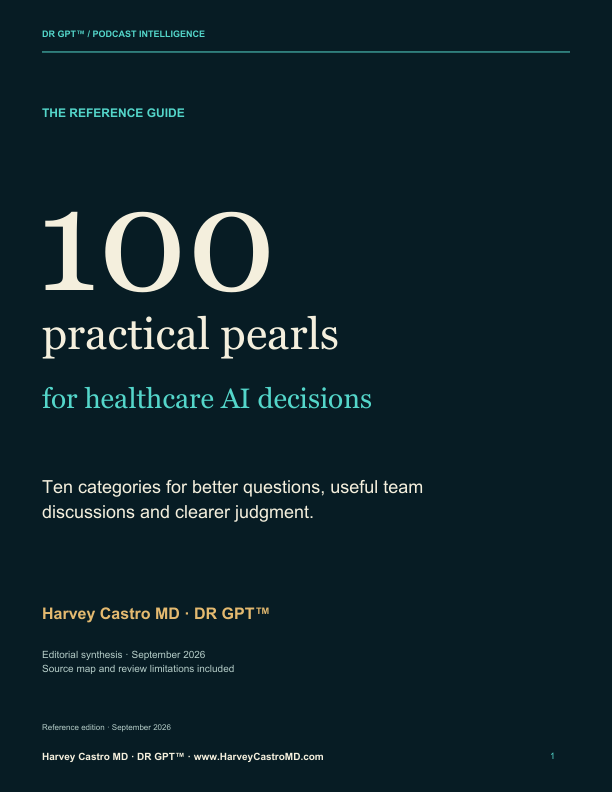
100 Practical Pearls for Healthcare AI Decisions brings together editorial lessons from the DR GPT™ Podcast Intelligence collection. The guide is designed for clinicians, healthcare leaders, educators and teams preparing an AI discussion, examining a proposal or planning a teaching session.
Download the complete 19 page guide: 100 Practical Pearls for Healthcare AI Decisions (PDF)
Start with one decision
Choose a current question before reading the guide. A team considering an AI documentation tool, for example, can start with evaluation and measurement. A team connecting an agent to operational systems can start with permissions and control. Each category includes ten pearls and a practical discussion prompt.
Use the collection to identify what needs examination. The pearls are editorial lessons and suggested applications, not a scientific ranking or a set of treatment recommendations.
Five pearls to begin a team discussion
- Evaluate the clinician and AI together. A strong model can still produce a weak workflow. Ask how the output reaches the person responsible for checking it. See pearl 1 and source F1 in the guide.
- Choose the success measure before choosing the model. Describe the task and the result you will measure before comparing tools. See pearl 11 and source JW.
- Include review time and correction costs when calculating time saved. A faster first draft may still require substantial work before it is usable. See pearl 13 and source LIAM.
- Define which consequential actions require a person’s approval. Make authority explicit before an agent can change important records or act on someone’s behalf. See pearl 33 and source JEV.
- Keep uncertainty attached to a claim. Preserve it when turning the idea into slides, audio or social posts. See pearl 70 and source READ.
These descriptions are editorial applications. The source map in the PDF distinguishes primary sources, podcast briefs and the collection’s own editorial practices.
What the ten categories cover
1. Clinical AI and patient care
Examine the people, information and handoffs around a tool. Identify the reviewer, the recipient of the final output and the fallback owner.
2. Evaluation and measurement
Define useful work before a pilot starts. Include representative tasks, consequential errors, review time and correction costs in the comparison.
3. Product design and adoption
Map the task people need to finish. Look at handoffs, application switching, useful defaults and how users report failures.
4. Agents, permissions and operational control
Specify what an agent may read, recommend and change. Examine access, spending, approval, records and recovery before connecting it to important systems.
5. Business and institutional strategy
Connect investment to a defined problem. Include implementation, oversight, vendor dependencies and exit costs in procurement discussions.
6. Creativity, communication and professional judgment
Choose an audience and purpose before drafting. Use concrete examples and check memorable lines against the original recording before quoting them.
7. Evidence and media judgment
Trace claims to their original evidence. Distinguish forecasts from observed results and repeated summaries from independent findings.
8. Health, longevity and research interpretation
Ask what a study measured, who participated and how long follow up lasted. Keep biological mechanisms separate from demonstrated treatment benefits.
9. Infrastructure, robotics and space
Examine operating conditions, power, connectivity, maintenance and human intervention. Use these items for strategic discussion rather than as claims about healthcare effectiveness.
10. Turning information into better decisions
Keep the source beside the insight, record uncertainty and define a limited test. Preserve corrections so an older claim does not quietly return.
A worked example
The guide includes a hypothetical documentation workflow exercise. A team asks whether an AI tool reduces total documentation time, including review and correction. It records the source, question, uncertainties, test, result and next decision.
The exercise uses fictional cases in an approved test environment. No results are assumed. A small simulation can inform further evaluation; it does not establish patient benefit or readiness for clinical use.
Sources and review limits
This September 2026 reference edition draws on a review of 41 local files. Substantive September briefs were prioritized, and selected archive sections were screened. Many pearls are editorial adaptations rather than statements made by a named guest. Original episode links have not all been independently verified.
The PDF includes a source map, review limits and archive file references. Its companion source inventory is separate from the download. Check the original source before quoting or presenting a specific factual claim.
Read or download all 100 practical pearls and the source map.
Use these questions in your next healthcare AI discussion
Select one category, bring one real decision to the discussion and record what evidence the team still needs. For a conference, leadership briefing or workshop on healthcare AI, explore Harvey Castro’s speaking topics and request availability.
Continue reading on LinkedIn
Subscribe to Harvey Castro’s Apple Vision + AI Healthcare newsletter for writing on AI and healthcare.