I asked emergency physicians, health system leaders and AI builders the same hard questions: where AI helps at triage, whether ambient scribes give time back, who is accountable when AI is wrong, what patients should be told, and what to do first in 2027. This page shares the voices that have approved their words so far.
Edited by Harvey Castro, MD, MBA
At a glance
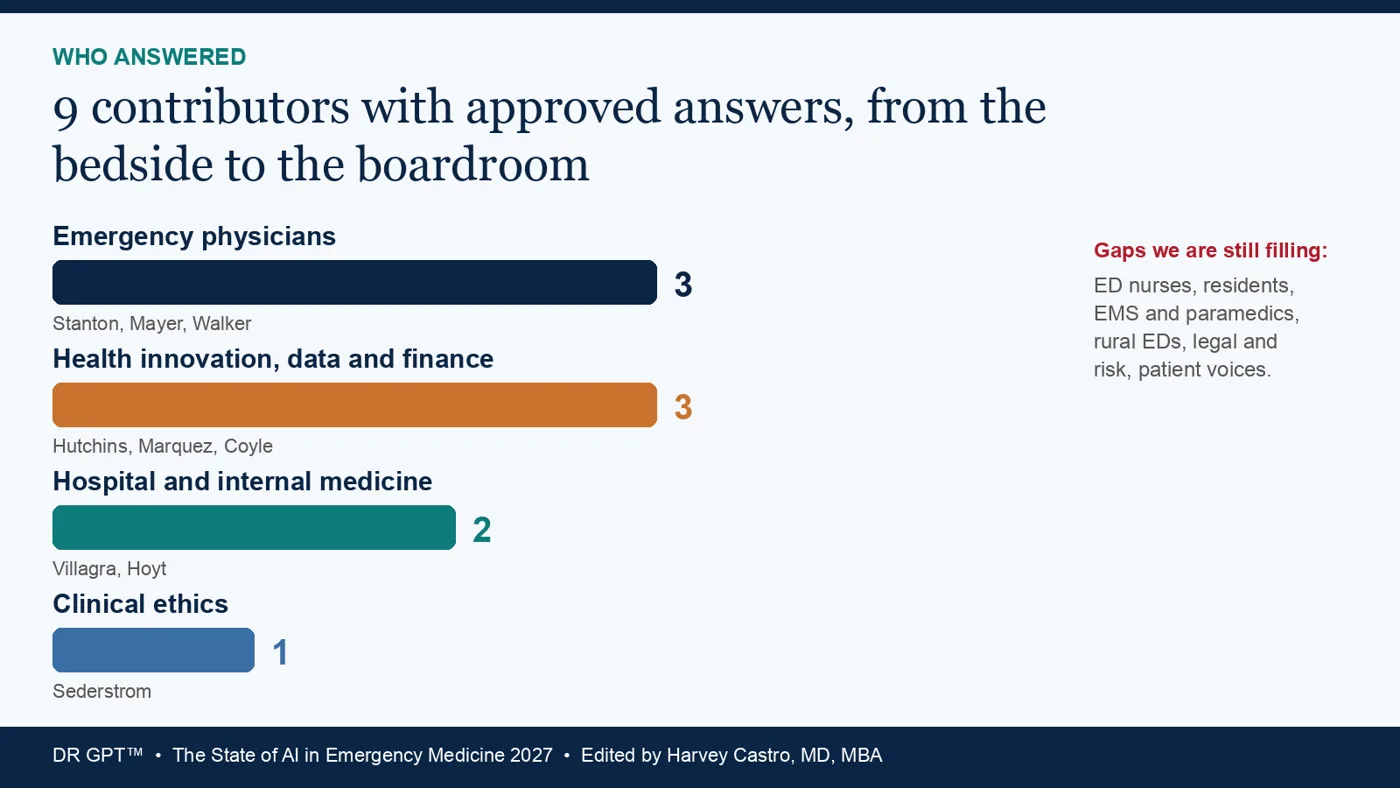
9contributors with approved answers
5questions
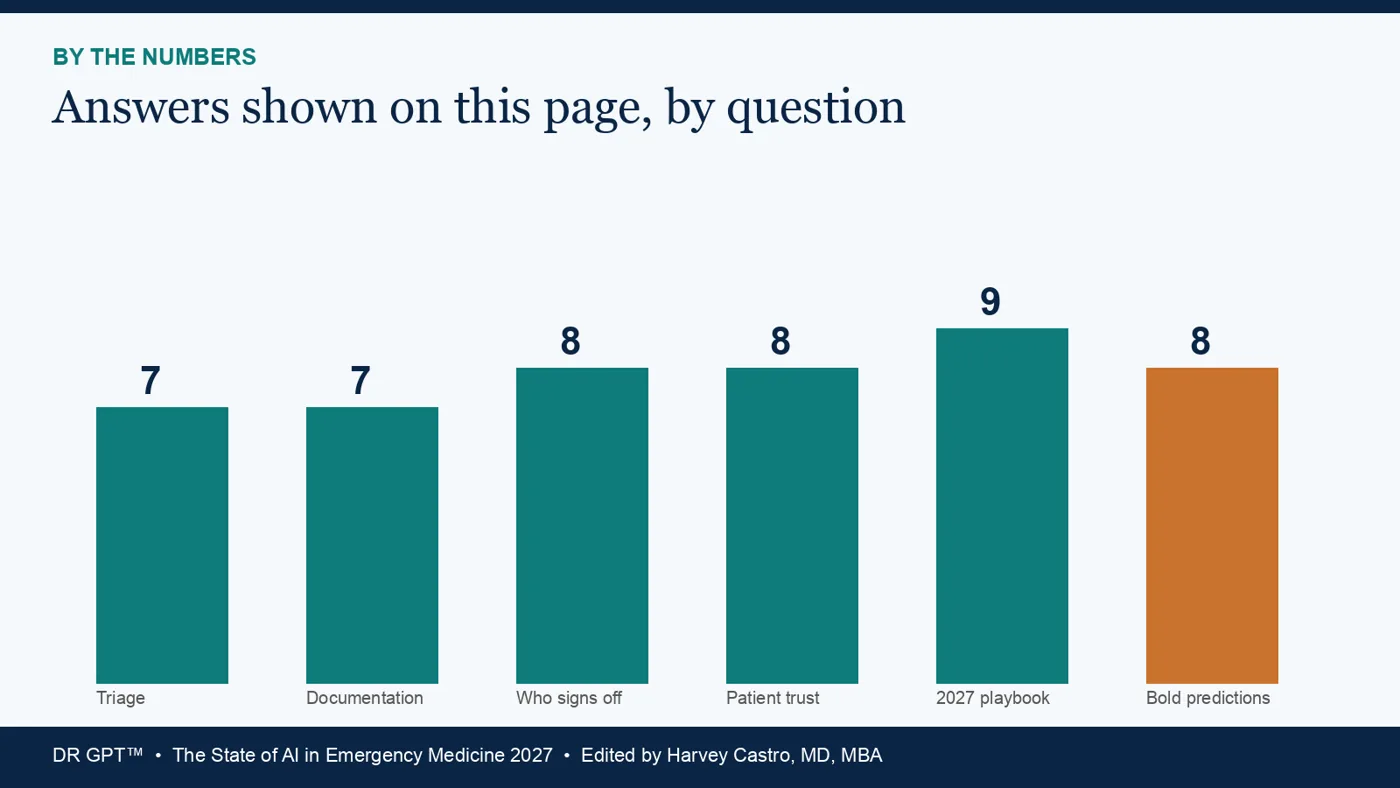
39answers
8bold predictions
Roles mix: Emergency physicians 3; Health innovation, data and finance 3; Hospital and internal medicine 2; Clinical ethics 1
President, American College of Emergency Physicians; President, Central Emergency Physicians; Medical Director, Lexington Fire/EMS; Medical Director, GMR Motorsports
Healthcare Executive, Clinical Ethicist, and Author of the forthcoming book Designed to Heal
Filter by role
All voicesEmergency physiciansOther cliniciansHealth system and organization leadersAI, data and innovationEthics, governance and accountability
Key themes
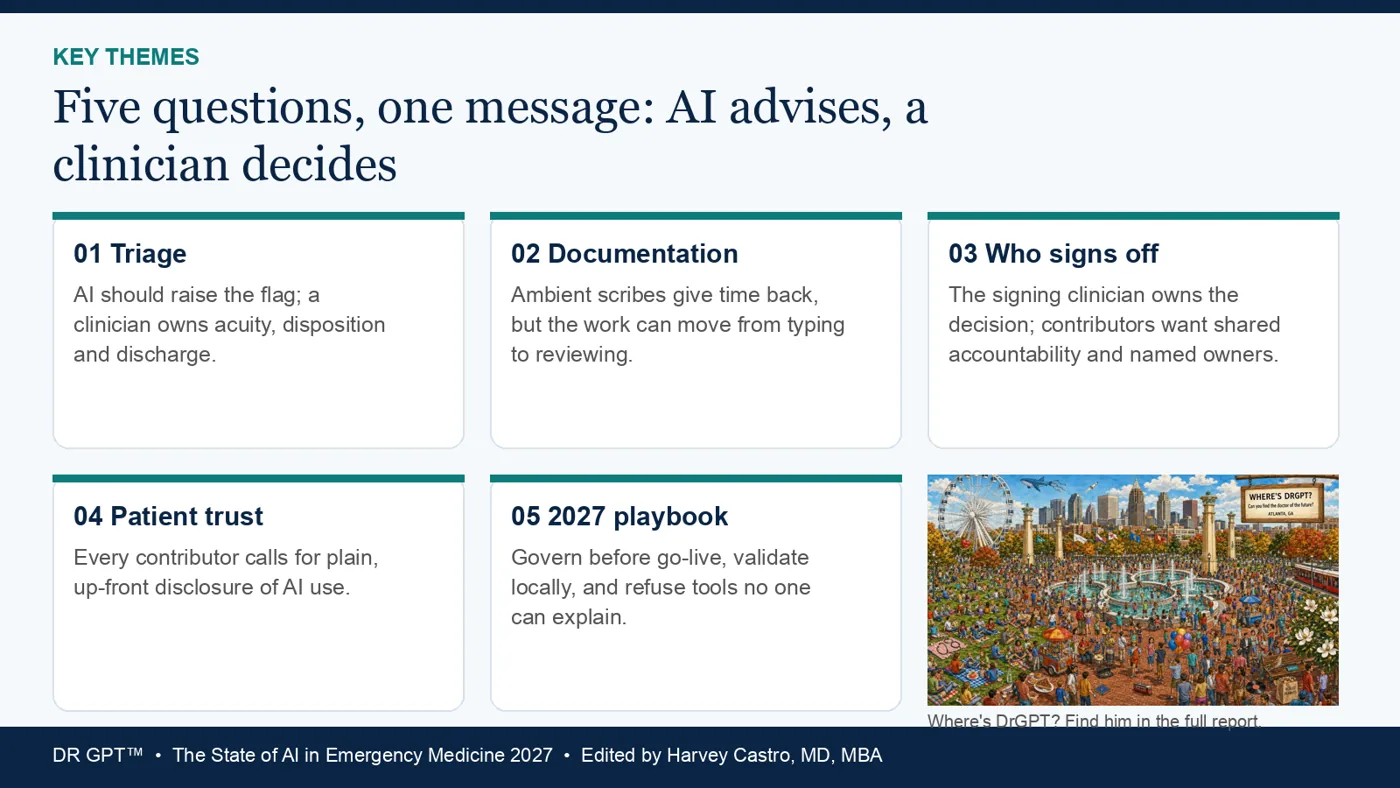
Five questions, one message: AI advises, a clinician decides.
Question 1
Triage
What we asked: Where will AI actually help triage and early risk recognition in the ED in 2027, and where should a human always make the call?
From Ryan A. Stanton, MD, FACEP, answer to question 1.
“AI has tremendous potential to improve triage, particularly in identifying patterns, recognizing high-risk patients, predicting deterioration, and helping us prioritize limited resources.”
Ryan A. Stanton, MD, FACEP
President, American College of Emergency Physicians; President, Central Emergency Physicians; Medical Director, Lexington Fire/EMS; Medical Director, GMR Motorsports
Read full answer from Ryan A. Stanton
AI has tremendous potential to improve triage, particularly in identifying patterns, recognizing high-risk patients, predicting deterioration, and helping us prioritize limited resources. It can process enormous amounts of information and recognize things that might otherwise be missed in a busy emergency department. But AI should augment clinical decision-making, not replace it. Emergency medicine is not simply an algorithm. It is the art and science of making decisions with incomplete information, often in seconds, while considering factors that cannot always be quantified. AI can help identify the patient who needs immediate attention, but the clinician must ultimately determine what that patient needs. We must also recognize that AI is only as good as the information, assumptions, and populations on which it was developed.
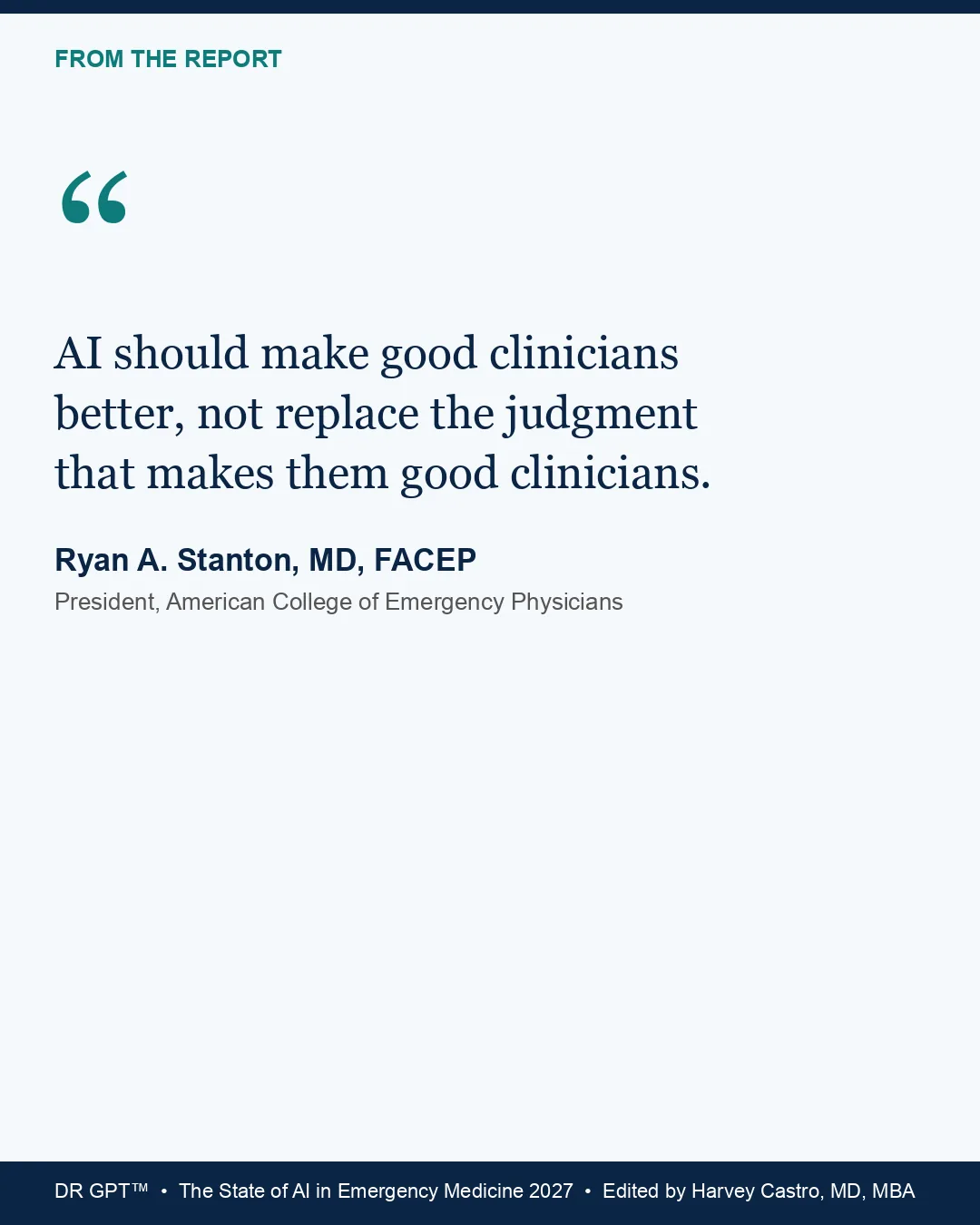
My bottom line: AI should make good clinicians better, not replace the judgment that makes them good clinicians.
“AI is hugely helpful at obtaining and organizing data and recognizing certain flags for consideration, based on VS, CC, etc.”
Thom Mayer, MD, FACEP, FAAP, FACHE
Medical Director, NFL Players Association; Senior Medical Advisor, Palantir for Hospitals
Read full answer from Thom Mayer
AI is hugely helpful at obtaining and organizing data and recognizing certain flags for consideration, based on VS, CC, etc. This allows the triage nurse to use her judgement and experience to "triage" among the possible suggestions. ESI, at least in my view, is a flawed methodology, as several studies show. Estimating the number and types of resources needed is likely much better done with AI, as well as later assessing and modifying the algorithm after determining how many and what type of resources were actually used.
“A doctor still needs to assess what it means for the patient.”
Chris Hutchins
Founder and CEO, Hutchins Data Strategy Consultants, and host of The Signal Room Podcast
Read full answer from Chris Hutchins
Some ways that it is helpful I think are in the way it can process information quickly to potentially alert a physician that something needs attention sooner than they might otherwise be aware. A patient may appear stable but there may have been changes in their history or recent results that might not be available otherwise. That can provide another opportunity for review. A doctor still needs to assess what it means for the patient. If they don't have enough information to evaluate it, it has to be addressed before we ask them to rely on it
“AI can organize the story.”
Miguel Villagra, MD, MBA, FACP, FHM
Hospitalist, AI Scribe Pilot Lead, and Digital Health Consultant; Founder, A Doctor's Journey
Read full answer from Miguel Villagra
I see the ED from the admitting side, as a hospitalist, so my answer comes from that handoff.
In 2027, I think AI's biggest help will be what I call documentation triage. An AI scribe can take the ED note, prior discharge summaries, consultant notes, and outside records and curate them into one concise working draft before I walk into the room. I start the encounter oriented instead of hunting through the chart. That is where early risk recognition begins for me: the detail buried in an old note shows up on page one.
A human should always make the call on acuity, disposition, and whether to admit or discharge. AI can organize the story. It cannot examine the patient, hear the worry in a family's voice, or own the outcome.
“AI helps most with the volume problem: spotting patterns in vitals, history, and the waiting room faster than any one person can, and flagging the patient who's quietly getting worse.”
Saul W. Marquez
Founder and CEO, Outcomes Rocket
Read full answer from Saul W. Marquez
AI helps most with the volume problem: spotting patterns in vitals, history, and the waiting room faster than any one person can, and flagging the patient who's quietly getting worse. Where a human must decide is anywhere context, judgment, and values come in. The algorithm can raise the flag, but a clinician has to own the call. The best tools make the care team faster and more effective. They also depend on data, so if the data isn't clean it'll accelerate more bad instead of doing good. None of these replaces the person at the bedside.
“AI should synthesize the chief complaint, age, prior history, and vital signs during nurse triage to suggest initial diagnostic orders.”
Robert Hoyt, MD, FACP
Associate Clinical Professor, Internal Medicine, Virginia Commonwealth University
Read full answer from Robert Hoyt
AI should synthesize the chief complaint, age, prior history, and vital signs during nurse triage to suggest initial diagnostic orders. Front-loading these tests will significantly reduce the long turnaround times plaguing most EDs and urgent care centers. However, a human clinician must always make the final call on acuity assignment, safe discharge, and complex or atypical presentations where subtle bedside "gestalt" and non-verbal cues cannot be captured by an algorithm.
“AI helps most where the patient's history is fragmented, because fragmentation is what hides risk.”
AI helps most where the patient's history is fragmented, because fragmentation is what hides risk. The patient who has been in three times in two weeks. The medication list nobody has time to reconcile. The result sitting in a system that does not talk to yours. That is pattern work, and pattern work is where a machine beats a tired human at hour ten.
A human has to decide anything where being wrong cannot be undone. Who goes home. Who gets the bed. The presentation that does not fit the pattern because this person is not the pattern.
The risk I would actually watch for is quieter than either of those. A tool that is right most of the time trains people to stop checking. The failure will not be the day the model is wrong. It will be the day it is wrong and nobody is still looking.
What we asked: Ambient scribes and AI charting are spreading fast. Are they giving clinicians time back or just moving the burden somewhere else? What have you seen?
“Ambient documentation may be one of the most immediately beneficial applications of AI in emergency medicine.”
Ryan A. Stanton, MD, FACEP
President, American College of Emergency Physicians; President, Central Emergency Physicians; Medical Director, Lexington Fire/EMS; Medical Director, GMR Motorsports
Read full answer from Ryan A. Stanton
Ambient documentation may be one of the most immediately beneficial applications of AI in emergency medicine. We spend far too much time staring at computer screens rather than looking at our patients. Anything that can reduce documentation burdens and give us more time at the bedside deserves serious consideration. But we need to be careful that we're actually eliminating work rather than simply moving it around. AI-generated notes can contain inaccuracies, omissions, and even fabricated information. Ultimately, the clinician remains responsible for ensuring the medical record accurately reflects the encounter, the medical decision-making, and the care provided. If I spend as much time correcting an AI-generated note as I would have spent writing it, we haven't accomplished much. We need to measure whether these technologies actually deliver on their promises.
The goal is not simply faster documentation. It is better documentation, less administrative burden, and more time caring for patients.
“Definitely time back, documentation capture excellent, driving better coding and appropriate revenue capture for the work the ED doc has done.”
Thom Mayer, MD, FACEP, FAAP, FACHE
Medical Director, NFL Players Association; Senior Medical Advisor, Palantir for Hospitals
Read full answer from Thom Mayer
Definitely time back, documentation capture excellent, driving better coding and appropriate revenue capture for the work the ED doc has done. "Hallucinations" overestimated and the doc should always review the record for accuracy anyway. I've always said, "Anything which puts you in front of the patient is a good thing. Anything which takes you away from the patient is a bad thing!" Ambient scribes puts you in front of the patient and away from the EMR.
“We need to easily be able to measure if we are meaningfully impacting time spent and whether we are actually enabling them to spend less time in the charts.”
Chris Hutchins
Founder and CEO, Hutchins Data Strategy Consultants, and host of The Signal Room Podcast
Read full answer from Chris Hutchins
I think ambient scribes can both help, or remove a burden. Where it is placed within workflows can either make things easier for review to verify accuracy it can give meaningful time back. If we're just moving the work and changing the nature of it so that instead of transcribing the note into the evening, means correcting it, I think we've just moved the work somewhere else. We need to easily be able to measure if we are meaningfully impacting time spent and whether we are actually enabling them to spend less time in the charts.
“Both, honestly.”
Miguel Villagra, MD, MBA, FACP, FHM
Hospitalist, AI Scribe Pilot Lead, and Digital Health Consultant; Founder, A Doctor's Journey
Read full answer from Miguel Villagra
Both, honestly. Burnout is multifactorial, and no single tool fixes it. But an AI scribe can take real weight off one piece of it: cognitive load.
In our small hospital medicine pilot at a regional medical center in northern Nevada, self-reported documentation time and mental drain, measured with items adapted from the NASA Task Load Index, each fell by a third or more. I felt it. I stopped composing the note in my head while the patient was talking. I could look at them, listen, and be fully present. That sense of doing the work well, of professional accomplishment, reignited my passion for patient care.
The burden does move. Someone still has to review every draft. But the time back is real, and the focus back matters even more.
“Both, depending on how they're rolled out.”
Saul W. Marquez
Founder and CEO, Outcomes Rocket
Read full answer from Saul W. Marquez
Both, depending on how they're rolled out. When a scribe fits into the workflow and the clinician trusts the note, it gives real time back, and you see it in eye contact with the patient. This means EHR integrations that don't require copy paste and take into consideration downstream things like billing that ultimately impact the patient as much as the physician. When it's dropped in without training or good editing tools, the burden just moves from typing to proofreading. Adoption is a change management problem as much as a technology problem.
“There is no evidence that ambient scribes are huge time-savers, and they are expensive.”
Robert Hoyt, MD, FACP
Associate Clinical Professor, Internal Medicine, Virginia Commonwealth University
Read full answer from Robert Hoyt
There is no evidence that ambient scribes are huge time-savers, and they are expensive. They are helpful for most clinicians and seem to reduce burnout, largely by easing cognitive load during visits. However, studies are mixed regarding whether they actually reduce "pajama time," the hours clinicians spend charting after getting home.
“Ambient scribes move the burden unless somebody decides in advance what the time is for.”
Ambient scribes move the burden unless somebody decides in advance what the time is for. I have built a lot of business cases and I have never once seen saved time stay saved by accident. It gets absorbed, usually into volume, and the clinician who was promised relief never experiences any of it.
There is also a new burden nobody is measuring. Reading and attesting to a note you did not write is real cognitive work. It does not show up in a time study, because the time study measured typing.
So the honest version of the question is not whether the scribe saves time. It is who gets the time. If the answer is the schedule, you have not reduced burden. You have repriced it.
What we asked: When an AI tool contributes to a clinical decision and it's wrong, who is accountable, and what one rule should every ED put in place before go-live?
“This may be one of the most important unresolved questions in healthcare AI.”
Ryan A. Stanton, MD, FACEP
President, American College of Emergency Physicians; President, Central Emergency Physicians; Medical Director, Lexington Fire/EMS; Medical Director, GMR Motorsports
Read full answer from Ryan A. Stanton
This may be one of the most important unresolved questions in healthcare AI. We have technology companies developing increasingly sophisticated tools, hospitals implementing them, and clinicians being encouraged, or even required, to use them. Yet when something goes wrong, the responsibility frequently lands squarely on the physician. That's a significant problem. We cannot have a system where technology companies benefit from the adoption of AI, healthcare organizations benefit from the efficiencies, but physicians shoulder virtually all the liability when the technology fails. Physicians absolutely have a responsibility to exercise clinical judgment and appropriately oversee the tools they use. But accountability must be shared among the developers, healthcare organizations, and clinicians according to their roles and responsibilities. As AI becomes more autonomous, we need clear standards for validation, transparency, oversight, and liability.
Innovation without accountability is not progress. We cannot ask physicians to trust technology while leaving them alone to absorb the consequences when it fails.
“2 answers.”
Thom Mayer, MD, FACEP, FAAP, FACHE
Medical Director, NFL Players Association; Senior Medical Advisor, Palantir for Hospitals
Read full answer from Thom Mayer
2 answers. 1st, redundant or back-up AI. 2nd, the human cognition of oversight will always be essential, but this gives us more time for that.
“When the AI is wrong, the accountability question is the whole game.”
Nneka Sederstrom, PhD, MPH, MA, FCCP, FCCM
Healthcare Executive, Clinical Ethicist, and Author of the forthcoming book Designed to Heal
Read full answer from Nneka Sederstrom
When the AI is wrong, the accountability question is the whole game. The clinician who signed the order owns it, because the patient in front of them never consented to an algorithm. That's the rule every ED needs before go-live: no AI output enters the chart without a named human who can explain the decision back to the patient. Not the vendor. Not the committee. A person. If your team can't say who owns the override, you aren't ready to turn the tool on. Accountability can't be averaged across a workflow. It has to live somewhere, with someone, on purpose.
“Someone has to be named before a pilot can begin.”
Chris Hutchins
Founder and CEO, Hutchins Data Strategy Consultants, and host of The Signal Room Podcast
Read full answer from Chris Hutchins
Someone has to be named before a pilot can begin. Pilots often start without any thought as to what operational support might be required if it goes well. Defensibility for AI recommendations or decisions requires named owners who have authority to pause or halt a pilot and that has to be carried forward into operations. There are a handful of workflows that have different owners. Historically we might name a department but shortly after a go-live that information lives in project documentation. That will not suffice as we deploy AI solutions. There is also a need to revisit contract language to ensure there is named ownership in key workflows there as well. We are no longer waiting for a scheduled system upgrade.
“The scribe will draft, but the physician will decide.”
Miguel Villagra, MD, MBA, FACP, FHM
Hospitalist, AI Scribe Pilot Lead, and Digital Health Consultant; Founder, A Doctor's Journey
Read full answer from Miguel Villagra
The clinician who signs the note owns it. AI does not change that, and it should not. The scribe will draft, but the physician will decide.
The organization owns something too: the configuration. Two clinicians on the same product can be running different templates and features without knowing it, and that quietly changes what the draft looks like.
So my one rule before go-live: no AI-drafted note is signed without line-by-line review by the clinician who saw the patient, on a template and feature set the organization has verified for every user. Review is not a formality. Even a good scribe still mishears medication names, and the signature is the last checkpoint before an error becomes part of the record.
“The licensed clinician still signs off, so the system owes that clinician tools that are transparent, validated, and easy to override.”
Saul W. Marquez
Founder and CEO, Outcomes Rocket
Read full answer from Saul W. Marquez
The licensed clinician still signs off, so the system owes that clinician tools that are transparent, validated, and easy to override. Accountability has to be shared, though. Health systems and vendors need to own validation, monitoring, and a clear process for reporting when the tool misses. If the frontline provider carries all the risk, adoption stalls.
“There is little question that the attending clinician bears primary clinical responsibility when utilizing AI; however, because hospitals have deeper pockets, health systems will inevitably share legal liability in malpractice claims.”
Robert Hoyt, MD, FACP
Associate Clinical Professor, Internal Medicine, Virginia Commonwealth University
Read full answer from Robert Hoyt
There is little question that the attending clinician bears primary clinical responsibility when utilizing AI; however, because hospitals have deeper pockets, health systems will inevitably share legal liability in malpractice claims. Before go-live, every ED must mandate comprehensive clinician training that transparently reviews the peer-reviewed literature, known failure modes, and validation data supporting the specific tool's use.
“Certification without the ability to inspect is not accountability. It is exposure.”
Today the answer is whoever signed the note, and that is not an accountability model. That is liability placement. The person carrying the consequence is the person with the least ability to change the tool.
I have been on the other side of this. As a CFO I certified financial statements I did not personally prepare, built on work done by people I would never watch do it. That signature means something only because of what sits underneath it. I could see the controls. I could test them. I could refuse to sign until they were fixed, and sometimes I did. Certification without the ability to inspect is not accountability. It is exposure.
A clinician attesting to an AI-generated note is in exactly that position, without any of that underneath. They cannot see how the tool decides, cannot test it, and cannot refuse it without refusing the workflow.
So the answer I would give is this. The organization that chose to deploy it owns the outcome, the vendor that sold it carries real contractual consequence, and the clinician signs only once they can actually inspect what they are signing for. Settle it in writing before deployment. Accountability determined after an event is not accountability. It is a search for somebody to hold.
What we asked: What should we tell patients about AI in their emergency care, and what will make them trust it, or stop trusting us?
“Patients deserve transparency, but they also deserve perspective.”
Ryan A. Stanton, MD, FACEP
President, American College of Emergency Physicians; President, Central Emergency Physicians; Medical Director, Lexington Fire/EMS; Medical Director, GMR Motorsports
Read full answer from Ryan A. Stanton
Patients deserve transparency, but they also deserve perspective. AI is already becoming part of healthcare, whether through documentation, imaging interpretation, clinical decision support, or operational systems. We should be open about how these tools are being used, particularly when they meaningfully influence patient care. But we shouldn't create unnecessary fear or give patients the impression that a computer has replaced their physician. I would tell patients that we are using technology to help us provide safer, more efficient, and more informed care, while emphasizing that their physician remains engaged in the decisions that matter. Patients should also understand when AI is directly interacting with them and how their information is being protected. Trust is earned through transparency, accuracy, and accountability, not simply because a technology is new or impressive.
My philosophy is simple: Trust in the right places, but verify.
“Complete transparency, of course, but guided by appropriate and measured language.”
Thom Mayer, MD, FACEP, FAAP, FACHE
Medical Director, NFL Players Association; Senior Medical Advisor, Palantir for Hospitals
Read full answer from Thom Mayer
Complete transparency, of course, but guided by appropriate and measured language. And be ready for the patient saying, "Great, if you are going to 'record' this, I'm sure you won't mind if I do so on my phone!" And the answer should be, "Yes, of course, just agree to forward me a copy."
“Tell them the truth, plainly.”
Nneka Sederstrom, PhD, MPH, MA, FCCP, FCCM
Healthcare Executive, Clinical Ethicist, and Author of the forthcoming book Designed to Heal
Read full answer from Nneka Sederstrom
Tell them the truth, plainly. AI helped gather information, and a human made the call. Patients don't need a technical briefing. They need to know a person is still responsible for them. Trust breaks the moment they discover the AI after the fact, from a bill or a portal note. Disclose it up front, in plain language, before it matters. And mean it: if the tool shapes the decision, the patient deserves to know. Trust isn't built by the technology working. It's built by the institution being honest about where the technology ends and the human begins.
“Patients need to be given a simple explanation about what AI is being used for, how their care team will use it and how it can aid them to care for the patient.”
Chris Hutchins
Founder and CEO, Hutchins Data Strategy Consultants, and host of The Signal Room Podcast
Read full answer from Chris Hutchins
Patients need to be given a simple explanation about what AI is being used for, how their care team will use it and how it can aid them to care for the patient. They also need to know where the data goes and how it is used and who can access it later. There is precedent because of how we have used EHRs but perhaps need to revisit how this is explained to make sure it is easy to understand. We also need to make sure they are comfortable to ask questions and choose to decline consent if that is their preference.
“Disclosure costs us one sentence.”
Miguel Villagra, MD, MBA, FACP, FHM
Hospitalist, AI Scribe Pilot Lead, and Digital Health Consultant; Founder, A Doctor's Journey
Read full answer from Miguel Villagra
Tell them plainly. My script is one sentence: "I'm using an AI transcriber that will summarize our conversation into your medical record." So far, no patient has said no, and several took it as a sign the hospital is keeping up.
Consent only means something if there is an alternative. When a patient lacks capacity, is confused, or would rather not be recorded, I switch to monologue mode. I narrate my own findings and plan, and the patient's voice is never captured.
Patients will trust AI when it lets us look at them instead of a screen. They will stop trusting us if a note says something that did not happen in the room, or if they learn they were recorded without being told. Disclosure costs us one sentence. Lost trust costs far more.
“Plain, honest language: that AI is helping the team, what it's doing, and that a human is making the decisions.”
Saul W. Marquez
Founder and CEO, Outcomes Rocket
Read full answer from Saul W. Marquez
Plain, honest language: that AI is helping the team, what it's doing, and that a human is making the decisions. Patients don't need a technical briefing, but they deserve to know. Trust is the currency of healthcare, and being upfront about it builds trust instead of eroding it.
“Patients should receive a clear disclosure at registration explaining that vetted AI tools are used selectively for clinical decision support, and potentially future triage, rather than replacing physician judgment.”
Robert Hoyt, MD, FACP
Associate Clinical Professor, Internal Medicine, Virginia Commonwealth University
Read full answer from Robert Hoyt
Patients should receive a clear disclosure at registration explaining that vetted AI tools are used selectively for clinical decision support, and potentially future triage, rather than replacing physician judgment. Patients will trust AI if it visibly shortens wait times and allows more face-to-face time with their doctor. Conversely, they will quickly lose trust if AI is used covertly, causes billing surprises, or replaces human empathy.
“Tell them when it materially influenced a decision about their care, in plain language, and tell them a human reviewed it.”
Tell them when it materially influenced a decision about their care, in plain language, and tell them a human reviewed it. That is the whole standard.
What I would avoid is burying it in a consent form. Disclosure nobody reads is documentation, not disclosure.
I have spent a career on the other side of the curtain, where decisions that shape whether a patient ever gets their therapy are made by people that patient will never meet and never hears about. The industry has gotten comfortable with that silence and it has cost us. I would not repeat it here.
Patients do not care which model you used. They care about two things. Whether a person is accountable, and whether somebody will tell them the truth if it goes wrong. The second one determines whether they believe the first. And you do not build that kind of trust during the crisis. You build it before, or you do not have it when you need it.
What we asked: If you ran an emergency department tomorrow, what is the one thing you would do in 2027 about AI, and the one thing you would refuse to do?
“DO: Get involved.”
Ryan A. Stanton, MD, FACEP
President, American College of Emergency Physicians; President, Central Emergency Physicians; Medical Director, Lexington Fire/EMS; Medical Director, GMR Motorsports
Read full answer from Ryan A. Stanton
DO: Get involved. AI is here. It is not going away, and its role in emergency medicine will only grow. Whether we embrace it or resist it, these technologies will continue to evolve. Emergency physicians must be at the table helping develop, evaluate, implement, and improve these tools. We understand the realities of emergency medicine, the complexity of our patients, and the consequences when systems fail. That perspective is essential.
DON'T: Sit on the sidelines and let others define the future of our specialty. If we leave these decisions entirely to technology companies, administrators, and people who have never worked a shift in an emergency department, we shouldn't be surprised when the resulting technology doesn't meet our needs. We have an extraordinary opportunity to shape AI into something that truly improves patient care, reduces burnout, and strengthens emergency medicine. Our goal should never be to replace the physician. It should be to give every emergency physician the tools, information, and time to be the best physician possible.
My message for 2027 is this: AI will not define the future of emergency medicine unless we allow it to. Emergency physicians must help define the future of AI. Ultimately, the greatest success of AI in emergency medicine won't be measured by how much technology we put between physicians and patients. It will be measured by how much technology allows us to remove the barriers between them.
“Do anticipate nursing pushback because they are concerned about it costing them their jobs.”
Thom Mayer, MD, FACEP, FAAP, FACHE
Medical Director, NFL Players Association; Senior Medical Advisor, Palantir for Hospitals
Read full answer from Thom Mayer
Don't say, "I hate AI and I refuse to use it!" My answer to that is, "What century would you have preferred to live in? Because AI isn't going away in the 21st century!"
Do anticipate nursing pushback because they are concerned about it costing them their jobs. (Especially nurses unions...) Have a deep conversation with them about how AI might make their jobs easier and free them up from mundane tasks causing burnout. I like to say, "What would have to be true...for AI to make your job easier?"
“I'd start by finding the decisions that actually matter and asking where AI could help us make them better.”
Graham Walker, MD
Emergency Physician; Co-founder and Head of AI, MDCalc; Co-founder, Offcall
Read full answer from Graham Walker
I'd start by finding the decisions that actually matter and asking where AI could help us make them better. Not where AI could generate more information, document more findings, or produce more alerts. Where could it meaningfully change patient outcomes?
For example, could we more accurately identify which patients can safely go home instead of being admitted? That's a clinical decision with enormous consequences for patients, boarding, hospital capacity, and healthcare costs. And it's exactly where well-validated predictive models might help.
What would I refuse to do? Deploy AI that continuously searches for more abnormalities, diagnoses, and reasons to intervene without demonstrating that doing so improves outcomes. I don’t need to add an exhaustive list of ICD10 codes to help my patient.
Emergency physicians already know that finding more things isn't necessarily practicing better medicine. Sometimes the most valuable clinical decision is the test you didn't order, the admission you avoided, or the incidental finding you wisely chose not to pursue. AI should help us make those decisions, too, and then the rest of the system should support those decisions, too.
“If I ran an ED tomorrow, the first thing I'd do is put an ethicist on the AI governance table before a single tool goes live.”
Nneka Sederstrom, PhD, MPH, MA, FCCP, FCCM
Healthcare Executive, Clinical Ethicist, and Author of the forthcoming book Designed to Heal
Read full answer from Nneka Sederstrom
If I ran an ED tomorrow, the first thing I'd do is put an ethicist on the AI governance table before a single tool goes live. Not after the rollout. Before. The questions that sink these deployments aren't technical, they're moral: who owns the override, what gets disclosed, whose data trained this. The one thing I'd refuse: any tool the vendor can't explain. If no one on your team can say why the model flagged this patient and not that one, it doesn't touch a living person. Unexplainable AI in the ED isn't innovation. It's an experiment, and the patients didn't consent to be subjects.
“Do make sure someone is named, accountable, and what authority they have.”
Chris Hutchins
Founder and CEO, Hutchins Data Strategy Consultants, and host of The Signal Room Podcast
Read full answer from Chris Hutchins
Do make sure someone is named, accountable, and what authority they have. That authority should extend to every clinician that has to sign off on a decision and clearly communicated and re-enforced across every organization. Don’t let pilots begin before naming the owners of key decisions and not before defining the operational support and ongoing ownership should the pilot produce the intended results. Perhaps most important, don’t launch before everyone knows what failure might look like and that they are all accountable to raise their concern and pause if necessary if that is not clear, or they start to see something concerning.
“Implementation, not software, is the intervention.”
Miguel Villagra, MD, MBA, FACP, FHM
Hospitalist, AI Scribe Pilot Lead, and Digital Health Consultant; Founder, A Doctor's Journey
Read full answer from Miguel Villagra
The one thing I would do: treat AI as a workflow redesign, not a software install. Name physician champions, help every clinician build their own custom instructions, and measure documentation quality and clinician experience before and after. In our pilot, clinical documentation specialists saw quality improve with the AI alone, and improve most after the prompts were optimized. Implementation, not software, is the intervention.
The one thing I would refuse: deploying it as a productivity tool to raise volume expectations. If the time and focus a scribe gives back are immediately absorbed by a heavier census, you have paid for a tool and kept the burnout. Position it as a wellbeing and documentation quality tool, and protect that.
“Do: start with a real problem your frontline teams feel every shift, measure the outcome, and bring clinicians into the design from day one with clean data at the center of it all.”
Saul W. Marquez
Founder and CEO, Outcomes Rocket
Read full answer from Saul W. Marquez
Do: start with a real problem your frontline teams feel every shift, measure the outcome, and bring clinicians into the design from day one with clean data at the center of it all.
Don't: buy AI for the headline. If it doesn't save time, improve outcomes, or lower cost in a way your teams can see, it's just another login.
“In 2027, I would closely monitor the medical literature to guide AI deployment based on rigorous, peer-reviewed studies, recognizing that commercial vendors are roughly a year ahead of academia, leaving us behind in proving real-world clinical benefit.”
Robert Hoyt, MD, FACP
Associate Clinical Professor, Internal Medicine, Virginia Commonwealth University
Read full answer from Robert Hoyt
In 2027, I would closely monitor the medical literature to guide AI deployment based on rigorous, peer-reviewed studies, recognizing that commercial vendors are roughly a year ahead of academia, leaving us behind in proving real-world clinical benefit. Conversely, I would strictly refuse to mandate AI use for any clinician until indisputable outcome data exists.
“Do: count the near misses. Every time the AI was wrong and a human caught it, write it down.”
Do: count the near misses. Every time the AI was wrong and a human caught it, write it down. In finance that is routine. You count the exceptions your controls catch, because the catches are the only evidence the control is working. Healthcare almost never counts them, because when prevention works nobody knows it happened and nobody gets credit for it. That number is the closest thing you will have to an honest read on whether the tool is safe.
Don't: approve anything on a time-savings number. Efficiency cases are the easiest to build and the least likely to ever be audited. If the only case for the tool is minutes, you will get the minutes and lose every other argument.
We asked each contributor to finish one sentence: "By the end of 2027, AI in emergency medicine will ______."
Prediction from Graham Walker, MD.
The editor’s prediction
"By the end of 2027, AI in emergency medicine will stop being the story. The story will be the leaders who closed the gap between what the technology can do and what their ER is ready to do."
Harvey Castro, MD, MBA
DR GPT™, Editor
"By the end of 2027, AI in emergency medicine will have completed the evolution and be well into the revolution of emergency medicine, for the better!"
Thom Mayer, MD, FACEP, FAAP, FACHE
Medical Director, NFL Players Association; Senior Medical Advisor, Palantir for Hospitals
Punctuation lightly edited (one dash changed to a comma).
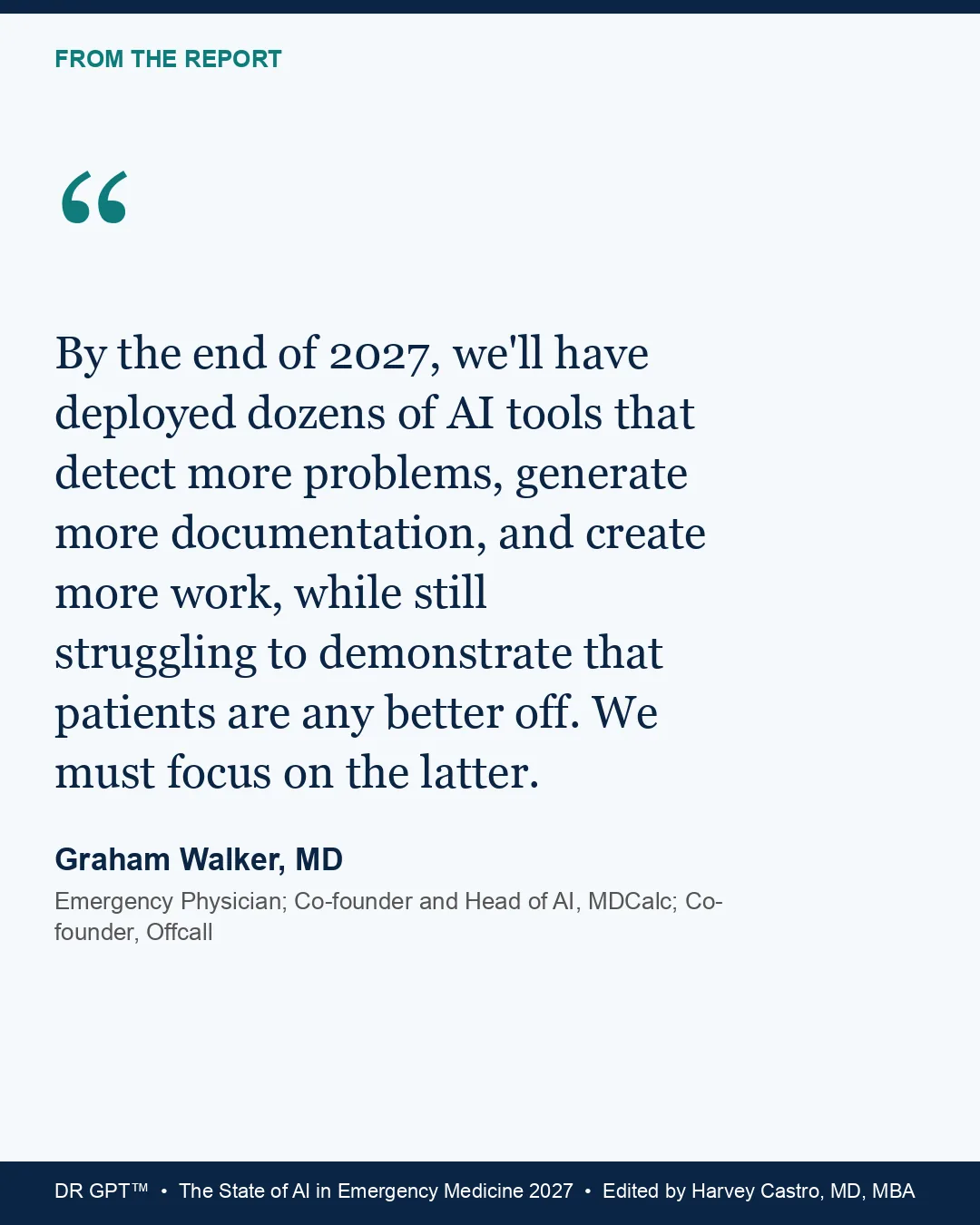
"By the end of 2027, we'll have deployed dozens of AI tools that detect more problems, generate more documentation, and create more work, while still struggling to demonstrate that patients are any better off. We must focus on the latter."
Graham Walker, MD
Emergency Physician; Co-founder and Head of AI, MDCalc; Co-founder, Offcall
"By the end of 2027, AI in emergency medicine will face its first major accountability lawsuit, and it will be about who signed off, not how the model worked."
Nneka Sederstrom, PhD, MPH, MA, FCCP, FCCM
Healthcare Executive, Clinical Ethicist, and Author of the forthcoming book Designed to Heal
"By the end of 2027, AI in emergency medicine will finally support ER physicians when they need it most, thanks to the clinicians who invested their own time and money to bring physicians and developers together before a single workflow was designed, and who built many of those tools themselves."
Chris Hutchins
Founder and CEO, Hutchins Data Strategy Consultants, and host of The Signal Room Podcast
"By the end of 2027, AI in emergency medicine will draft most of the chart, and the best departments will be the ones that redesigned the work around it."
Miguel Villagra, MD, MBA, FACP, FHM
Hospitalist, AI Scribe Pilot Lead, and Digital Health Consultant; Founder, A Doctor's Journey
"By the end of 2027, AI in emergency medicine will be as routine as the triage desk, and the EDs that win will be the ones whose frontline teams actually trust it as an extension of themselves."
Saul W. Marquez
Founder and CEO, Outcomes Rocket
"By the end of 2027, I expect to see pilot projects using agents in the emergency room to triage."
Robert Hoyt, MD, FACP
Associate Clinical Professor, Internal Medicine, Virginia Commonwealth University
"By the end of 2027, AI in emergency medicine will be audited like a financial control: counted, tested and signed for by the organization that chose to deploy it."
President, American College of Emergency Physicians; President, Central Emergency Physicians; Medical Director, Lexington Fire/EMS; Medical Director, GMR Motorsports
The full report brings every approved answer together, chapter by chapter. If you work in emergency care and want to add your voice, I would love to hear from you.