
Agents Are Minions: Why One Person Directing Many Agents Beats One Chatbot
A plain-language guide to AI agents for healthcare leaders.

A plain-language guide to AI agents for healthcare leaders.
If you lead a hospital or a practice and AI agents still feel abstract, start with the plainest definition I've heard from anyone in the field.
At the SMU Cox Healthcare Conference in Dallas, Microsoft's Dr. David Rhew described an agent as a large language model wrapped in rules and guidelines, given tools to look things up and take actions, and given memory so it can pick up where the last conversation left off. Then he offered the analogy that stuck with the room. Agents are like minions. Each one does a single task very well, and if you ask one to do everything at once, you get chaos.
That matches what I see in the agents I run for my own work.
How an agent differs from a chatbot
A chatbot answers. You type a question, it replies, and the exchange ends there. An agent can act: it looks things up, uses software, drafts and sends a message, updates a record, and decides what to do next. It also remembers context, so you don't start from zero each time. And it can take its cue from a person, from another agent, or from the environment itself, such as a new lab result landing in the chart.
One person, many agents
Most people still use AI as one person talking to one assistant. Dr. Rhew's point was that one person directing many agents works better, and that several people directing many agents works better still.
Microsoft's diagnostic orchestrator, MAI-DxO, shows why. It splits diagnosis across several focused agents, including one whose only job is to challenge the others, and Microsoft reported that it reached the correct diagnosis in up to 85% of complex published cases. Those were teaching cases rather than live patients, and the system still needs clinical validation. Even so, the structure drove the result more than any single model did.
What this looks like in a clinic
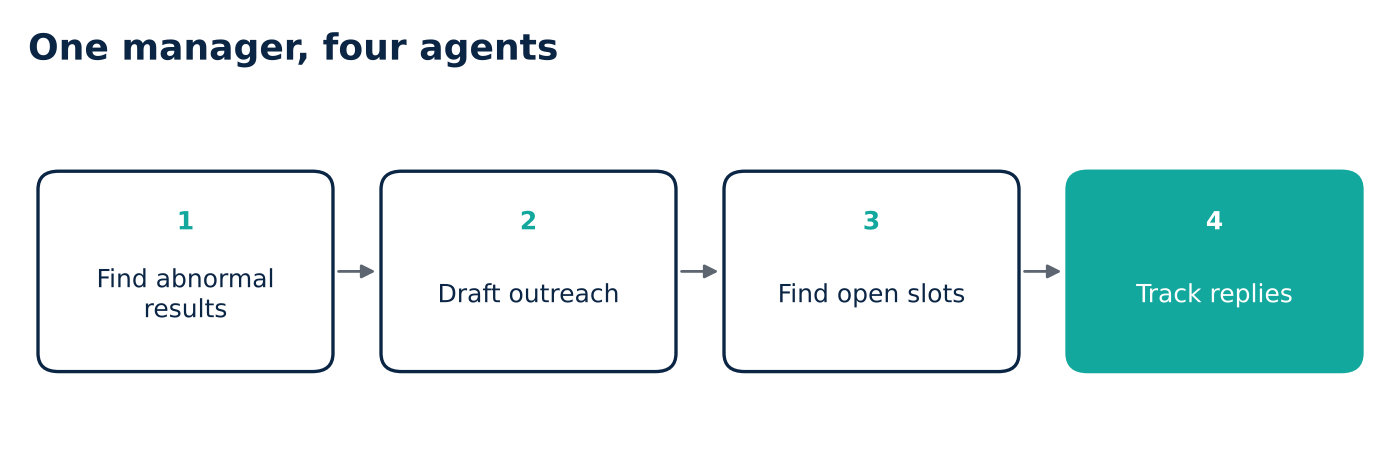
Picture a clinic manager who owns one problem: patients with abnormal results who never get follow-up.
- One agent finds abnormal results with no follow-up on the schedule.
- A second drafts the outreach message.
- A third checks the schedule for open slots.
- A fourth tracks replies and flags anyone who never answered.
- The manager reviews the exceptions and decides who needs a human phone call.
Kai-Fu Lee, in his book AI Native, calls that manager a Directly Responsible Individual: one owner with a clear goal, directing a team of agents. The manager doesn't do every step anymore. She makes sure the steps add up to fewer patients slipping through.
Five rules for building agent teams
- One job per agent. Narrow beats broad.
- Clear handoffs. Each agent should know exactly what it receives and what it passes on.
- A skeptic in the group. Some agent, or some person, has to check the others' work.
- Human ownership. A named person stays accountable for the outcome, whatever the agents did.
- Logs. Every action should be traceable, because sooner or later someone will ask what happened and why.
Start small
Pick one workflow that frustrates your staff. Break it into steps, give each step to a narrow agent or a person, and measure the result for a month before you add the next one. Grow your agents this way, one well-understood job at a time, with a human who knows the goal and watches the numbers.
What task in your day would you split among three agents?
Frequently asked questions
What is an AI agent?
A large language model wrapped in rules and guidelines, with tools to retrieve information and take actions, and memory of earlier conversations.
How is an agent different from a chatbot?
A chatbot answers questions. An agent can look things up, use software, update records, remember context, and decide on next steps.
How should a health system start with agents?
Pick one painful workflow, split it into narrow steps, give each step to one agent or person, name a human owner, keep logs, and measure the result.
Keep reading: From Intern to Attending: How Physicians Should Supervise AI Agents and Every AI Team Needs a Naysayer.
This article is for education and does not replace individual medical advice.
Harvey Castro, MD, MBA, is a board-certified emergency physician, healthcare AI keynote speaker, 6x TEDx speaker, Advisor to the CEO at Phantom Space, and author of over 45 books, including ChatGPT and Healthcare (2023). Learn more at https://www.harveycastromd.com · /HarveyCastroMD
Sources
- Dr. David Rhew, keynote, SMU Cox Healthcare Conference, November 17, 2026 (public talk)
- Kai-Fu Lee, AI Native (Crown, 2026), chapters 3 and 8
- Microsoft AI, MAI-DxO: https://microsoft.ai/new/the-path-to-medical-superintelligence/