AI Replaces Tasks, Not Surgeons
On Signal & Symptoms, Stanford's Jay Park and Vivek Buch explain why surgical AI should deliver insight to the surgeon, not replace the surgeon.

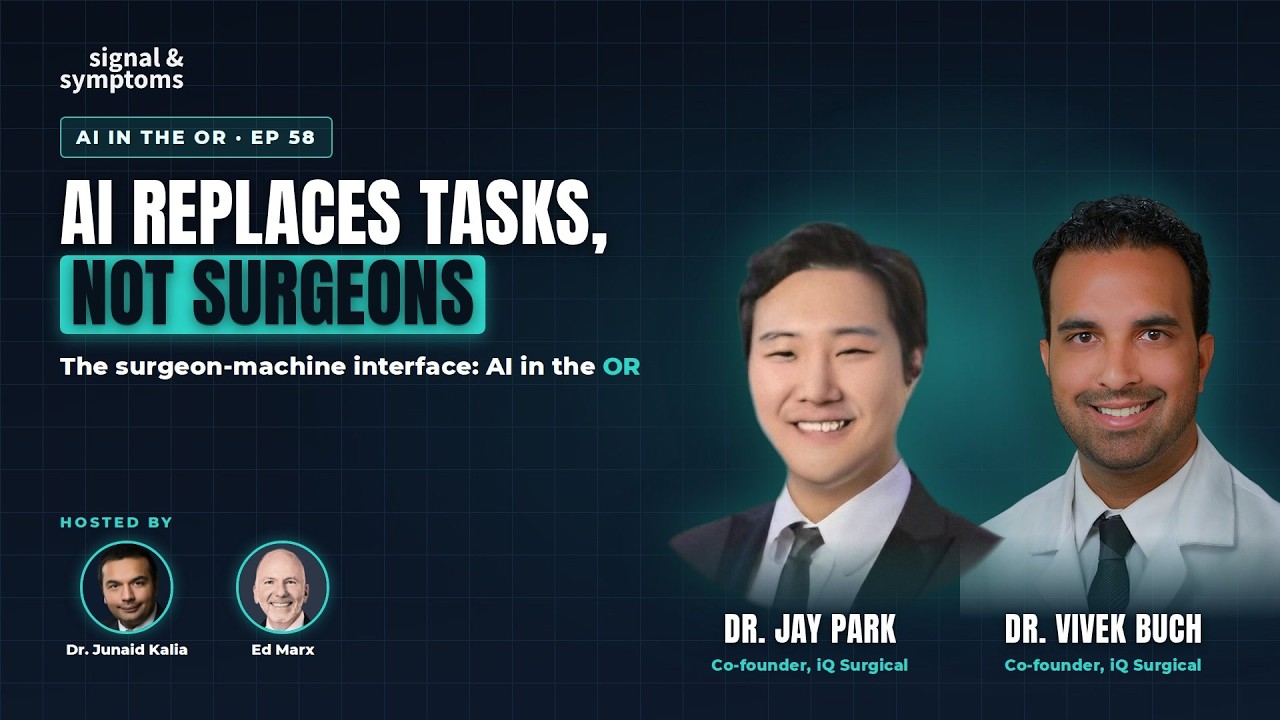
Outside the operating room, we can pull out a phone and find almost anything in seconds. Inside it, as Stanford neurosurgery postdoctoral scholar Dr. Jay Park puts it, “how we’re doing surgery right now is like riding a horse.” Surgeons rely on instinct and experience built up through residency, “but there’s not enough data in real time that supports those decisions.” On this episode of Signal & Symptoms, Dr. Junaid Kalia and Edward Marx sit down with Jay and his co-founder, Dr. Vivek Buch, Assistant Professor of Neurosurgery and Bioengineering at Stanford and director of the SIMI Lab, to talk about what they call the surgeon-machine interface.
“The AI can only replace a task. They don’t replace the human.” Dr. Jay Park
Vivek came to the idea from brain-machine interfaces. The technology he worked with on the academic side had no equivalent in his clinical world: the operating room has always been “dominated by a single surgeon’s experience and knowledge base,” and that experience directly dictates the outcome for the patient on the table. His question to a lay audience is blunt: is it really fair that your outcome depends one hundred percent on the analog, anecdotal experience of the one surgeon operating on you?
Neither guest is selling a robot surgeon. Jay lays out the two sides of AI, autonomy and augmentation, and puts the team firmly on augmentation. If any job is not to be replaced, he says, it’s the surgeon’s: a human has to take liability and stay in control. Vivek’s rule for getting there is just as practical. “Workflow barriers are the number one killer of any operating technology.” Offer the greatest thing in the world, and if it takes six hours in the OR, it won’t happen. So the plan is a low barrier to entry and low workflow burden, with insight delivered to the surgeon, who decides what to do with it.
“Regulatory FDA is not the ceiling, it’s the floor.” Dr. Jay Park
Edward Marx, who served as an anesthesia tech even while he was CIO at Cleveland Clinic, asks the change-management question: won’t a tenured surgeon feel threatened? Jay’s answer is to stay focused on a problem surgeons feel, not on AI. They started before the AI boom, and it was never meant to replace anyone. The surprise came from the other direction: some very senior surgeons wanted more. “Where is my ChatGPT?” Roughly two in ten asked for features more advanced than the team was comfortable offering yet.
On medical-legal risk, Vivek is direct about the fear: can this data be weaponized against surgeons? The answer is to build safeguards in from the start, with de-identification the moment information comes in, for the patient, the surgeon and the institution. On regulation, Jay says the FDA has been more helpful than people expect, and that their team chose information-giving over decision-giving precisely because recommendations carry a higher regulatory bar.
Join the SMART Surgeon Collaborative
Dr. Jay Park and Dr. Vivek Buch have built a community of surgeons who want to practise data-driven surgery. You don’t have to be a full-time researcher: everyone can take part in AI research, and the collaborative helps PIs at different centres turn their own surgical data into research that is actually usable. They are looking for surgeon colleagues, collaborators and partners.
Connect with us
Dr. Junaid Kalia, Neurocritical Care Specialist, Founder of Savelife.AI™
DR GPT™ Harvey Castro, ER Physician, #DrGPT
Edward Marx, CEO, Advisor
Originally published on my Substack. Planning a surgical or hospital leadership meeting on AI? Explore my healthcare AI keynotes.