
What a Broken Ankle Taught Me About Fixing a Process Before Adding AI
The lesson from building emergency departments: redesign the process before you automate it.

The lesson from building emergency departments: redesign the process before you automate it.
Picture a child who falls off a trampoline. The ankle is swollen and clearly deformed. Everyone in the waiting room can see it's broken.
In a traditional emergency department, that child goes through a ritual. Check in. Triage nurse. Wait. Room. Nurse assessment. Wait. Physician exam. Order X-ray. Wait. X-ray. Wait. Results. Splint. Orthopedic follow-up.
When I built and operated freestanding emergency departments in Texas, I asked a simple question: why?
What I changed
For cases like that ankle, the patient didn't need every step. Bring the child straight to imaging. Give pain medicine there. Take the X-ray. Splint. Get orthopedic input. Send them home. The child spent less time in pain. The family was happier. Staff time was used better.
People pushed back. That isn't how it's done. But when you looked at results, the new path was better for patients.
What this has to do with AI
At the SMU Cox Healthcare Conference in Dallas, Microsoft's Dr. David Rhew summarized his keynote with three ideas. One of them was models, and he didn't mean AI models. He meant models of care. His warning: redesign a broken process before you use AI to optimize it.
That's the most common mistake I see in healthcare AI. A hospital takes a twelve-step workflow and adds AI to make each step slightly faster. The result is a slightly faster bad process.
A better approach
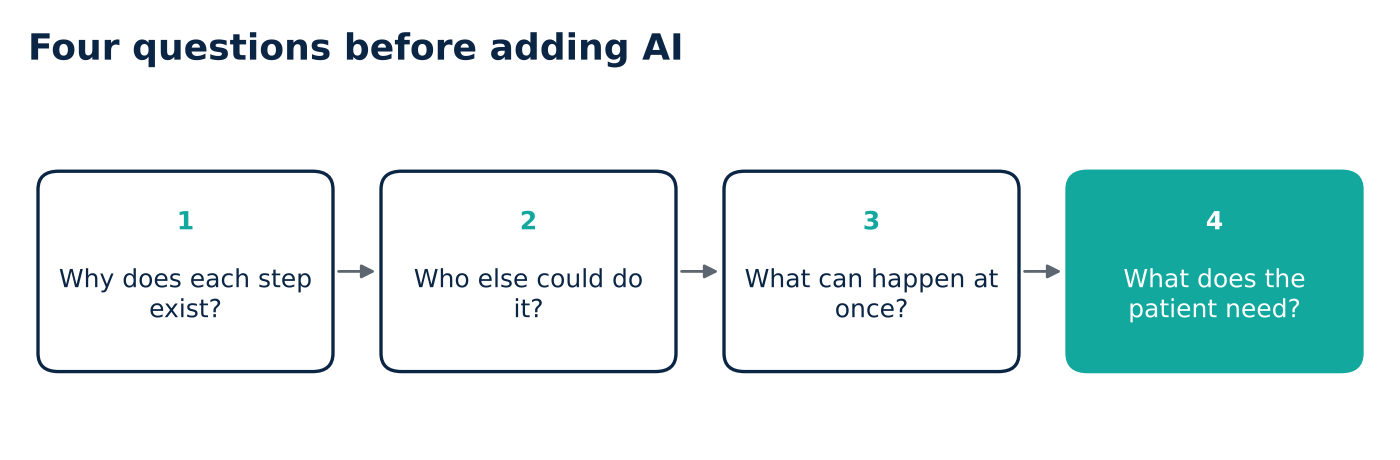
Before adding AI to any workflow, I ask four questions:
- Why does each step exist? Many steps exist because of a constraint that no longer applies.
- Who could do this step instead? A pharmacist, a nurse, a protocol, or an agent.
- Which steps could happen at the same time? Sequential processes waste hours.
- What does the patient actually need? Start there and work backward.
Only after answering those do I ask where AI fits.
Examples where redesign beats automation
- Abnormal results follow-up: instead of a faster inbox alert, an agent that schedules the follow-up and confirms it happened.
- Discharge: instead of a faster discharge summary, starting discharge planning on day one.
- Prior authorization: instead of faster forms, checking requirements at the moment of ordering.
AI is powerful. It's most powerful when it powers a better process.
If you could remove one step from your daily work, which would it be?
Related: A bad workflow has nowhere to hide https://harveycastromd.substack.com/p/a-bad-workflow-has-nowhere-to-hide
Frequently asked questions
Should a hospital add AI to an existing workflow?
Only after asking why each step exists, who else could do it, which steps can run at the same time, and what the patient needs. Redesign first, then decide where AI fits.
What is an example of redesign beating automation?
For abnormal results, an agent that schedules the follow-up and confirms it happened does more than a faster inbox alert.
Where did this idea come from?
From running emergency departments, and from Dr. David Rhew's SMU Cox keynote warning against using AI to optimize a broken model of care.
Keep reading: Four Times Better Than Doctors? What Microsoft's Diagnostic AI Really Teaches Physicians and Put the Subspecialist at the Front of the Line.
This article is for education and does not replace individual medical advice.
Harvey Castro, MD, MBA, is a board-certified emergency physician, healthcare AI keynote speaker, 6x TEDx speaker, Advisor to the CEO at Phantom Space, and author of over 45 books, including ChatGPT and Healthcare (2023). Learn more at https://www.harveycastromd.com · /HarveyCastroMD
Sources
- Harvey Castro, MD, operating experience (first-person account)
- Dr. David Rhew, keynote, SMU Cox Healthcare Conference, November 17, 2026 (public talk on redesigning models of care)