Four Years After ChatGPT: Where Medicine Was in 2022, What Changed, and Where Care Goes Next
ChatGPT turns four on November 30, 2026. Here is where medicine stood in 2022, why 300 million weekly health searches raise new safety and privacy stakes, and what accountability must look like next.


Monday, November 30, 2026 marks four years since ChatGPT launched to the public. In four short years, medical artificial intelligence moved from a late night curiosity on a laptop screen to an everyday habit for hundreds of millions of people.
I wrote a book on ChatGPT in healthcare back in 2022. That early work started a conversation, yet this four year milestone is not about a book. It is about where medicine stood when ChatGPT arrived, the transition happening in patient care right now, and where clinical accountability has to go next.
Journalists and creators: a Media and creator kit with downloadable clips, charts, quotes and bios is at the end of this page.
25.5 seconds. On-screen captions read DR GPT™. The voiceover says "Doctor GPT." Download this clip and the rest of the media kit.
Where medicine was in 2022
When ChatGPT debuted on November 30, 2022, I had already practiced emergency medicine in Dallas Fort Worth for about 20 years. Inside hospitals and clinics, the early debate sounded simple: what can a general chatbot actually do? Clinicians tested whether a language model could pass sample board questions, translate discharge instructions into plain English, or draft a prior authorization appeal letter.
Patients ran their own tests at home. Someone worried about a new lab result or a strange rash after dinner suddenly had a conversational tool that answered in seconds without waiting for a callback. At that stage, almost nobody treated a general chatbot as part of formal health infrastructure. Most hospitals blocked it on work computers or watched from the sidelines while physicians argued over whether it was hype or a threat.
The transition happening right now
Four years later, consumer adoption outpaced almost every institutional policy. In July 2026, OpenAI reported at the launch of Health in ChatGPT that more than 300 million people turn to ChatGPT with health questions every week. An earlier OpenAI report from January 2026, AI as a Healthcare Ally, documented that 7 in 10 health related conversations happen outside normal clinic hours, and users send 1.6 million to 1.9 million messages every week just trying to decode health insurance, claims, and billing.
That shift is no longer limited to copying and pasting text into a browser tab. On November 19, 2026, OpenAI expanded ChatGPT Health to Android Health Connect, the desktop app, dots, and sites, building on earlier U.S. support for Apple Health and connected medical records. Health context is now moving directly into everyday devices and daily chats.
Yet adoption is not the same as clinical safety. In February 2026, researchers published a structured stress test of ChatGPT Health in Nature Medicine using 60 clinician authored vignettes across 21 clinical domains, generating 960 total responses. Accuracy peaked in middle acuity tiers, reaching 93.0 percent on semi urgent cases and 76.9 percent on urgent cases. At the clinical extremes, performance fell sharply: 35.2 percent accuracy on nonurgent cases and 48.4 percent on emergency conditions. Put plainly, the system undertriaged 51.6 percent of true emergencies, including cases such as diabetic ketoacidosis and impending respiratory failure, directing them toward 24 to 48 hour follow up instead of an emergency department.
The same study found that when family or friends downplayed symptoms in borderline cases, anchoring bias shifted triage recommendations significantly toward less urgent care (odds ratio 11.7). Crisis safeguards for suicidal ideation also fired inconsistently. Those findings match what I saw in emergency departments for two decades: real patients rarely present like a textbook exam question, and a confident sounding paragraph can miss a life threatening clue.
Patient safety rule
Use AI to organize questions before an appointment, never to clear an emergency. If you or someone with you has chest pain, stroke signs, trouble breathing, or another acute emergency, skip the app and call 911 immediately.
Where medicine is going next
In 2022, the main question was whether AI could sound knowledgeable. By late 2026, fluency is table stakes. The next four years in healthcare AI will be decided by three practical questions that clinicians, hospital leaders, and families need answered before trusting any tool:
- Who checks the tool's work? A summary, medication note, or triage suggestion needs human clinical oversight before anyone acts on it.
- What happens when it gets something wrong? Health systems and software makers need clear ownership, escalation rules, and stop conditions when an answer misses an edge case.
- Where does personal health data go? With medical records and wearable streams connecting to consumer apps, patients need plain rules on privacy and what stays outside general chatbots.
When patients bring AI notes into the clinic, the right response is not shaming them for searching at midnight. It is asking what they read, checking the facts together, and using technology to protect more time for human care. You can explore more practical questions through Ask DR GPT™ or review upcoming speaking topics on my speaker page.
Frequently asked questions about ChatGPT in medicine
How many people use ChatGPT for health questions in 2026?
OpenAI reported in July 2026 that more than 300 million people ask ChatGPT health related questions every week. In its January 2026 report, OpenAI also reported that 7 in 10 health conversations happen outside normal clinic hours.
Is ChatGPT Health safe for medical emergencies?
No. A February 2026 stress test published in Nature Medicine found that ChatGPT Health undertriaged 51.6 percent of true emergencies in clear test cases, often suggesting 24 to 48 hour evaluation instead of emergency care. For chest pain, stroke signs, severe trouble breathing, or any urgent emergency, skip the app and call 911.
What changed with ChatGPT Health in November 2026?
On November 19, 2026, OpenAI expanded ChatGPT Health beyond web and iOS to Android (with Android Health Connect), the desktop app, dots, and sites, allowing users who opt in to bring connected fitness and medical record context into everyday conversations.
Should patients put sensitive medical records into general AI chatbots?
Patients should check privacy notices carefully before connecting records or typing sensitive personal details. General consumer apps may operate outside traditional HIPAA rules that cover hospitals and clinics, so keep identifying details out of general prompts and discuss connected records with your physician.
Media and creator kit
Materials you can use
Journalists, producers and creators can download the charts, heroes, headshot and video clips from this page. Everything below is cleared for educational or news use with credit.
Usage
Free to use with credit: Harvey Castro, MD | DR GPT™ | harveycastromd.com
Do not alter the quotes. Use these materials in an educational or news context only. This kit is not medical, legal, or compliance advice. For chest pain, stroke signs, trouble breathing, or any medical emergency, call 911.
Media and booking inquiries: use the contact form at harveycastromd.com/contact.
Downloadable videos
 Anniversary video, 1:125.5 seconds, 1080x1080. Voiceover says "Doctor GPT." Captions on screen read DR GPT™.Download MP4
Anniversary video, 9:1625.5 seconds, 1080x1920, for Reels, Shorts and TikTok. Same voiceover and captions.Download MP4
Doctor's Lounge mom clip24.9 seconds, 1080x1920. Harvey describes his mom asking ChatGPT a health question.Download MP4
Charts and still images
 Chart 1. After hours health AI useOpenAI January and July 2026 usage figures, including 300M+ weekly health users and 7 in 10 chats outside clinic hours.Download PNG
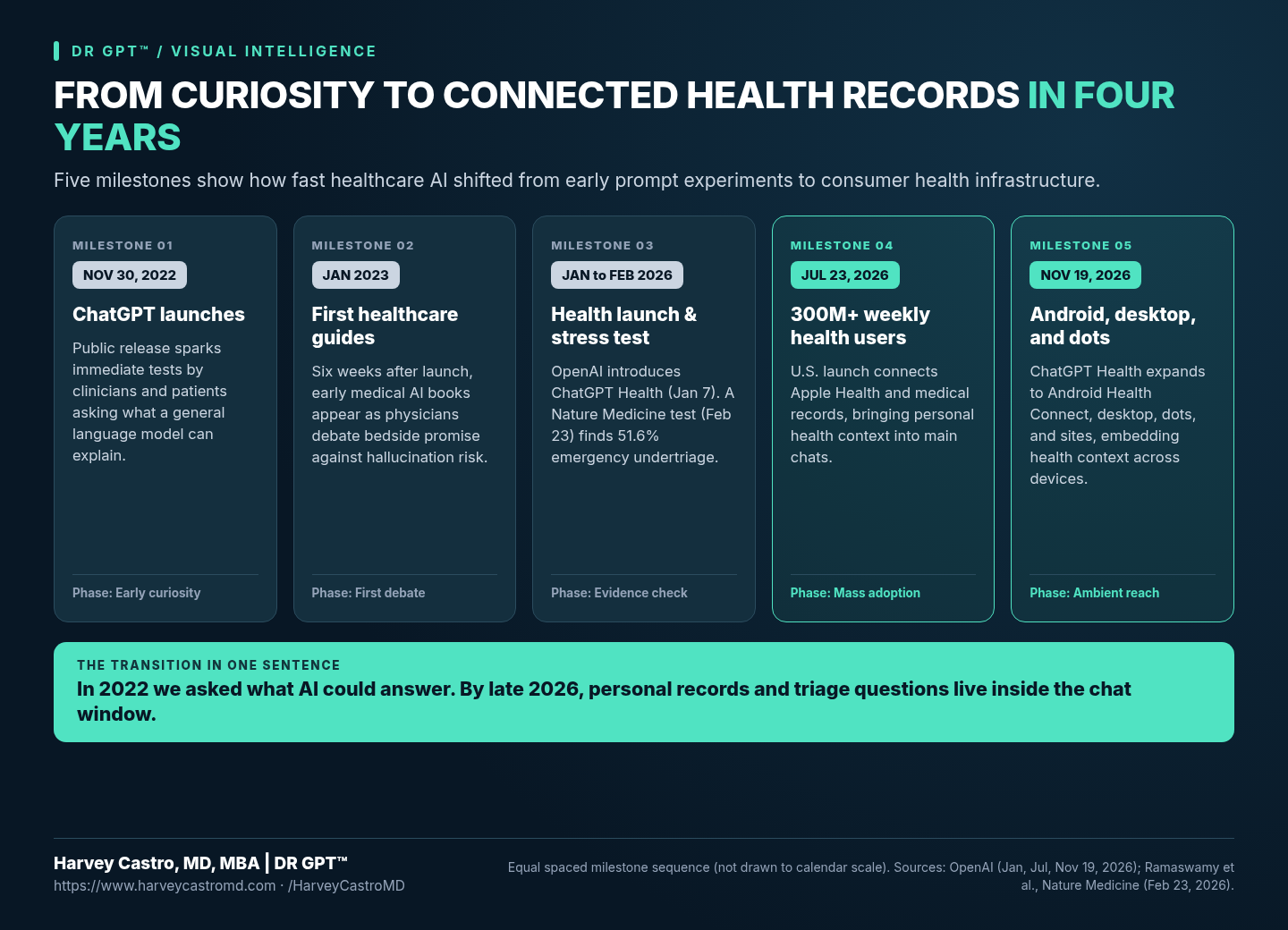 Chart 2. Four year shift timelineEqual spaced milestones from November 30, 2022 to November 19, 2026. Not drawn to calendar scale.Download PNG
 Chart 3. Nature Medicine triage findingsMeasured vignette stress test published February 23, 2026. 51.6 percent of true emergencies were undertriaged.Download PNG
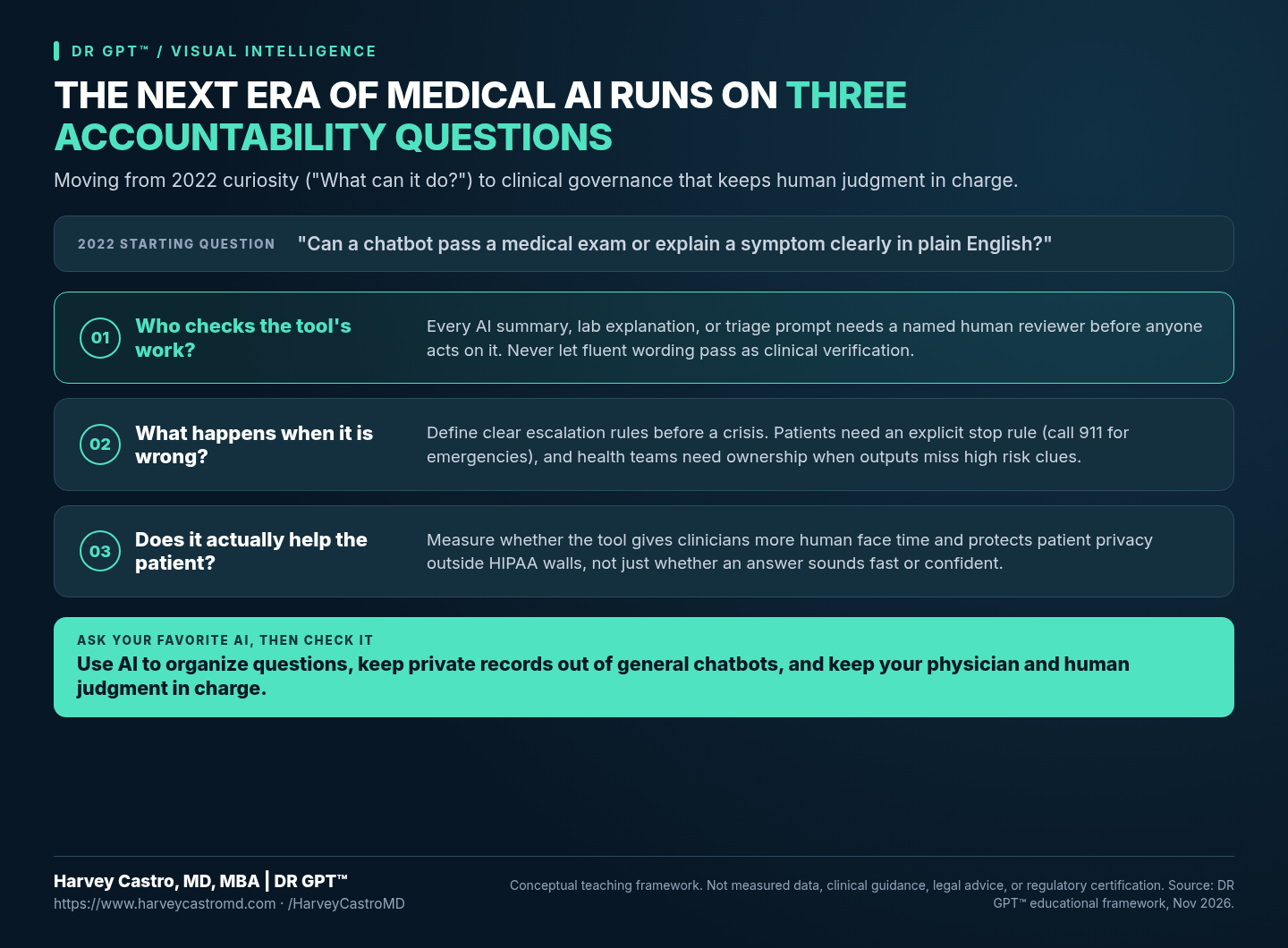 Chart 4. Three accountability questionsConceptual teaching framework. Not measured data or a validated checklist.Download PNG
Blog hero image16:9 editorial still with the blog title as real text and an approved 2026 portrait.Download JPG
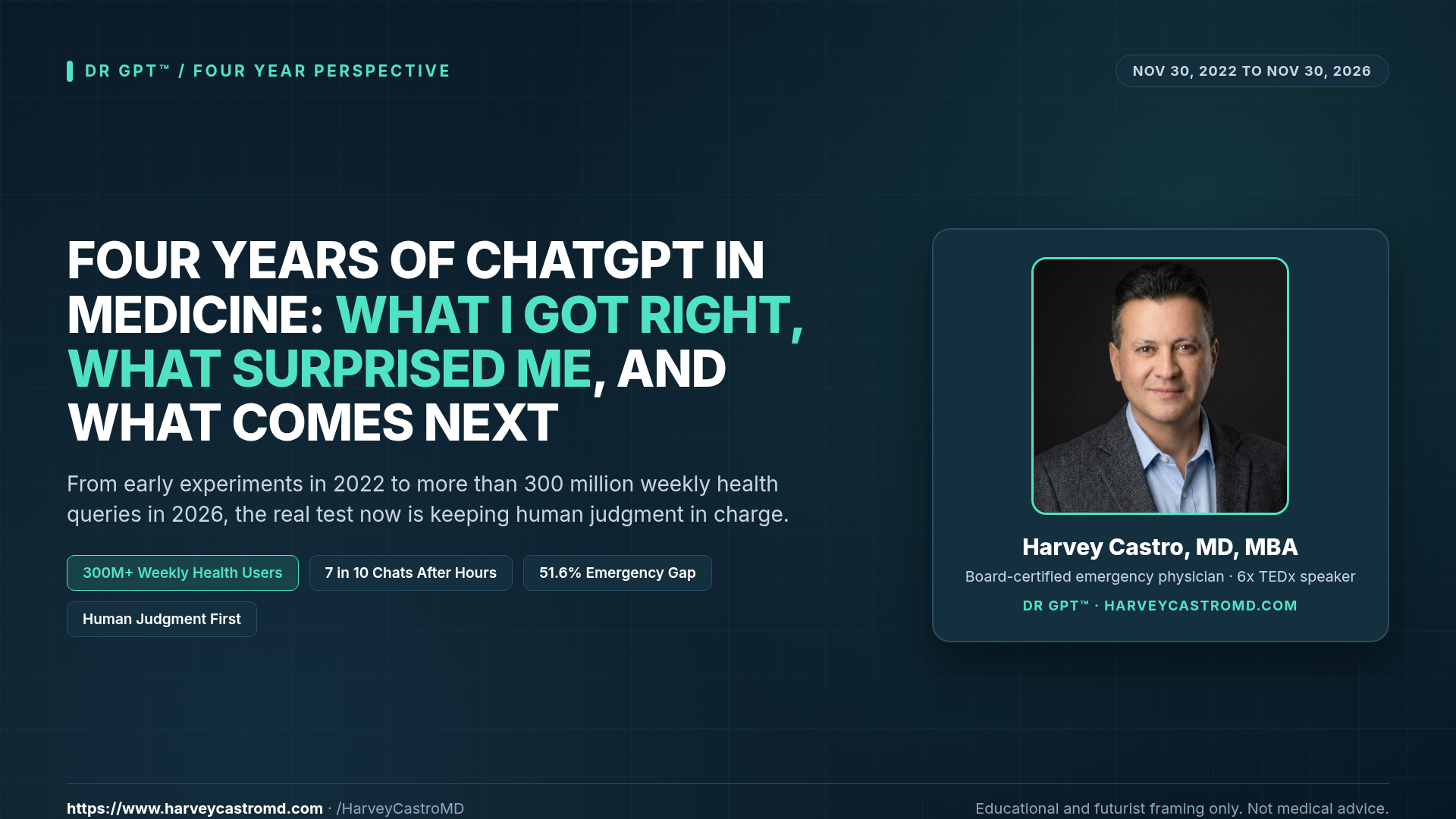 Substack hero image16:9 editorial still with the Substack title as real text and the same approved portrait.Download PNG
 Approved headshot2026 square portrait of Harvey Castro, MD, MBA. Use this photo, unfiltered.Download JPG
Approved quotable lines
Please use these lines as written. Do not shorten or rewrite them.
"Ask your favorite AI, then check it with human judgment."
"For chest pain or stroke signs, skip the app and call 911."
"In 2022, I asked what this could do. Now I ask who checks its work, what happens when it is wrong, and whether a faster process actually helps the patient."
Key facts
- ChatGPT launched to the public on November 30, 2022. Wikipedia entry for ChatGPT
- More than 300 million people ask ChatGPT health questions every week, as reported by OpenAI on July 23, 2026. Launching Health in ChatGPT
- 7 in 10 health related conversations in ChatGPT happen outside normal clinic hours, per OpenAI's January 2026 report. AI as a Healthcare Ally (PDF)
- On November 19, 2026, OpenAI expanded ChatGPT Health to Android Health Connect, the desktop app, dots, and sites. ChatGPT release notes
- A Nature Medicine stress test published February 23, 2026 found ChatGPT Health undertriaged 51.6 percent of true emergencies (33 of 64 clear emergency responses). Ramaswamy et al., Nature Medicine
Short bio
Harvey Castro, MD, MBA (DR GPT™) is a board-certified emergency physician, healthcare AI keynote speaker, and 6x TEDx speaker. He is the author of more than 45 books on medicine and technology. As Former CEO of Trusted Medical Centers he scaled freestanding emergency care, and he now serves as Advisor to the CEO of Phantom Space.
Long bio
Harvey Castro, MD, MBA, known as DR GPT™, is a board-certified emergency physician, healthcare AI keynote speaker, and 6x TEDx speaker. He is the author of more than 45 books on medicine and technology.
He spent about 20 years in emergency medicine. As Former CEO of Trusted Medical Centers he owned and ran 2 micro hospitals, opened 20 freestanding emergency departments, and ran a system of 8. He serves as Advisor to the CEO of Phantom Space.
Harvey speaks and advises on responsible AI in healthcare, AI governance and regulation, clinician adoption of AI, and the future of care delivery.
Suggested social captions
Use #DRGPT only on X, Instagram, YouTube and TikTok. Do not add hashtags on LinkedIn, Facebook or Substack.
LinkedIn, Facebook and Substack (no hashtags)
X, Instagram, YouTube and TikTok (short)
X, Instagram, YouTube and TikTok (longer)
Educational and futurist commentary only by Harvey Castro, MD, MBA (DR GPT™), a board-certified emergency physician, healthcare AI keynote speaker, and 6x TEDx speaker. This article does not provide medical, legal, or compliance advice. For any medical emergency, call 911.