
Medicare Will Now Pay for Outcomes: What the ACCESS Model Means for AI
A ten-year CMS model pays for technology-enabled chronic care when patients actually get healthier.

A ten-year CMS model pays for technology-enabled chronic care when patients actually get healthier.
The best payment models let everyone win: the payer, the provider, and the patient. One of the clearest examples is a model many physicians haven't heard of yet.
It's called ACCESS: Advancing Chronic Care with Effective, Scalable Solutions.
What ACCESS is
ACCESS is a voluntary, ten-year model from the CMS Innovation Center for traditional Medicare. It was announced December 1, 2025, and launched in July 2026. It tests outcome-aligned payments: participants receive predictable payments for managing qualifying conditions, but earn the full amount only when patients meet measurable health goals, such as lower blood pressure or reduced pain.
Care can be in person, virtual, or asynchronous. Technologies expected to support the model include telehealth, wearables, remote monitoring, AI tools, and digital platforms. Watch the wording in new CMS materials: under Executive Order 14434, signed in September 2026, federal agencies now say "Super Intelligence" (SI) where they used to say AI. The technology itself hasn't changed.
The four tracks
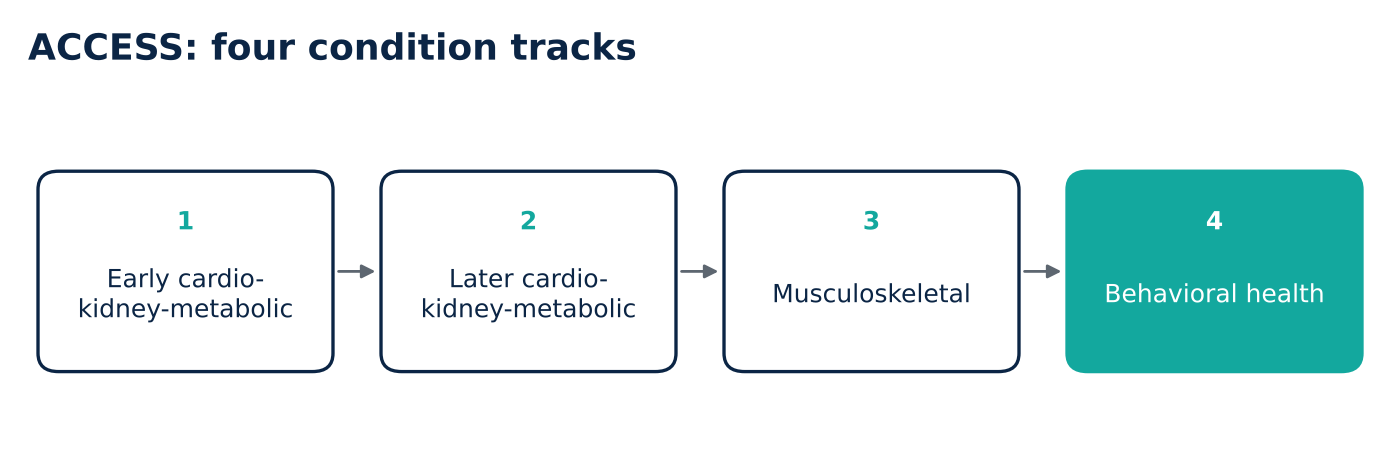
ACCESS focuses on four groups of conditions:
- Early cardiometabolic and kidney disease, such as hypertension, dyslipidemia, and obesity.
- Later cardio-kidney-metabolic disease, such as diabetes, chronic kidney disease, and heart disease.
- Musculoskeletal conditions, such as chronic musculoskeletal pain.
- Behavioral health conditions, such as depression and anxiety.
Participants must designate a Medicare-enrolled physician clinical director responsible for oversight, quality, and compliance.
Why this matters for AI
For years, many AI tools for chronic disease had a business problem. They could help patients, but the payment system mostly rewarded visits and procedures. ACCESS rewards outcomes. That favors tools that actually change results:
- Remote monitoring that spots rising blood pressure early.
- AI coaching between visits.
- Risk prediction that focuses nurses on patients most likely to slip.
- Voice and behavioral screening for depression and anxiety.
What to do now
- Know your data. Can your systems measure outcomes accurately and report them?
- Pick the right track. Match your strengths to a condition group.
- Choose tools by results. Ask vendors for outcome data, not feature lists.
- Plan the human side. Technology without nurses, coaches, and physicians to act on it won't move outcomes.
A balanced view
Outcome-based payment is promising, but it isn't easy. Measurement takes infrastructure. Patients with the most social barriers may be the hardest to move, and programs must avoid quietly avoiding them.
Still, this is the clearest signal yet that Medicare wants to pay for health over activity. AI tools that deliver measurable results finally have a payment model built for them.
Which chronic condition would you want to tackle first with an outcome-based model?
Frequently asked questions
What is the CMS ACCESS model?
A voluntary ten-year CMS Innovation Center model for traditional Medicare, announced December 1, 2025 and launched July 2026, that ties full payment to measurable patient outcomes.
Which conditions does ACCESS cover?
Early cardiometabolic and kidney disease, later cardio-kidney-metabolic disease, musculoskeletal conditions, and behavioral health conditions such as depression and anxiety.
Why does ACCESS matter for AI tools?
It rewards results over visits, which favors remote monitoring, coaching between visits, risk prediction, and screening tools that can show measurable improvement.
Keep reading: Symptoms Mean You Are Already Late and Pharmacists Are the Missing Front Line for AI Screening.
This article is for education and does not replace individual medical advice.
Harvey Castro, MD, MBA, is a board-certified emergency physician, healthcare AI keynote speaker, 6x TEDx speaker, Advisor to the CEO at Phantom Space, and author of over 45 books, including ChatGPT and Healthcare (2023). Learn more at https://www.harveycastromd.com · /HarveyCastroMD
Sources
- Foley & Lardner, January 2026: https://www.foley.com/insights/publications/2026/01/cms-access-model-providers-prepare-for-technology-driven-value-based-care/
- Nelson Mullins, May 2026: https://www.nelsonmullins.com/insights/blogs/healthcare_essentials/payment/access-model-technology-as-key-to-managing-chronic-conditions
- Michigan State Medical Society summary: https://www.msms.org/news/cms-launches-access-model-expand-tech-enabled-chronic-care
- White House, Executive Order 14434, Inaugurating the Era of Super Intelligence (September 29, 2026): https://www.whitehouse.gov/presidential-actions/2026/09/inaugurating-the-era-of-super-intelligence/