NIM 2026 keynote: The AI-Native Hospital, what healthcare could look like in 2035
My NIM keynote at TUM Munich, Nov 27 at 17:20 CET, free to join online: a patient-first 2035 scenario, the evidence, guardrails, a 90-day plan and sources.


Friday, November 27, at 17:20 CET
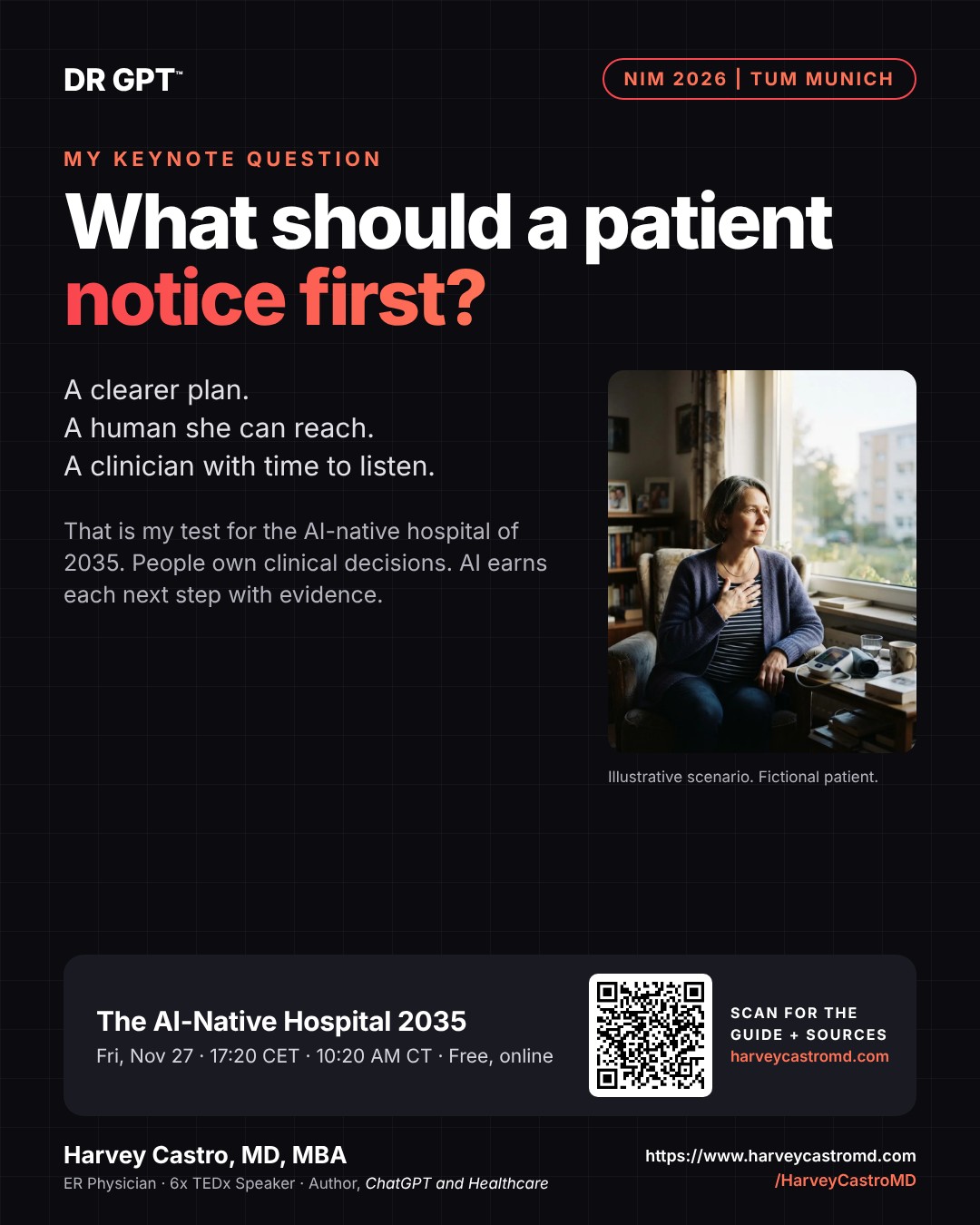
I am giving the keynote at NIM, New Ideas for Medicine, hosted by TUM in Munich. My question for the room: what should a patient notice first in a better hospital? It is free and online. Register here. This page is the guide behind the QR code on my slides.
Audience guide
Seven sections: the session, a fictional patient, the evidence, the guardrails, your next ninety days, the reading list and graphics you can share.
The AI-Native Hospital: What Healthcare Could Look Like in 2035
I am an emergency physician. When I picture a better hospital, I start with the patient, not the model. This is a patient-centered scenario, not a forecast and not a TUM plan. People own clinical decisions. AI earns each next step with evidence.
Times can change. Check your registration email before the session.
The afternoon around my talk
Friday, November 27, English lectures, times in CET. NIM is hosted by the Department of Dermatology and Allergy at TUM with Digital Dermatology e.V. and the German Dermatological Society (DDG).
From the NIM programme dated November 17, 2026. Short titles are mine. German lectures follow on Saturday, November 28.
One patient. Seven steps. A person decides where care changes.
Anna is a teaching example, not a real patient. I use her so every idea has a person attached to it. The gold steps are where a human decides or confirms.
Care starts before arrival
With consent, selected readings reach an approved service. A nurse reviews a change and calls Anna. False alarms, staffing and response ownership decide whether this helps.
A phone call counts
Keep a phone route, a staffed person and a paper option. Declining a device must never reduce care.
Draft notes, protect attention
Ask before recording. The tool drafts; the clinician checks drug names, dates and negation, then signs.
Every handoff has an owner
A reviewed plain-language plan, an acknowledged follow-up and a named team. A sent message is not a handoff.

Your turn: where in Anna’s path would your hospital lose ownership first? Tell me on LinkedIn and I will bring the best answers to Munich.

Of 100 patients with sepsis, the model missed 67.
In a 2021 external validation at one academic health system, a widely used sepsis model flagged only a third of the patients who went on to develop sepsis, while alerting on nearly one in five of everyone admitted.
That is one model version at one site, years ago. I show it for the lesson, not the vendor: a confident number from somewhere else is not your hospital’s number.
How much weight each study can carry
- MASAI mammography ■■■■□Randomised trial, about 105,000 women, one country
- Epic Sepsis Model ■■■□□Retrospective cohort, one system, 38,455 stays
- Ambient AI scribes ■■□□□Pre and post survey, 263 clinicians, no control
Squares reflect design and size, not whether the news is good.
Three more pictures, drawn honestly


The question I leave with the room
What evidence would justify expansion at your hospital? Name the outcome, the comparison group and the local validation before the contract, not after.

A request is not completion.
A permitted agent may book Anna’s follow-up. It may not infer permission to change her medication or discharge her. Narrow tool access, approval points, audit logs, stop conditions and a named owner come first. Chained steps multiply failure.
Make missing information visible
A fluent summary can hide an empty field. Show source and date and flag gaps.
Stopping must preserve care
A tested off switch, a named person who can pause it, and a manual route staff have rehearsed.


Start with one safe workflow
Pick one bounded workflow and name its owner. Measure a baseline, test in shadow mode, define approvals and the manual fallback, and only then go live. At day ninety, write the decision down.
Good first candidates
- Draft discharge instructionsA nurse reviews every one
- Booking with confirmationThe destination system confirms
- Note draftingClinician sign-off
- Staffing simulationNo patient effect
Examples only. Your risk review decides.
Start with the evidence
Six sources worth reading before the session. Each answers a different kind of question, and a law or guidance document is not proof of clinical benefit.
MASAI: AI-supported mammography screening
Lancet Digital Health, 2025
Compared AI-supported screening with standard double reading in about 105,000 women in Sweden.
Keep in mind: One country, one AI system, radiologists in the loop. Detection is not mortality.
Read the sourceMASAI: interval cancers
The Lancet, 2026
The primary endpoint: cancers that appear between screening rounds.
Keep in mind: Non-inferior, but the confidence interval crosses 1.0, so fewer missed cancers is not proven.
Read the sourceEpic Sepsis Model in hospitalised patients
JAMA Internal Medicine, 2021
Tested a widely used sepsis model at one academic health system.
Keep in mind: Retrospective, one site, one model version. Today’s versions may differ.
Read the sourceAmbient AI scribes and burnout
JAMA Network Open, 2025
Surveyed 263 clinicians in six US health systems before and after 30 days with an ambient scribe.
Keep in mind: Voluntary surveys, no control group, one vendor, no patient outcomes.
Read the sourceEU AI Act timeline after the 2026 Omnibus
Future of Privacy Forum
Explains the new dates for high-risk AI, including AI in medical devices from August 2028.
Keep in mind: An explainer, not the legal text. Check EUR-Lex and get qualified local advice.
Read the sourceWHO: ethics and governance of large multi-modal models
World Health Organization, 2024
Guidance for governments, developers and providers using generative AI in health.
Keep in mind: Guidance, not law, and written before many of today’s agentic tools.
Read the sourceAlso useful: the European Health Data Space page and the FDA list of AI-enabled devices. Links checked November 23, 2026.
Take it with you
Free to share. Open any image full size, then save it. Every graphic carries its source and a QR code back to this page. Please tag me so I can thank you.

Open full size

Open full size

Open full size
Open full size
Open full size
Open full size
Open full size
Open full size
Open full size
Open full size
Open full size
Open full size
Open full size
Open full size
A caption you can copy
The question: what should a patient notice first?
https://www.harveycastromd.com/blog-posts/nim-2026-ai-native-hospital-2035
#NIM2026 #HealthcareAI #DigitalHealth
Please keep personal medical details out of public posts.
More from me on AI in care
The AI-Native Hospital 2035
You are here
The State of AI in Emergency Medicine 2027
Read the report
Jan 8 · Panel · CES 2027Personalized Health: One Size Fits None
Read the guide
Planning a 2027 event?
I speak on AI in care through the eyes of an emergency physician who still works shifts. Watch the speaker reel and see the keynotes, or check availability.
Anna and the 2035 scenario are fictional. The pilot sequence is a proposal, not a regulatory timetable. Session details are from the NIM programme and my talk materials, checked November 23, 2026. This post is educational and is not medical, legal or regulatory advice. Always consult your doctor. https://www.harveycastromd.com · /HarveyCastroMD