When AI Enters Care, Trust Has More Than One Language
Minda Harts' Seven Trust Languages®, applied to trust in healthcare AI, with seven questions leaders can ask before a tool earns a place in care.

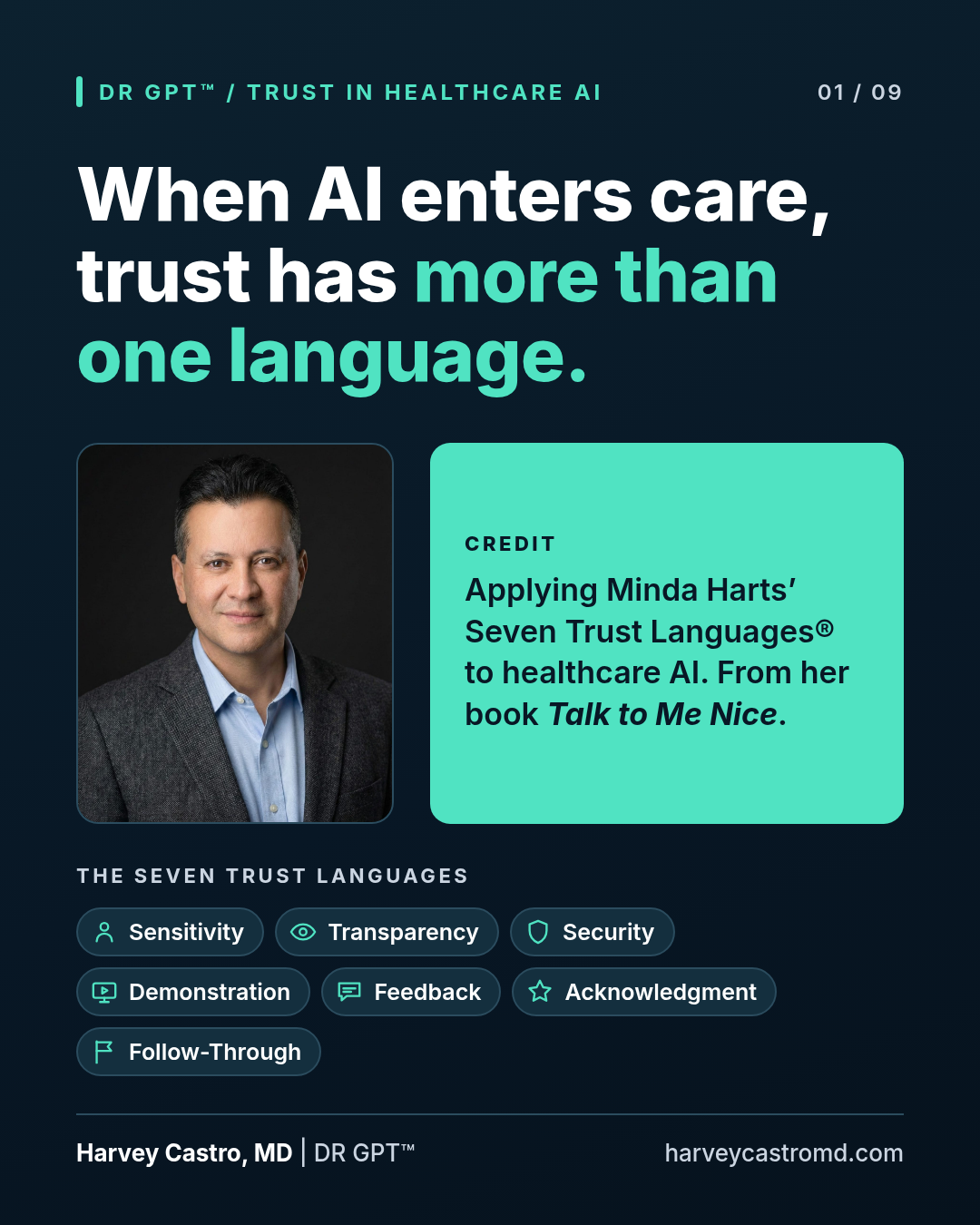
People talk about trusting AI as if it is one switch.
In a hospital, it is not.
A clinician deciding whether to trust a tool, a patient trusting a team that uses AI, and a leader rolling it out are each asking a different question. I have been applying Minda Harts' Seven Trust Languages® to what happens when AI enters a care setting. The framework is hers, from her book Talk to Me Nice: The Seven Trust Languages for a Better Workplace. You can learn more on her site at https://www.mindaharts.com/.
I am not offering this as a validated clinical checklist, a formal hospital framework, or anything an agency has endorsed. It is a teaching lens. It helps me ask better questions before a tool earns a place in care.
Sensitivity

Does the tool still see the person, not only the score?
A risk score can be useful and still flatten someone into a number. If a tool marks a patient as low risk while a family member is describing a change that does not fit the score, the question is whether anyone is still looking at the person in the room.
Transparency
Can a clinician and a family follow why the model leaned this way?
If the only explanation is a confidence number or a long list of features, trust gets thin fast. People need a reason they can repeat in plain language, including when the honest answer is that no one fully knows yet.
Security

Can someone raise a concern without putting their job or their care at risk?
Trust fails when a nurse, a resident, or a patient has to choose between speaking up and staying safe. If reporting a bad recommendation could cost someone their standing on the team, their license, or the quality of their care, the tool may be in place, but the safety system is not.
Demonstration
Has this been shown in a setting like ours, not only in a pitch?
A polished demo is not the same as evidence from a unit like yours, with patients like yours, and a workflow like yours. Leaders should ask what was tested, where it was tested, and what still has not been shown.
Feedback
When the tool is wrong, is there a real way to say so?
A form that nobody reads is not feedback. If a clinician cannot flag an error inside the workflow, and nobody reviews what was flagged, the system will keep making the same mistake.
Acknowledgment
When a person catches what the model missed, does the team give that credit?
If the story is always about what the model caught, and never about the person who stopped a miss, people stop speaking up. Credit is not a nicety. It tells the team that human judgment still counts.
Follow-Through
After the kickoff, do training, oversight, and human review actually arrive?
Too many launches cut the ribbon and promise the hard parts for later. Trust is built when training shows up on the floor, when someone is clearly responsible for oversight, and when human review is still there after the first week.
Trust in healthcare AI gets built in these small moments, or it does not get built at all.

The Seven Trust Languages® come from Minda Harts and her book Talk to Me Nice: The Seven Trust Languages for a Better Workplace, at https://www.mindaharts.com/. Thank you, Minda, for giving leaders a language for this.
When you think about AI in your own work, which of these seven matters most to you right now?
This is an educational reflection only. It is not medical advice, and it is not a checklist for clinical use.
For more on this theme, see my earlier note on patient trust and human accountability.