At a certain moment, AI reached the emergency department faster than the rules, the time and the training to use it.
Every day, clinicians triage, chart and sign off with AI scribes and alerts in the loop, and each department works out its answers alone.
Then, one day, I asked the people who do this work the same five questions. 41 answered: emergency physicians, nurses, EMS, a pharmacist, an ethicist and leaders across the field. Five patients told me what it felt like from the bed.
Because of that, 145 answers became a map. Only one question came close to consensus: tell patients.
Because of that, the real fault line showed up. 15 of 29 coded answers on accountability say it must be shared with health systems and vendors.
Until finally, this report ends where your next go-live starts: name the owner, write the exit criteria, and tell patients plainly.
Harvey Castro, MD, MBA, DR GPT™, Editor
What I found
41 leaders answered five questions. Only one came close to consensus: tell patients.
So what
Accountability is the sharpest split. 15 of 29 coded answers say it must be shared with health systems and vendors.
Now what
Before your next AI go-live, name the owner, write the exit criteria, and tell patients plainly.
The report on one page
41 contributors, five questions. Emergency physicians, nurses, a pharmacist, a paramedic, an EMS leader, an ethicist, a malpractice attorney, informatics and industry leaders.
AI raises the flag, a clinician makes the call. Contributors see AI spotting risk and deterioration faster than a busy team. The decision to admit, discharge or de-escalate stays human, with one sharp dissent: Dr. Rhew argues humans cannot reassess every case.
Scribes are not all the same. Some give real time back, others move the work from writing to proofreading. Measure which one you bought.
Accountability is the sharpest split. 15 of 29 coded answers say it must be shared with health systems and vendors. 9 say it rests with the clinician who signs.
Disclosure is the closest thing to consensus. Tell patients plainly, early, and who reviewed the AI’s work. The argument is over how, and Dr. Tseng warns that consent for every use will not last.
Proof beats promise. 10 of 27 predictions turn on patient outcomes or evidence, and 3 doubt outcomes will move by the end of 2027.
Write the off switch before go-live. Local validation, a named owner, exit criteria and counted near misses come up again and again.
“AI should make good clinicians better, not replace the judgment that makes them good clinicians.” Ryan A. Stanton, MD, FACEP, President, ACEP
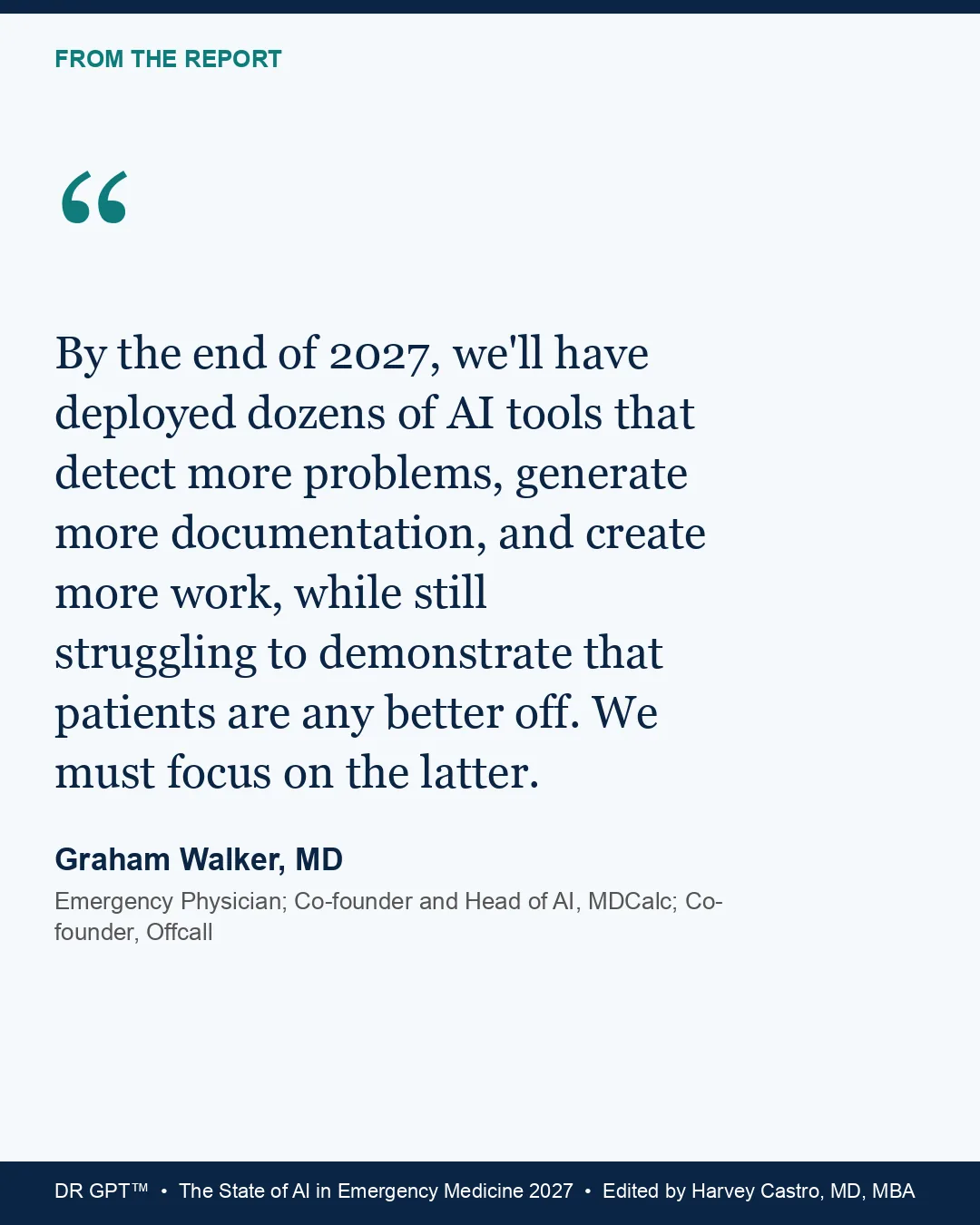
“Where could it meaningfully change patient outcomes?” Graham Walker, MD, Co-founder and Head of AI, MDCalc
“I’ve always maintained that AI should be our co-pilot, never our autopilot.” Natasha Dole, FRCEM (UK), Milton Keynes University Hospital NHS
Before your next AI go-live, name the owner, write the exit criteria, and tell patients plainly.
Where they agree and where they split
Five questions. Only one came close to consensus. The disagreement is the useful part.
Decide the owner, the exit and the measure before the first patient. Refuse tools nobody can explain.
Who is in the room
Emergency physicians (17)
Other physicians (11)
Non-clinician leaders (5)
Nurses (4)
EMS leader and paramedic (2)
Clinical ethicist (1)
Pharmacist (1)
Patient Voices (5)
41 contributors by role, from their own credit lines. The 5 hollow rings are Patient Voices: patients telling their own ER stories, shared separately and not counted in the 41.
Question 1
Where AI helps ED triage, and where a human decides
What I asked: Where will AI actually help triage and early risk recognition in the ED in 2027, and where should a human always make the call?
What I heard
Stanton sees AI identifying patterns, recognizing high risk patients and predicting deterioration, but says it should augment clinical decision making, not replace it, and is only as good as the data and populations it was built on.
Tamayo-Sarver splits triage into pattern recognition, where models are strong, and pattern verification, where a physician has to stand. Mayer sees AI organizing data and flags so the triage nurse can use judgment. Hutchins and Marquez want AI to raise the flag and a clinician to own the call.
Coyle draws the line at anything that cannot be undone. Rhew goes further than the rest: he argues humans cannot reassess every case, and that validated low-risk patients can move through a defined pathway.
AI raises the flag
Vital sign trend at hour three Tamayo-Sarver
Waiting-room deterioration Mahajan
Fragmented history and unreconciled meds Coyle
A detail buried in an old note Villagra
A clinician decides here
A person makes the call
Acuity, disposition and discharge Mahajan
“Sick versus not sick” Olaf
Anything that cannot be undone Coyle
The patient who looks wrong Dole
The dissent. “We cannot have humans reassess every case.” David C. Rhew, MD. Read his full answer
Examples drawn from 32 answers to question 1. Every answer is in full below.
“AI has tremendous potential to improve triage, particularly in identifying patterns, recognizing high-risk patients, predicting deterioration, and helping us prioritize limited resources.”
Ryan A. Stanton, MD, FACEP
President, American College of Emergency Physicians; President, Central Emergency Physicians; Medical Director, Lexington Fire/EMS; Medical Director, GMR Motorsports
Read full answer from Ryan A. Stanton
AI has tremendous potential to improve triage, particularly in identifying patterns, recognizing high-risk patients, predicting deterioration, and helping us prioritize limited resources. It can process enormous amounts of information and recognize things that might otherwise be missed in a busy emergency department. But AI should augment clinical decision-making, not replace it. Emergency medicine is not simply an algorithm. It is the art and science of making decisions with incomplete information, often in seconds, while considering factors that cannot always be quantified. AI can help identify the patient who needs immediate attention, but the clinician must ultimately determine what that patient needs. We must also recognize that AI is only as good as the information, assumptions, and populations on which it was developed.
My bottom line: AI should make good clinicians better, not replace the judgment that makes them good clinicians.
“The goal is to focus clinicians' attention on the patients who need their judgment, while helping everyone get appropriate care sooner.”
David C. Rhew, MD
Global Chief Medical Officer and Vice President of Health & Life Sciences, Microsoft
Read full answer from David C. Rhew
Think about putting the specialist’s expertise at the front of the triage line instead of the end. AI can help bring that expertise into the first encounter, identifying risk factors and helping determine who needs what level of care, and how quickly.
AI can help risk-stratify the patient queue, identifying patients who are more complex, aren’t improving, or have risk factors for serious conditions. It can also expand the capabilities of the care team. The clinician using AI might be a physician, nurse, pharmacist, or another health professional, working within their scope of practice with appropriate support.
We cannot have humans reassess every case. We need to define, validate, and monitor which patients can safely continue through an AI-supported pathway and which need human evaluation. Human review should be triggered by red flags, greater clinical complexity, failure to improve, risk factors that exceed established thresholds, or missing or conflicting information that prevents a reliable assessment. Cases outside the system’s validated capabilities also need human review.
Patients who meet established low-risk criteria can continue through the defined pathway without individual human review at every step, with clear instructions for seeking help and reassessment if their condition changes. Patients should also have a way to request human review. The goal is to focus clinicians’ attention on the patients who need their judgment, while helping everyone get appropriate care sooner.
“A reassuring AI output should never overrule a clinician who thinks something is wrong or a patient who says they are getting worse.”
Jesse M. Ehrenfeld, MD, MPH
Global Chief Medical Officer, Aidoc; Past President, American Medical Association
Read full answer from Jesse M. Ehrenfeld, MD, MPH
In 2027, I expect AI’s greatest contribution to be helping teams recognize the patient whose risk is greater than their place in the queue suggests. That means bringing together signals from vital signs, clinical history, laboratory results and imaging and getting concerning findings to someone who can act. Clinicians should retain authority over triage priority, escalation and disposition. A reassuring AI output should never overrule a clinician who thinks something is wrong or a patient who says they are getting worse.
“Humans should always ‘make the call.’”
Michael Chang, MD, FAAEM
System Chief Medical Officer, Nutex Health
Read full answer from Michael Chang
Synthesis of data using all relevant triage information, such as chief complaint, vitals, and brief history; with optics, maybe even how the patient “looks.” The AI then can give an acuity score. Humans should always “make the call.”
“I do think that the human triager will need to make the final call on expectant versus immediate patients.”
Jessica Ryder, MD, MPH
Physician Lead, ED Disaster Preparedness; Assistant Professor, Department of Emergency Medicine, University of Colorado Anschutz
Read full answer from Jessica Ryder
I envision AI helping as a decision support tool for our human triage teams, as long as the method of implementation can keep pace with our rapid triage goals (i.e. avoid anything that requires typing). Some of our colleagues have already demonstrated the benefit of AI in casualty location and initial assessment to aid our human triagers in prioritizing evaluations and lifesaving interventions. There is definitely a role for AI in helping to track patients evaluated and potentially resources utilized both in the prehospital and hospital settings to help guide decision around expectant patients, but in the end, I do think that the human triager will need to make the final call on expectant versus immediate patients.
On disaster preparedness: AI can be a tool to support our teams before, during, and after any disaster. This technology can be trained on existing procedures and policies to help guide event-specific responses. It can aid as a decision support tool for mass casualty triage and resources allocation and can help screen and suggest courses of action for patients suspected of having a high consequence infectious disease. It can be a valuable tool if used appropriately but should be developed in collaboration with subject matter experts and clinicians to guide its direction forward.
All thoughts are her own and do not represent the University of Colorado Anschutz.
“A clinician must always make the final call on acuity, disposition, and especially de-escalation or discharge.”
Prashant Mahajan, MD, MPH, MBA
Chair, Department of Emergency Medicine, University of Michigan; William G. Barsan Collegiate Professor of Emergency Medicine; Co-Chief, Division of Clinical Informatics; Chair, E.M.E.R.G.E. Network (a global emergency research and education network)
Read full answer from Prashant Mahajan
AI will help where the task is narrow and the output is an outcome/flag to be considered such as sepsis, stroke, PE on imaging, detecting ischemia on triage ECGs, and scoring waiting-room deterioration. The evidence is still mostly retrospective and single-site, and performance often degrades when external validation is attempted. AI when used indiscriminately, can lead to alert fatigue, automation bias, and inequities when trained on skewed historical data. A clinician must always make the final call on acuity, disposition, and especially de-escalation or discharge. Until regulation, reimbursement, and liability mature, AI should remain advisory, used by clinicians trained to question it.
“Being a human in the loop is one thing. Loop 2.0 is now being the human at the helm.”
Arlen Meyers, MD, MBA
President and CEO, Society of Physician Entrepreneurs; Emeritus Professor, University of Colorado School of Medicine
Read full answer from Arlen Meyers
Being a human in the loop is one thing. Loop 2.0 is now being the human at the helm.
“The danger of over-reliance on AI comes when a score closes the conversation.”
Gil Bashe
Managing Partner and Chair Global Health and Purpose, FINN Partners
Read full answer from Gil Bashe
Triage determines who can wait and who cannot effectively. AI can surface patterns and assemble information under time pressure. The danger of over-reliance on AI comes when a score closes the conversation. A caregiver saying, “This is not how she usually behaves,” deserves attention even when the screen offers reassurance. Human-augmented intelligence requires clinicians who can question AI output and institutions that support that judgment. The patient must retain a voice in a process that determines access to care.
“AI is hugely helpful at obtaining and organizing data and recognizing certain flags for consideration, based on VS, CC, etc.”
Thom Mayer, MD, FACEP, FAAP, FACHE
Medical Director, NFL Players Association; Senior Medical Advisor, Palantir for Hospitals
Read full answer from Thom Mayer
AI is hugely helpful at obtaining and organizing data and recognizing certain flags for consideration, based on VS, CC, etc. This allows the triage nurse to use her judgement and experience to "triage" among the possible suggestions. ESI, at least in my view, is a flawed methodology, as several studies show. Estimating the number and types of resources needed is likely much better done with AI, as well as later assessing and modifying the algorithm after determining how many and what type of resources were actually used.
“Triage is two cognitive acts, not one.”
Joshua Tamayo-Sarver, MD, PhD, FACEP, FAMIA, FAIM
Vice President of Innovation, Vituity and Inflect Health; Adjunct Lecturer, Stanford University School of Medicine
Read full answer from Joshua Tamayo-Sarver
Triage is two cognitive acts, not one. Pattern recognition asks what this looks like. Pattern verification asks whether the pattern actually fits this patient. Current models are very good at the first and structurally incapable of the second. When a pattern does not fit, a physician switches to hypothetico-deductive reasoning. A language model runs pattern recognition again, slightly differently, and calls that a second opinion.
So AI helps most where the signal is already sitting in the data and nobody has time to look at it: the vital sign trend at hour three, the return visit nobody connected to the first one, the lab value that is unremarkable alone and alarming in context. I have watched a model summarize a chart and fixate on a minor rash while missing a pulmonary embolism, because the rash was the patient's chief concern and so it took up the most room in the note. The model weighted by documentation volume. Triage weights by threat to life. Those are different functions, and the space between them is where a human has to stand.
The human decides every time the pattern does not fit, and every time the question is what this particular patient needs rather than what this presentation usually needs.
“A doctor still needs to assess what it means for the patient.”
Chris Hutchins
Founder and CEO, Hutchins Data Strategy Consultants, and host of The Signal Room Podcast
Read full answer from Chris Hutchins
Some ways that it is helpful I think are in the way it can process information quickly to potentially alert a physician that something needs attention sooner than they might otherwise be aware. A patient may appear stable but there may have been changes in their history or recent results that might not be available otherwise. That can provide another opportunity for review. A doctor still needs to assess what it means for the patient. If they don't have enough information to evaluate it, it has to be addressed before we ask them to rely on it
“AI can organize the story.”
Miguel Villagra, MD, MBA, FACP, FHM
Hospitalist, AI Scribe Pilot Lead, and Digital Health Consultant; Founder, A Doctor's Journey
Read full answer from Miguel Villagra
I see the ED from the admitting side, as a hospitalist, so my answer comes from that handoff.
In 2027, I think AI's biggest help will be what I call documentation triage. An AI scribe can take the ED note, prior discharge summaries, consultant notes, and outside records and curate them into one concise working draft before I walk into the room. I start the encounter oriented instead of hunting through the chart. That is where early risk recognition begins for me: the detail buried in an old note shows up on page one.
A human should always make the call on acuity, disposition, and whether to admit or discharge. AI can organize the story. It cannot examine the patient, hear the worry in a family's voice, or own the outcome.
“AI helps most with the volume problem: spotting patterns in vitals, history, and the waiting room faster than any one person can, and flagging the patient who's quietly getting worse.”
Saul W. Marquez
Founder and CEO, Outcomes Rocket
Read full answer from Saul W. Marquez
AI helps most with the volume problem: spotting patterns in vitals, history, and the waiting room faster than any one person can, and flagging the patient who's quietly getting worse. Where a human must decide is anywhere context, judgment, and values come in. The algorithm can raise the flag, but a clinician has to own the call. The best tools make the care team faster and more effective. They also depend on data, so if the data isn't clean it'll accelerate more bad instead of doing good. None of these replaces the person at the bedside.
“AI should synthesize the chief complaint, age, prior history, and vital signs during nurse triage to suggest initial diagnostic orders.”
Robert Hoyt, MD, FACP
Associate Clinical Professor, Internal Medicine, Virginia Commonwealth University
Read full answer from Robert Hoyt
AI should synthesize the chief complaint, age, prior history, and vital signs during nurse triage to suggest initial diagnostic orders. Front-loading these tests will significantly reduce the long turnaround times plaguing most EDs and urgent care centers. However, a human clinician must always make the final call on acuity assignment, safe discharge, and complex or atypical presentations where subtle bedside "gestalt" and non-verbal cues cannot be captured by an algorithm.
“AI helps most where the patient's history is fragmented, because fragmentation is what hides risk.”
AI helps most where the patient's history is fragmented, because fragmentation is what hides risk. The patient who has been in three times in two weeks. The medication list nobody has time to reconcile. The result sitting in a system that does not talk to yours. That is pattern work, and pattern work is where a machine beats a tired human at hour ten.
A human has to decide anything where being wrong cannot be undone. Who goes home. Who gets the bed. The presentation that does not fit the pattern because this person is not the pattern.
The risk I would actually watch for is quieter than either of those. A tool that is right most of the time trains people to stop checking. The failure will not be the day the model is wrong. It will be the day it is wrong and nobody is still looking.
“AI cannot evaluate a patient's work of breathing, the gray color of their skin, or the panicked look in a mother.”
Mark F Olaf, DO, FACEP
Associate Professor of Emergency Medicine; System Director of Quality, Emergency Medicine; Associate Chief Medical Officer, Geisinger Shamokin Area Community Hospital, Geisinger Health
Read full answer from Mark F Olaf
AI excels at mining the electronic health record in the background to flag subtle, high-risk features, or "hidden" elements of medical history, like a creeping white blood cell count paired with borderline vitals that might signal early sepsis before the patient looks toxic. In the near future it will act as a powerful early warning system to catch things in the waiting room that get lost in the noise of a crowded ED. However, the initial "sick versus not sick" judgment will always belong to a human. AI cannot evaluate a patient's work of breathing, the gray color of their skin, or the panicked look in a mother. The physical and behavioral nuances that tell an experienced triage nurse or physician a patient is crashing will not be replaced soon.
“A human clinician must always keep the final say, adding clinical gestalt by observing the patient directly and up-triaging as needed.”
Chief of Emergency Medicine, Sinai Health; Assistant Professor, University of Toronto
Read full answer from Maxim Ben-Yakov
AI can help by letting capable patients enter free-text complaints that map to standardized triage decision trees. That is a low-lift, high-benefit way to bring in machine-assisted triage. AI can also support touchless vital signs, which lowers infection risk. A human clinician must always keep the final say, adding clinical gestalt by observing the patient directly and up-triaging as needed. For nonverbal patients and those with mobility issues, human triage remains essential, though robotics may help in the future.
“But I think a human still has to be involved to pick up on the physical signs, and at the end of the day, the human has to make the call.”
Jay Woody, MD, FACEP
Founder and Chief Medical Officer, Intuitive Health
Read full answer from Jay Woody
I think AI will help most with triage and risk stratification, based on the algorithms and the risk factors a patient has. For example, say someone comes in with chest pain and tells you they have high blood pressure, they smoke, and they have diabetes. AI can recognize that the HEART score is elevated and flag it for the physician. That helps make sure we don’t miss anything and that the patient gets the appropriate workup. It could also take over some of the routine tasks, like getting vital signs and oxygenation into the EMR automatically.
But I think a human still has to be involved to pick up on the physical signs, and at the end of the day, the human has to make the call.
“The future is moving from point-in-time triage to continuous risk recognition throughout the ED visit.”
Andrew Slifko, DNP, MBA, RN
NEA-BC, Client Engagement Specialist, Emergency Nurses Association
Read full answer from Andrew Slifko
I envision AI enhancing triage by helping nurses identify risk earlier and make more informed decisions. At the time of triage, AI could suggest acuity levels based on presenting symptoms, vital signs, and clinical history while pulling relevant information from previous visits to the forefront of the assessment.
Integration with wearable technology could further help identify early signs of deterioration. I also see opportunities for AI to support ongoing reassessment of patients in the waiting room. As new information becomes available, such as laboratory results or changes in vital signs, AI could flag patients whose risk profile has changed and recommend reassessment.
However, the triage nurse must always retain clinical judgment and make the final acuity decision. AI should support, not replace, the nurse’s assessment, experience, and understanding of the patient. The future is moving from point-in-time triage to continuous risk recognition throughout the ED visit.
“It also helped train my eyes to recognize these subtle EKG changes on my own.”
Andrew J. Bowman, MSN, RN, ACNP-BC, ACNPC, NRP, FAEN
Acute care nurse practitioner, Boone County Emergency Physicians, Indiana
Read full answer from Andrew J. Bowman
How does Queen of Hearts show up in your ED work for OMI detection?
I’m part of a small ED group in central Indiana that covers four community EDs, none of them trauma centers. Our APPs see ESI 1 to 5 patients, and every patient is staffed with the on-duty physician. I mainly use AI in two situations: PMCARDIO Queen of Hearts for OMI detection, and OpenEvidence to research less common clinical scenarios. I started using Queen of Hearts about a year ago to help me quickly identify patients with occlusion MI who don’t have classic ST elevation. I’ve always been the “go to” EKG guy in my group, and this solidified that role, with frequent middle-of-the-night requests from colleagues to “take a look at this EKG with that app of yours.” The app helped me recognize NSTEMI-OMI patients and get them to reperfusion faster. It also helped train my eyes to recognize these subtle EKG changes on my own. Now that it’s FDA cleared, I chart when Queen of Hearts was used, and a new billable code for AI-assisted EKG interpretation arrives in January 2027.
How does OpenEvidence fit into a shift?
I use OpenEvidence almost every shift, for a quick review of a condition or treatment recommendation I’m less familiar with, and of nuances that may affect my care for a patient. On and off shift, I also use it for deeper dives to prepare presentations or run a literature search for an article. Recent searches include a deep dive comparing STEMI/NSTEMI with OMI/NOMI, a quick review of crowned dens syndrome when it showed up on a CT report, the best imaging choice for a pediatric Orbeez ingestion, lidocaine toxicity and treatment, IV versus IO lab results, and management of a Wegovy overdose. So I use AI in a limited but very helpful way, both in daily practice and off shift for articles and presentations.
Lightly edited and shortened, with the contributor's approval.
Editor’s note: The FDA authorized Queen of Hearts through the De Novo pathway, and I could not confirm the January 2027 billing code, so check current FDA and CPT sources before relying on either.
“The nurse who is physically assessing the patient, however, should have final authority in determining the patient’s urgency and triage acuity.”
Domenique Johnson, MSN, RN
Practice Excellence Specialist, Emergency Nurses Association
Read full answer from Domenique Johnson
Artificial intelligence can be a valuable decision-support tool in emergency department triage, helping nurses identify potential clinical risks and recognize time-sensitive conditions such as sepsis, stroke, high-risk pregnancy complications, and other emergent presentations. AI could also assist with identifying the appropriate Emergency Severity Index (ESI) level by analyzing presenting symptoms, vital signs, patient history, and other clinical indicators. The nurse who is physically assessing the patient, however, should have final authority in determining the patient’s urgency and triage acuity.
Punctuation and grammar lightly edited, with the contributor’s approval.
“AI will be most valuable in the ED as a second set of eyes, not a replacement for the triage nurse’s clinical judgment or clinical decision-making process.”
Amy Toopes, MSN, APN, FNP-BC, CEN
Senior Nursing Program Specialist, Triage, Emergency Nurses Association
Read full answer from Amy Toopes
AI will be most valuable in the ED as a second set of eyes, not a replacement for the triage nurse’s clinical judgment or clinical decision-making process. It can help interpret presenting symptoms, vital signs, medical history, medications, and clinical trends to identify atypical presentations, subtle risks, and deterioration earlier. It may also support reassessment, alert changes in condition, and reduce documentation burden. However, the nurse must remain responsible for the initial assessment - including subjective and objective data, recognition of risk, and final triage acuity. AI cannot fully interpret the patient’s general appearance, recognize every subtle clinical cue, understand changes from patient’s baseline, or account for context. AI should strengthen clinical judgment, not replace it.
“AI recognizes possibilities. Human judgment determines what they mean.”
Nima Ataei, PharmD, CPh, MS
Founder/CEO of Pharther Health
Read full answer from Nima Ataei
In 2027, I think one of AI’s biggest opportunities in the ED will be recognizing medication-related problems that aren’t immediately obvious. Today, our systems can already flag drug interactions. What’s exciting is AI’s potential to connect information across a patient’s entire medication history. Imagine an older adult arriving with dizziness, confusion, and a recent fall. AI could review recent prescription changes, kidney function, blood pressure trends, and clinical notes to identify whether medications might be contributing to those symptoms. As a pharmacist, that’s where I see tremendous value. Instead of waiting for someone to recognize a possible adverse drug reaction, AI could bring those connections to our attention earlier. But identifying a pattern doesn’t establish a diagnosis. Pharmacists and physicians still need to evaluate the evidence, consider other causes, and make the treatment decisions. AI recognizes possibilities. Human judgment determines what they mean.
“The discharge decision is a critical (and high liability) decision and should always be made by an emergency physician.”
Azita Hamedani, MD, MPH, MBA
Chief Clinical Officer, Bunkerhill Health, San Francisco, CA; Clinical Professor of Emergency Medicine, University of Wisconsin School of Medicine & Public Health, Madison, WI
Read full answer from Azita Hamedani
This coming year we will see an uptick in the adoption and rollout of AI that doesn’t just highlight a care gap at the point of care in the emergency department, but acts to address what needs to get done for the patient. The decision to discharge a patient carries a lot of thought, as it incorporates many known, unknown, tangible, and intangible factors. The discharge decision is a critical (and high liability) decision and should always be made by an emergency physician.
Lightly edited and shortened, with the contributor's approval.
“AI should identify risk and tell us where to look.”
William Tseng, MD, MPH, FACP
Assistant Chief of Staff, KP San Diego; Assistant Area Medical Director, Southern California Permanente Medical Group, San Diego; San Diego County Medical Society, Past President; California Medical Association, Board of Trustee; American Medical Association, Alternate Delegate
Read full answer from William Tseng
I think AI can help us move beyond ESI toward a triage system based more directly on disease severity and acuity rather than anticipated resource utilization. It can also help identify conditions like sepsis earlier. But AI working from text and numbers alone, especially with incomplete information at triage, can overcall disease like sepsis and other diagnoses. AI should identify risk and tell us where to look. The clinician must speak with the patient, examine the patient, and make the final diagnosis call.
“AI can raise the alarm, but a clinician must decide what happens next.”
Natasha Dole
MBChB (Stell), DipPEC (SA), FRCEM (UK), Emergency Medicine Consultant; Digital/AI, Education & Portfolio Pathway (CESR) Lead, Milton Keynes University Hospital NHS Foundation Trust, UK
Read full answer from Natasha Dole
I think AI's greatest contribution to triage will be recognising patterns that busy clinicians might miss, particularly subtle physiological deterioration, evolving sepsis, abnormal investigations and patients whose risk isn't immediately obvious.
But triage is not simply an exercise in processing observations and assigning scores. It's recognising the patient who looks wrong despite reassuring numbers, understanding context and sometimes trusting clinical instinct.
AI can identify risk, but it doesn't necessarily understand the patient in front of us.
By 2027, I'd like to see AI working quietly in the background, flagging concerns early and supporting reassessment rather than replacing clinical judgement.
AI can raise the alarm, but a clinician must decide what happens next.
And importantly, we must measure how many false alarms it generates.
Alarm fatigue is already a problem in Emergency Medicine. We don't need to automate more noise.
“The real value of AI is not simply predicting risk, but helping clinicians recognize deterioration sooner, so that they can intervene appropriately, and improve patient safety.”
Vijay Akkapeddi, MD, MBA, CPE, FACHE, FACEP
Physician Executive; Senior Medical Director, Emergency Department, Good Samaritan Hospital, Suffern, NY, WMCHealth
Read full answer from Vijay Akkapeddi
In 2027, AI's greatest contribution to Emergency Medicine will be earlier recognition of clinical deterioration, particularly in overcrowded emergency departments where patients may wait extended periods for evaluation. AI can integrate vital signs, medical histories, laboratory findings, and physiological trends to identify patients at risk for sepsis, acute coronary syndromes, stroke, and respiratory failure, using inputs such as wearable continuous monitoring devices and facial recognition.
AI should augment, not replace, clinical judgment. Tools shouldn’t be used to under-triage or downgrade patients. Final triage acuity, critical interventions, and disposition decisions must remain under qualified clinicians' authority. AI systems also require rigorous validation, continuous monitoring, and safeguards against bias and alert fatigue.
The real value of AI is not simply predicting risk, but helping clinicians recognize deterioration sooner, so that they can intervene appropriately, and improve patient safety.
Punctuation and grammar lightly edited, with the contributor's approval.
“A human must verify the information without assuming it is complete or accurate, then decide what to order or test next.”
Anne Johnson, MD
CTropMed, LTC (ret), Founder, sevandER
Read full answer from Anne Johnson
AI could support early risk recognition by reviewing patient-specific data and giving the clinician information personalized information. Like a senior resident, it should distill key details: a patient with abdominal pain has a known AAA last seen on CT in 2022; a patient with myalgia had their statin dose doubled last week; or a patient in AF with RVR never filled their latest metoprolol prescription. Those insights might prompt me to investigate further and act.
Current AI is more like a medical student, with apologies to medical students, presenting a long list of findings in a box that interrupts the workflow and must be minimized to continue.
A human must verify the information without assuming it is complete or accurate, then decide what to order or test next.
“AI can narrow the list; a clinician must catch what can kill.”
Junaid Kalia, MD
Founder, SaveLife.AI
Read full answer from Junaid Kalia
AI triage is only as good as the patient context it can see, and today, it can't see much.
AI-based triage is going to be a reality, and a welcome one. The bottleneck isn't the model, it's patient context. Abdominal pain in an otherwise healthy adult is a completely different problem than the same complaint in a patient with Crohn's disease or ulcerative colitis, and an AI that can't see that difference will triage both the same way. That's why data silos are the core issue: proper triage requires a significant amount of information on hand: prior records, comorbidities, medications. Where a system has real access to the patient's information, AI should be able to help meaningfully. And red flags must always be reviewed by a human. AI can narrow the list; a clinician must catch what can kill.
“AI can help with initial triage when its performance is well established. Any uncertainty about a patient's urgency or level of care should prompt assessment by a physician.”
Itzel Fer, MD
Founder, AIMedily
Read full answer from Itzel Fer
AI can help with initial triage when its performance is well established. Any uncertainty about a patient's urgency or level of care should prompt assessment by a physician.
“AI can inform clinical judgment, but it should not replace it.”
John Dayton, MD, MBA, FACEP, FAAEM
Emergency Physician, Assistant Professor at Stanford University School of Medicine, Managing Partner at Wildfire Partners
Read full answer from John Dayton
Physicians should approach AI tools as they would a resourceful resident or consulting colleague: AI can help synthesize information, identify potential diagnoses, review evidence, and inform clinical decisions. However, physicians must critically evaluate recommendations against the patient's presentation, clinical context, and available evidence. AI can inform clinical judgment, but it should not replace it. The treating physician remains responsible for making appropriate clinical decisions when using AI as a decision-support tool.
“I’d want crews to be able to see what information the tool used and override its suggestion without slowing down care.”
Amanda Cooksy, LP
Paramedic
Read full answer from Amanda Cooksy
What’s the hardest part of getting a patient from the scene to the ER today?
From my time working in both rural and city EMS, I’d say the hardest part is getting the patient to the right hospital while their condition and the circumstances around you can change at any moment. In a rural setting, a long transport can mean managing a sick patient for an extended period with limited backup. In the city, you may have more hospitals nearby, but traffic and a busy ER can still affect how quickly you can transfer care.
Where could AI help EMS most?
I’d start with the ER handoff. If AI could pull together a short report that the crew could quickly review and confirm, it could help the receiving team get the details that matter most: what we found, what changed on the way, what we did, and how the patient responded. That would be especially helpful when we’re still caring for the patient as we arrive.
What worries you about AI being used in prehospital care?
My biggest concern is how easy it might be to trust a confident answer based on incomplete information. In the field, you might be working with a limited history, a monitor reading you’re still trying to confirm, or a patient who looks worse than their numbers suggest. I’d want crews to be able to see what information the tool used and override its suggestion without slowing down care.
What I asked: Ambient scribes and AI charting are spreading fast. Are they giving clinicians time back or just moving the burden somewhere else? What have you seen?
What I heard
Stanton calls ambient documentation one of the most immediately beneficial uses of AI, but warns that if correcting the note takes as long as writing it, “we haven’t accomplished much.”
Tamayo-Sarver says some products return no time at all and others are nearly magical, so they are not interchangeable. Mayer sees definite time back.
Coyle and Hutchins warn the work can simply move from writing to correcting. Hoyt notes there is no evidence of big time savings, though scribes seem to ease burnout. Stanton and Hutchins both want the results measured.
Question 2 · Where the time went
Time back, or burden moved?
9
Mostly time back
RhewChangMayerWoodyHamedaniTsengKaliaHollandD. Johnson
Editor coding of 26 answers into one main position. See how this report was made.
“Ambient scribes are best viewed as time back, not merely a burden shifted, especially when clinicians maintain control and transparency in the workflow.”
Bradford Holland, MD, FACS
President, Texas Medical Association
Read full answer from Bradford Holland
Ambient scribes are best viewed as time back, not merely a burden shifted, especially when clinicians maintain control and transparency in the workflow. In my experience as an otolaryngologist in Texas, using an AI scribe has been a practical way to cut documentation time, improve focus on the person, and keep my attention away from a computer and mouse, and towards my patient. So far, that approach has met with very little resistance, reinforcing that these tools can support care rather than detract from it.
Punctuation lightly edited (one dash changed to a comma).
“Ambient documentation may be one of the most immediately beneficial applications of AI in emergency medicine.”
Ryan A. Stanton, MD, FACEP
President, American College of Emergency Physicians; President, Central Emergency Physicians; Medical Director, Lexington Fire/EMS; Medical Director, GMR Motorsports
Read full answer from Ryan A. Stanton
Ambient documentation may be one of the most immediately beneficial applications of AI in emergency medicine. We spend far too much time staring at computer screens rather than looking at our patients. Anything that can reduce documentation burdens and give us more time at the bedside deserves serious consideration. But we need to be careful that we're actually eliminating work rather than simply moving it around. AI-generated notes can contain inaccuracies, omissions, and even fabricated information. Ultimately, the clinician remains responsible for ensuring the medical record accurately reflects the encounter, the medical decision-making, and the care provided. If I spend as much time correcting an AI-generated note as I would have spent writing it, we haven't accomplished much. We need to measure whether these technologies actually deliver on their promises.
The goal is not simply faster documentation. It is better documentation, less administrative burden, and more time caring for patients.
“It doesn't matter whether you're one inch underwater or five inches underwater. What matters is getting above water.”
David C. Rhew, MD
Global Chief Medical Officer and Vice President of Health & Life Sciences, Microsoft
Read full answer from David C. Rhew
The term “ambient scribe” makes this sound like a tool whose value is simply documenting a visit in the EHR. I prefer “ambient voice,” because documentation is a means to an end. The goal is to reduce burnout and allow clinicians to focus on their patients.
In a Microsoft survey of 879 clinicians across 340 healthcare organizations using DAX Copilot, clinicians reported saving an average of about five minutes per encounter. Seventy percent also reported reduced feelings of burnout and fatigue.
Some people might say, “Five minutes, is that really transformational?” My response is: It doesn’t matter whether you’re one inch underwater or five inches underwater. What matters is getting above water. For a clinician struggling to finish notes between visits or after dinner, those minutes can make a meaningful difference. We should measure success by whether clinicians feel less overwhelmed, can give patients more attention, and can finish their work within the workday.
But documentation is just the tip of the iceberg. Once the conversation is digitized, additional AI capabilities can build on it: supporting revenue cycle management, providing clinical decision support, identifying gaps in care, and helping coordinate follow-up. With appropriate validation and consent, characteristics of the voice itself may also serve as biomarkers of health conditions.
That value depends on thoughtful implementation. If we create more corrections, alerts, and tasks than we eliminate, we move the burden. The opportunity is to turn the clinical conversation into better support for both the clinician and the patient, starting with documentation, then extending across care delivery.
“If every minute saved becomes another patient added to the schedule we should be honest: that is a productivity initiative, not necessarily a burnout intervention.”
Jesse M. Ehrenfeld, MD, MPH
Global Chief Medical Officer, Aidoc; Past President, American Medical Association
Read full answer from Jesse M. Ehrenfeld, MD, MPH
The test is whether clinicians finish their shifts with less work and more time for patients. If an ambient scribe saves ten minutes of typing but creates ten minutes of checking and correcting we have just shifted the burden. We should measure total documentation time, after hours work, accuracy and the clinician’s experience. And if every minute saved becomes another patient added to the schedule we should be honest: that is a productivity initiative, not necessarily a burnout intervention.
“Most I’ve talked to will not go back to the keyboard.”
Michael Chang, MD, FAAEM
System Chief Medical Officer, Nutex Health
Read full answer from Michael Chang
Improvement. Most I’ve talked to will not go back to the keyboard.
“Clinicians trade typing for reviewing.”
Prashant Mahajan, MD, MPH, MBA
Chair, Department of Emergency Medicine, University of Michigan; William G. Barsan Collegiate Professor of Emergency Medicine; Co-Chief, Division of Clinical Informatics; Chair, E.M.E.R.G.E. Network (a global emergency research and education network)
Read full answer from Prashant Mahajan
Ambient scribes give real time back, but less than the early enthusiasm promised. Clinicians trade typing for reviewing. In our department, we've also seen longer notes and expansive AI-generated differentials that can prompt additional testing, and payers are beginning to scrutinize coding intensity. The deeper risk is deskilling for trainees and APPs.
“When recovered time translates only into more appointments, technology reinforces the transactional relationship that leaves people feeling rushed and unheard.”
Gil Bashe
Managing Partner and Chair Global Health and Purpose, FINN Partners
Read full answer from Gil Bashe
Ambient technology can help clinicians turn from the laptop screen toward the person seeking care. That creates room to listen, notice uncertainty and help patients and caregivers understand what happens next. Leadership determines whether that opportunity becomes part of the care experience. When recovered time translates only into more appointments, technology reinforces the transactional relationship that leaves people feeling rushed and unheard. Success should account for the work of reviewing and correcting notes, alongside whether clinicians have more time to connect and patients leave with greater understanding. Then technology is serving the balance sheet of care and outcomes.
“Definitely time back, documentation capture excellent, driving better coding and appropriate revenue capture for the work the ED doc has done.”
Thom Mayer, MD, FACEP, FAAP, FACHE
Medical Director, NFL Players Association; Senior Medical Advisor, Palantir for Hospitals
Read full answer from Thom Mayer
Definitely time back, documentation capture excellent, driving better coding and appropriate revenue capture for the work the ED doc has done. "Hallucinations" overestimated and the doc should always review the record for accuracy anyway. I've always said, "Anything which puts you in front of the patient is a good thing. Anything which takes you away from the patient is a bad thing!" Ambient scribes puts you in front of the patient and away from the EMR.
“Both, and which one you get depends on the product.”
Joshua Tamayo-Sarver, MD, PhD, FACEP, FAMIA, FAIM
Vice President of Innovation, Vituity and Inflect Health; Adjunct Lecturer, Stanford University School of Medicine
Read full answer from Joshua Tamayo-Sarver
Both, and which one you get depends on the product. Ambient documentation is advancing fast, but it is nowhere near commoditized, and treating these tools as interchangeable is the most expensive mistake a group can make right now.
Some products return no time at all. They move the work from a writing function to a reviewing and editing function, and reviewing someone else's draft of your own thinking is slower and more error-prone than writing it yourself, particularly at 3 a.m. Others are nearly magical. They reduce chart authoring to a brief review and an approval, and the time back is real. In the study we published this year with Sayvant, the largest study of AI-assisted documentation in emergency medicine to date, it was real.
The difference is a design philosophy, and I would put it this way. We have to move from human in the loop, where the human works in service to the AI, to AI in the loop, where the AI works in service to the human and to the human relationship. Human in the loop builds a system that produces output and recruits a physician to validate it. AI in the loop builds a system that absorbs the work the physician should never have been doing and hands back attention. The first makes you the quality control step in someone else's pipeline. The second gives you your patient back.
The medical note is a judicial opinion, not a court record. A scribe can capture the record. Only the physician can write the opinion, so the tools that win in 2027 will make the physician's reasoning easier to see and check, not just faster to produce.
“We need to easily be able to measure if we are meaningfully impacting time spent and whether we are actually enabling them to spend less time in the charts.”
Chris Hutchins
Founder and CEO, Hutchins Data Strategy Consultants, and host of The Signal Room Podcast
Read full answer from Chris Hutchins
I think ambient scribes can both help, or remove a burden. Where it is placed within workflows can either make things easier for review to verify accuracy it can give meaningful time back. If we're just moving the work and changing the nature of it so that instead of transcribing the note into the evening, means correcting it, I think we've just moved the work somewhere else. We need to easily be able to measure if we are meaningfully impacting time spent and whether we are actually enabling them to spend less time in the charts.
“Both, honestly.”
Miguel Villagra, MD, MBA, FACP, FHM
Hospitalist, AI Scribe Pilot Lead, and Digital Health Consultant; Founder, A Doctor's Journey
Read full answer from Miguel Villagra
Both, honestly. Burnout is multifactorial, and no single tool fixes it. But an AI scribe can take real weight off one piece of it: cognitive load.
In our small hospital medicine pilot at a regional medical center in northern Nevada, self-reported documentation time and mental drain, measured with items adapted from the NASA Task Load Index, each fell by a third or more. I felt it. I stopped composing the note in my head while the patient was talking. I could look at them, listen, and be fully present. That sense of doing the work well, of professional accomplishment, reignited my passion for patient care.
The burden does move. Someone still has to review every draft. But the time back is real, and the focus back matters even more.
“Both, depending on how they're rolled out.”
Saul W. Marquez
Founder and CEO, Outcomes Rocket
Read full answer from Saul W. Marquez
Both, depending on how they're rolled out. When a scribe fits into the workflow and the clinician trusts the note, it gives real time back, and you see it in eye contact with the patient. This means EHR integrations that don't require copy paste and take into consideration downstream things like billing that ultimately impact the patient as much as the physician. When it's dropped in without training or good editing tools, the burden just moves from typing to proofreading. Adoption is a change management problem as much as a technology problem.
“There is no evidence that ambient scribes are huge time-savers, and they are expensive.”
Robert Hoyt, MD, FACP
Associate Clinical Professor, Internal Medicine, Virginia Commonwealth University
Read full answer from Robert Hoyt
There is no evidence that ambient scribes are huge time-savers, and they are expensive. They are helpful for most clinicians and seem to reduce burnout, largely by easing cognitive load during visits. However, studies are mixed regarding whether they actually reduce "pajama time," the hours clinicians spend charting after getting home.
“Ambient scribes move the burden unless somebody decides in advance what the time is for.”
Ambient scribes move the burden unless somebody decides in advance what the time is for. I have built a lot of business cases and I have never once seen saved time stay saved by accident. It gets absorbed, usually into volume, and the clinician who was promised relief never experiences any of it.
There is also a new burden nobody is measuring. Reading and attesting to a note you did not write is real cognitive work. It does not show up in a time study, because the time study measured typing.
So the honest version of the question is not whether the scribe saves time. It is who gets the time. If the answer is the schedule, you have not reduced burden. You have repriced it.
“AI is transforming physicians from creators of medical information into editors of AI-generated content. Those who are skilled at critically evaluating information will benefit, while others may become overly reliant on it.”
Richard D. Shin, MD, FACEP, CHSE
Vice-Chief of Clinical Services, Department of Emergency Medicine, NewYork-Presbyterian Queens; Clinical Assistant Professor of Emergency Medicine, Weill Cornell Medicine
Read full answer from Richard D. Shin
AI should augment clinical judgment, not delay critical interventions or replace decisive action. One concern is that AI is transforming physicians from creators of medical information into editors of AI-generated content. Those who are skilled at critically evaluating information will benefit, while others may become overly reliant on it. I also suspect AI has already reduced some unnecessary ED visits by providing patients with access to medical guidance that might otherwise be unavailable. Ultimately, AI integration must be thoughtful, with an emphasis on safety and clinical judgment. AI will make us more efficient before it makes us better clinicians, and meaningful improvements in healthcare quality will likely take many more years.
Lightly edited: his opening sentence runs as his prediction and is not repeated here. No other words changed.
“It also introduces automation error, a factor not previously encountered in this part of medicine.”
Mark F Olaf, DO, FACEP
Associate Professor of Emergency Medicine; System Director of Quality, Emergency Medicine; Associate Chief Medical Officer, Geisinger Shamokin Area Community Hospital, Geisinger Health
Read full answer from Mark F Olaf
Ambient scribes successfully reduce on-shift documentation time, but not by much. They do allow clinicians to maintain eye contact rather than staring at a screen. However, this technology largely shifts the burden from typing to editing. Instead of drafting a note from scratch, physicians must carefully proofread the AI's output to catch hallucinations, correct misunderstood medical jargon, and ensure the medical decision-making accurately reflects their thought process. The time saved typing is partially reallocated to the cognitive load of fact-checking an algorithm, meaning it improves the quality of the patient interaction but does not completely eliminate the mental fatigue of charting. It also introduces automation error, a factor not previously encountered in this part of medicine.
Chief of Emergency Medicine, Sinai Health; Assistant Professor, University of Toronto
Read full answer from Maxim Ben-Yakov
Ambient scribes are not solving burnout. Documentation is already fairly efficient with templates and dictation, and I don’t believe the marketing that AI scribes are solving burnout. The root causes are high patient volumes, bed block and unrealistic expectations. In fact, AI can increase workload by driving up demand on limited resources and by helping patients generate complex, scripted complaints.
“The biggest change is that 100% of my charts are done when my shift ends.”
Jay Woody, MD, FACEP
Founder and Chief Medical Officer, Intuitive Health
Read full answer from Jay Woody
In my experience, ambient scribes give time back. Charting used to be the most laborious part of every patient encounter. Now my charts are nearly complete by the time I leave the room. The notes are also better, because they capture details of the conversation I never had the time to type or dictate. The biggest change is that 100% of my charts are done when my shift ends. I don’t take work home, and that matters enormously for burnout. What I notice is less stress and more time to think, process and disposition patients faster, because I’m not stuck behind a computer.
“Taking the time to do the same for ambient scribes will pay off in the long run.”
Azita Hamedani, MD, MPH, MBA
Chief Clinical Officer, Bunkerhill Health, San Francisco, CA; Clinical Professor of Emergency Medicine, University of Wisconsin School of Medicine & Public Health, Madison, WI
Read full answer from Azita Hamedani
With the right training and initial time investment for customization and in the right area of the emergency department, ambient scribes are giving clinicians time back. We all took the time to make our Epic smart phrases. Taking the time to do the same for ambient scribes will pay off in the long run. There are some ED settings that are high volume and low documentation burden (e.g. MD triage), where good old-fashioned typing is faster than dictation or ambient scribes.
“Final word: let AI write the note, but not do the thinking.”
William Tseng, MD, MPH, FACP
Assistant Chief of Staff, KP San Diego; Assistant Area Medical Director, Southern California Permanente Medical Group, San Diego; San Diego County Medical Society, Past President; California Medical Association, Board of Trustee; American Medical Association, Alternate Delegate
Read full answer from William Tseng
Ambient AI is genuinely giving clinicians time back rather than simply shifting the work elsewhere. In my experience, the time saved is substantially greater than the time required to review and correct the note. That is different from AI-generated inbox replies, where the time savings have been less convincing (if not longer). My bigger concern with ambient AI is cognitive surrender: if AI does the work too well, clinicians may gradually stop thinking critically and relinquish some of the thinking that active documentation forces us to do.
Final word: let AI write the note, but not do the thinking.
“Fluency can create false confidence.”
Natasha Dole
MBChB (Stell), DipPEC (SA), FRCEM (UK), Emergency Medicine Consultant; Digital/AI, Education & Portfolio Pathway (CESR) Lead, Milton Keynes University Hospital NHS Foundation Trust, UK
Read full answer from Natasha Dole
I've been directly involved in implementing ambient AI documentation in our Emergency Department.
I've seen genuine benefits. Less typing, more eye contact, better clinical conversations and clinicians feeling that they can practise medicine rather than constantly document it.
But I've also seen the other side. Incorrect anatomical sites, reversed negatives, missing resuscitation decisions and occasionally beautifully written notes that are clinically wrong.
That's what worries me most. Fluency can create false confidence.
We've seen encouraging improvements in documentation workflows, but faster documentation doesn't automatically mean less burnout.
If clinicians spend the time they've saved correcting AI-generated errors, we've simply redistributed the workload.
The real measure of success isn't how quickly AI writes a note. It's whether clinicians genuinely get more time to care for patients, without compromising safety.
“A quick first draft is not the same as less work.”
Bert Witherspoon, MS, MBA, FACHE
Founder & Managing Partner, Triaxiom Advisors
Read full answer from Bert Witherspoon
I would judge AI charting by the time it returns after the medic has checked and corrected the record.
A quick first draft is not the same as less work.
I would measure the complete documentation workflow, including corrections and the receiving team’s ability to use the handoff, before calling it a productivity gain.
“But the burden isn't zero: in some cases you go back and edit a lot, and that cleanup lands on the physician.”
Junaid Kalia, MD
Founder, SaveLife.AI
Read full answer from Junaid Kalia
Net positive in my practice today, but some notes take longer to edit than to write.
Ambient scribes face the same data-silo problem. With siloed information they're just documenters; once we break the silos, they become dramatically more useful. In my current practice we do get time back, they're a net positive. But the burden isn't zero: in some cases you go back and edit a lot, and that cleanup lands on the physician. The real unlock is a scribe that can read the chart: it will finally write like someone who read the chart.
“I see ambient scribes as a way to reduce documentation work and give us more time to focus on patients. We need more research measuring that benefit after accounting for the time spent reviewing and correcting notes.”
Itzel Fer, MD
Founder, AIMedily
Read full answer from Itzel Fer
I see ambient scribes as a way to reduce documentation work and give us more time to focus on patients. We need more research measuring that benefit after accounting for the time spent reviewing and correcting notes.
“While it does reduce the burden, it does not remove all of it.”
Domenique Johnson, MSN, RN
Practice Excellence Specialist, Emergency Nurses Association
Read full answer from Domenique Johnson
Ambient scribes and AI charting significantly reduce documentation burden, allowing nurses and clinicians to engage more with patients and spend less time at the computer. While it does reduce the burden, it does not remove all of it. All documentation must be reviewed for accuracy and to confirm that it reflects what was observed in the assessment.
Punctuation and grammar lightly edited, with the contributor’s approval.
“Ambient scribes just feel like a moved burden, but I'm open to learning how to more effectively utilize it.”
Jessica Ryder, MD, MPH
Physician Lead, ED Disaster Preparedness; Assistant Professor, Department of Emergency Medicine, University of Colorado Anschutz
Read full answer from Jessica Ryder
I may be against the grain on this one, but I've been a bit resistant to ambient scribes in the emergency department. For me, it feels like another note I need to review and edit prior to signing, whereas, if I dictate my own note, I already know what was said. I don't need to do as much editing or refining. Ambient scribes just feel like a moved burden, but I'm open to learning how to more effectively utilize it. That being said, I have dictation at my facility. If I didn't have dictation software, I think this would be a good alternative to typing notes.
All thoughts are her own and do not represent the University of Colorado Anschutz.
What I asked: When an AI tool contributes to a clinical decision and it's wrong, who is accountable, and what one rule should every ED put in place before go-live?
What I heard
Stanton, Tamayo-Sarver, Sederstrom and Villagra agree the clinician who signs still owns the note. The split is over who else carries it.
Stanton says physicians cannot shoulder virtually all the liability while developers and health systems share the benefits, and calls for shared accountability and clear standards. Coyle calls putting it all on the signer “liability placement.” Marquez and Hoyt expect health systems to share it.
Hutchins wants named owners with authority to pause a pilot before it begins. Tamayo-Sarver: if a vendor cannot say who carries the risk, it is you, so buy accordingly.
Editor coding of 29 answers into one main position. Many answers in every group say the signer stays responsible, and several “clinician who signs” answers also expect systems to share risk. Dr. Mayer’s answer addresses safeguards and is not coded. Domenique Johnson says it depends on the situation, so her answer is not coded either.
Questions 2 and 3 · Side by side
Where the time went, and who answers for it
Each name sits where the editor coded that person’s two answers. Rows are question 2, columns are question 3.
Shared: clinician, system, vendor
The clinician who signs
Fix the process first
Mostly time back
Shared: clinician, system, vendor2
RhewKalia
The clinician who signs3
ChangWoodyTseng
Fix the process first0
Both, depending on the product and the rollout
Shared: clinician, system, vendor7
StantonEhrenfeldMahajanBasheMarquezDoleFer
The clinician who signs2
Tamayo-SarverVillagra
Fix the process first1
Hutchins
Burden moved, or the savings are unproven
Shared: clinician, system, vendor2
HoytCoyle
The clinician who signs3
OlafBen-YakovRyder
Fix the process first1
Witherspoon
Of the 5 people coded “mostly time back” on question 2, 3 are coded “the clinician who signs” on question 3.
Of the 10 people coded “both” on question 2, 7 are coded “shared responsibility” on question 3.
Editor coding of the 21 contributors coded on both questions. An invited group, so read this as a pattern among these voices, not a finding about the specialty. See how the charts were coded.
“This may be one of the most important unresolved questions in healthcare AI.”
Ryan A. Stanton, MD, FACEP
President, American College of Emergency Physicians; President, Central Emergency Physicians; Medical Director, Lexington Fire/EMS; Medical Director, GMR Motorsports
Read full answer from Ryan A. Stanton
This may be one of the most important unresolved questions in healthcare AI. We have technology companies developing increasingly sophisticated tools, hospitals implementing them, and clinicians being encouraged, or even required, to use them. Yet when something goes wrong, the responsibility frequently lands squarely on the physician. That's a significant problem. We cannot have a system where technology companies benefit from the adoption of AI, healthcare organizations benefit from the efficiencies, but physicians shoulder virtually all the liability when the technology fails. Physicians absolutely have a responsibility to exercise clinical judgment and appropriately oversee the tools they use. But accountability must be shared among the developers, healthcare organizations, and clinicians according to their roles and responsibilities. As AI becomes more autonomous, we need clear standards for validation, transparency, oversight, and liability.
Innovation without accountability is not progress. We cannot ask physicians to trust technology while leaving them alone to absorb the consequences when it fails.
“Human accountability does not require reviewing every AI action. It requires establishing and overseeing a system that knows when to proceed, when to check, and when to stop and ask for help.”
David C. Rhew, MD
Global Chief Medical Officer and Vice President of Health & Life Sciences, Microsoft
Read full answer from David C. Rhew
At the end of the day, a human must take responsibility. But does that mean a human needs to assess every decision AI makes? No. It means people must be accountable for defining what AI can do, how its performance is monitored, and when a human must intervene.
We need clear boundaries for safety, quality, and expected outcomes. We also need to consider how quickly an error could cause harm, and whether there is enough time to detect and correct it. The safeguards for drafting a follow-up reminder should be different from those for recommending a medication dose.
Medicine already has multiple layers of checks and balances, some so familiar that we barely notice them. An intern’s medication order may pass through pharmacist verification and nursing checks before the medication reaches the patient. We rely on a system of safeguards rather than expecting one person to catch every mistake.
We need a similar approach for AI, with technology, tools, and processes that support independent checks. One agent might perform a task, another check it against clinical evidence and patient-specific risks, and another monitor outcomes and flag exceptions for human review. Those checks need to be validated: multiple agents repeating the same mistake would give us false reassurance.
Using the medical training analogy, if AI takes on intern-like work, humans need to develop the skills to supervise as residents do and take responsibility as attendings do. Human accountability does not require reviewing every AI action. It requires establishing and overseeing a system that knows when to proceed, when to check, and when to stop and ask for help.
“No AI output enters a care pathway without a named clinical owner and a clear response plan.”
Jesse M. Ehrenfeld, MD, MPH
Global Chief Medical Officer, Aidoc; Past President, American Medical Association
Read full answer from Jesse M. Ehrenfeld, MD, MPH
“Human in the loop” cannot just mean that the physician is going to absorb responsibility for every failure. Clinicians are accountable for their judgment, health systems for how tools are selected and deployed, and developers for the performance and limitations of their products. My one rule before go-live: no AI output enters a care pathway without a named clinical owner and a clear response plan. Who reviews it, who acts and what happens when it is wrong or unavailable must be settled before the first patient is exposed.
“Ultimately the buck must stop at the human.”
Michael Chang, MD, FAAEM
System Chief Medical Officer, Nutex Health
Read full answer from Michael Chang
Ultimately the buck must stop at the human. This way it enforces accountability. The license to practice resides in the physician, so physicians must act like AI is an extension of them, similar to the way we supervise APPs (advanced practice providers).
One word lightly edited, with the contributor's approval.
“Every actionable AI alert needs a clearly assigned human owner.”
Nima Ataei, PharmD, CPh, MS
Founder/CEO of Pharther Health
Read full answer from Nima Ataei
AI doesn’t hold a professional license, and it can’t explain a mistake to a patient. That’s why human accountability must remain central to clinical decisions involving AI. But responsibility extends beyond the healthcare professional using the tool. Hospitals are accountable for how AI is validated and implemented, developers for the systems they build, and pharmacists and physicians for exercising their professional judgment. From a pharmacist’s perspective, this isn’t entirely new. We already use clinical decision support systems that flag drug interactions, dosing concerns, and potential medication errors. My one rule before go-live would be simple: every actionable AI alert needs a clearly assigned human owner. Someone must review the alert, determine whether intervention is necessary, and ensure high-risk findings are escalated appropriately. Because identifying a potential problem is only the first step. Patient safety depends on what happens next.
“Health organizations need a common operating language for responsible AI.”
Brian Anderson, MD
CEO and Co-Founder, Coalition for Health AI (CHAI)
Read full answer from Brian Anderson
As AI develops and scales rapidly in the health sector, we must make sure that the innovation is matched with safe and responsible implementation. This is why governance is so important and will be a leading topic again in 2027. Health organizations need a common operating language for responsible AI to ensure that when AI gets it wrong, there are processes in place that maintain trust and patient safety.
“My one rule: no AI decision support tool goes live without local validation, ideally through silent testing in non-clinical/simulated contexts prior to deployment on our own patients, an accountable clinical owner, and a defined off switch.”
Prashant Mahajan, MD, MPH, MBA
Chair, Department of Emergency Medicine, University of Michigan; William G. Barsan Collegiate Professor of Emergency Medicine; Co-Chief, Division of Clinical Informatics; Chair, E.M.E.R.G.E. Network (a global emergency research and education network)
Read full answer from Prashant Mahajan
Accountability is shared: the signing clinician owns the decision, and the health system owns what it chooses to deploy. Vendor liability is largely untested in court. My one rule: no AI decision support tool goes live without local validation, ideally through silent testing in non-clinical/simulated contexts prior to deployment on our own patients, an accountable clinical owner, and a defined off switch. Before go-live, it must show safety, equitable performance, and value over current practice. After go-live, it must be monitored for performance drift, with clear authority to pause it.
“Vendors need to comply with regulations and good practices, clinicians need ethical practice rules and patients need to understand their rights.”
Arlen Meyers, MD, MBA
President and CEO, Society of Physician Entrepreneurs; Emeritus Professor, University of Colorado School of Medicine
Read full answer from Arlen Meyers
Vendors need to comply with regulations and good practices, clinicians need ethical practice rules and patients need to understand their rights.
AI should be a tool to augment human expertise, not replace it entirely.
“Placing a physician's signature at the end of an automated process cannot absolve everyone who designed and purchased it.”
Gil Bashe
Managing Partner and Chair Global Health and Purpose, FINN Partners
Read full answer from Gil Bashe
That question must begin before the error: Who authorized the tool, established its limits and gave clinicians the time to challenge it? Placing a physician’s signature at the end of an automated process cannot absolve everyone who designed and purchased it. Accountability must follow authority across developers, health system leaders and clinical teams. Patients should never have to untangle those relationships to obtain an explanation or correction. The leadership within an organization deploying AI must remain answerable for what happens when people depend on it.
“The human cognition of oversight will always be essential.”
Thom Mayer, MD, FACEP, FAAP, FACHE
Medical Director, NFL Players Association; Senior Medical Advisor, Palantir for Hospitals
Read full answer from Thom Mayer
2 answers. 1st, redundant or back-up AI. 2nd, the human cognition of oversight will always be essential, but this gives us more time for that.
“The physician who signs the note, every time.”
Joshua Tamayo-Sarver, MD, PhD, FACEP, FAMIA, FAIM
Vice President of Innovation, Vituity and Inflect Health; Adjunct Lecturer, Stanford University School of Medicine
Read full answer from Joshua Tamayo-Sarver
The physician who signs the note, every time. That is not going to change, and it should not. What has to change is the tool. A draft that documents a plan as care already given, or rules out a diagnosis because a test was never ordered, reads very differently on the witness stand than it did on the screen. If a vendor cannot tell you who carries the coffin when their decision support is wrong, the answer is you, so buy accordingly. And the patient is the one who lives with the note.
“When the AI is wrong, the accountability question is the whole game.”
Nneka Sederstrom, PhD, MPH, MA, FCCP, FCCM
Co-founder, UzObi, Inc.; Healthcare Executive, Clinical Ethicist, and Author of the forthcoming book Designed to Heal
Read full answer from Nneka Sederstrom
When the AI is wrong, the accountability question is the whole game. The clinician who signed the order owns it, because the patient in front of them never consented to an algorithm. That's the rule every ED needs before go-live: no AI output enters the chart without a named human who can explain the decision back to the patient. Not the vendor. Not the committee. A person. If your team can't say who owns the override, you aren't ready to turn the tool on. Accountability can't be averaged across a workflow. It has to live somewhere, with someone, on purpose.
“Someone has to be named before a pilot can begin.”
Chris Hutchins
Founder and CEO, Hutchins Data Strategy Consultants, and host of The Signal Room Podcast
Read full answer from Chris Hutchins
Someone has to be named before a pilot can begin. Pilots often start without any thought as to what operational support might be required if it goes well. Defensibility for AI recommendations or decisions requires named owners who have authority to pause or halt a pilot and that has to be carried forward into operations. There are a handful of workflows that have different owners. Historically we might name a department but shortly after a go-live that information lives in project documentation. That will not suffice as we deploy AI solutions. There is also a need to revisit contract language to ensure there is named ownership in key workflows there as well. We are no longer waiting for a scheduled system upgrade.
“The scribe will draft, but the physician will decide.”
Miguel Villagra, MD, MBA, FACP, FHM
Hospitalist, AI Scribe Pilot Lead, and Digital Health Consultant; Founder, A Doctor's Journey
Read full answer from Miguel Villagra
The clinician who signs the note owns it. AI does not change that, and it should not. The scribe will draft, but the physician will decide.
The organization owns something too: the configuration. Two clinicians on the same product can be running different templates and features without knowing it, and that quietly changes what the draft looks like.
So my one rule before go-live: no AI-drafted note is signed without line-by-line review by the clinician who saw the patient, on a template and feature set the organization has verified for every user. Review is not a formality. Even a good scribe still mishears medication names, and the signature is the last checkpoint before an error becomes part of the record.
“The licensed clinician still signs off, so the system owes that clinician tools that are transparent, validated, and easy to override.”
Saul W. Marquez
Founder and CEO, Outcomes Rocket
Read full answer from Saul W. Marquez
The licensed clinician still signs off, so the system owes that clinician tools that are transparent, validated, and easy to override. Accountability has to be shared, though. Health systems and vendors need to own validation, monitoring, and a clear process for reporting when the tool misses. If the frontline provider carries all the risk, adoption stalls.
“There is little question that the attending clinician bears primary clinical responsibility when utilizing AI; however, because hospitals have deeper pockets, health systems will inevitably share legal liability in malpractice claims.”
Robert Hoyt, MD, FACP
Associate Clinical Professor, Internal Medicine, Virginia Commonwealth University
Read full answer from Robert Hoyt
There is little question that the attending clinician bears primary clinical responsibility when utilizing AI; however, because hospitals have deeper pockets, health systems will inevitably share legal liability in malpractice claims. Before go-live, every ED must mandate comprehensive clinician training that transparently reviews the peer-reviewed literature, known failure modes, and validation data supporting the specific tool's use.
“Certification without the ability to inspect is not accountability. It is exposure.”
Today the answer is whoever signed the note, and that is not an accountability model. That is liability placement. The person carrying the consequence is the person with the least ability to change the tool.
I have been on the other side of this. As a CFO I certified financial statements I did not personally prepare, built on work done by people I would never watch do it. That signature means something only because of what sits underneath it. I could see the controls. I could test them. I could refuse to sign until they were fixed, and sometimes I did. Certification without the ability to inspect is not accountability. It is exposure.
A clinician attesting to an AI-generated note is in exactly that position, without any of that underneath. They cannot see how the tool decides, cannot test it, and cannot refuse it without refusing the workflow.
So the answer I would give is this. The organization that chose to deploy it owns the outcome, the vendor that sold it carries real contractual consequence, and the clinician signs only once they can actually inspect what they are signing for. Settle it in writing before deployment. Accountability determined after an event is not accountability. It is a search for somebody to hold.
“AI can suggest a differential diagnosis or flag a critical lab, but the physician must explicitly own the final call.”
Mark F Olaf, DO, FACEP
Associate Professor of Emergency Medicine; System Director of Quality, Emergency Medicine; Associate Chief Medical Officer, Geisinger Shamokin Area Community Hospital, Geisinger Health
Read full answer from Mark F Olaf
The attending physician remains entirely accountable for every patient outcome. Legally and professionally, AI is viewed as an advanced tool, not a licensed practitioner. Automation bias is a novel risk as blindly trusting a machine's outputs does not protect a doctor from malpractice liability. The single most important rule an ED must implement before deploying any clinical AI is mandatory independent verification. No clinician should finalize a chart or execute a clinical decision without explicitly documenting their own independent medical reasoning to justify it. AI can suggest a differential diagnosis or flag a critical lab, but the physician must explicitly own the final call.
“Automation bias is real, but final clinical accountability clearly rests with the human provider.”
Chief of Emergency Medicine, Sinai Health; Assistant Professor, University of Toronto
Read full answer from Maxim Ben-Yakov
Concerns about automated AI errors are often overstated. Clinicians remain the final executors of any machine prompt or decision. AI will not independently give medications or perform interventions. Automation bias is real, but final clinical accountability clearly rests with the human provider. I tell my digital health and ethics colleagues that, realistically, this isn’t a major concern given how medicine is actually carried out today.
“The clinician who acts on the output owns the decision, and that will not change.”
Sarah Matt, MD, MBA
healthcare AI strategist, former VP of Healthcare Product Strategy at Oracle Health, and author of The Borderless Healthcare Revolution (Wiley)
Read full answer from Sarah Matt
The clinician who acts on the output owns the decision, and that will not change. What has to change is everything above that clinician. Every AI tool in an emergency department needs a named owner before go-live: one person, by title, who reviews its errors and has the authority to switch it off. Most hospitals can tell you who bought the tool. Far fewer can tell you who answers for it at 2 AM. If the answer is a committee, nobody does.
“The one rule every ED should adopt before go-live is that AI can recommend, but a human must make and own every clinical decision.”
Jay Woody, MD, FACEP
Founder and Chief Medical Officer, Intuitive Health
Read full answer from Jay Woody
The physician is accountable. AI is a tool, like every other tool we use, and you can’t shift your liability because AI suggested something. The one rule every ED should adopt before go-live is that AI can recommend, but a human must make and own every clinical decision.
“Accountability cannot rest solely on the clinician; organizations must also take responsibility for ensuring the technology is safe, appropriate, and performing as intended.”
Andrew Slifko, DNP, MBA, RN
NEA-BC, Client Engagement Specialist, Emergency Nurses Association
Read full answer from Andrew Slifko
I think clinician accountability is an important part of this discussion, but we also have to be realistic. If AI consistently produces reliable recommendations, clinicians may become overly reliant on the technology or take shortcuts in their decision-making. AI should be treated like any other clinical technology: clinicians must understand its capabilities, limitations, and how its recommendations align with the patient’s presentation.
The one rule I would establish before go-live is that every AI tool must undergo rigorous clinical validation before implementation, followed by ongoing monitoring to evaluate accuracy, reliability, and performance in real-world practice. Accountability cannot rest solely on the clinician; organizations must also take responsibility for ensuring the technology is safe, appropriate, and performing as intended.
“AI should be a second opinion, not the first impression.”
William Tseng, MD, MPH, FACP
Assistant Chief of Staff, KP San Diego; Assistant Area Medical Director, Southern California Permanente Medical Group, San Diego; San Diego County Medical Society, Past President; California Medical Association, Board of Trustee; American Medical Association, Alternate Delegate
Read full answer from William Tseng
The physician is accountable for the patient. The vendors should be accountable for the outputs their products generate. That should never change despite the fact that an AI tool contributed to the decision.
My rule before go-live would be simple: speak with the patient, examine the patient, and formulate your own diagnosis before looking at AI’s decision-support result. AI should be a second opinion, not the first impression.
“Clinical accountability cannot disappear behind an algorithm.”
Natasha Dole
MBChB (Stell), DipPEC (SA), FRCEM (UK), Emergency Medicine Consultant; Digital/AI, Education & Portfolio Pathway (CESR) Lead, Milton Keynes University Hospital NHS Foundation Trust, UK
Read full answer from Natasha Dole
Clinical accountability cannot disappear behind an algorithm.
The treating clinician remains responsible for the clinical decisions they make, but organisations and technology providers must also be accountable for the safety, reliability and governance of the systems they deploy.
We cannot expect clinicians to carry all the risk of technology they didn't design, procure or validate.
My non-negotiable rule before any AI tool goes live is this: there must be a named clinical safety owner, a documented escalation pathway and a mechanism for reporting, reviewing and learning from AI-related errors.
Not after something goes wrong. Before the first patient encounters it.
Every department should also know when to stop using a tool.
AI governance isn't a document that sits somewhere on SharePoint. It's an ongoing clinical safety responsibility.
And if nobody can explain who is accountable when the system fails, it isn't ready for clinical use.
“Accountability has to be visible in the workflow, rather than treated as a question to resolve after something goes wrong.”
Bert Witherspoon, MS, MBA, FACHE
Founder & Managing Partner, Triaxiom Advisors
Read full answer from Bert Witherspoon
I would define the decision owner, the reviewer and the escalation path before putting a tool into use.
The team needs a practical way to question an output, record a correction and report a failure.
Accountability has to be visible in the workflow, rather than treated as a question to resolve after something goes wrong.
“No high-stakes clinical decision should rely solely on an AI recommendation without appropriate human oversight.”
Vijay Akkapeddi, MD, MBA, CPE, FACHE, FACEP
Physician Executive; Senior Medical Director, Emergency Department, Good Samaritan Hospital, Suffern, NY, WMCHealth
Read full answer from Vijay Akkapeddi
Accountability for AI-assisted clinical decisions must be clearly defined across treating clinicians, hospital leadership, and technology developers, according to their respective responsibilities. Clinicians remain accountable for exercising independent clinical judgment, while healthcare organizations must ensure appropriate validation, integration, and monitoring of AI tools.
No high-stakes clinical decision should rely solely on an AI recommendation without appropriate human oversight.
AI governance must include clear escalation pathways, clinician override capabilities, transparent performance metrics, and continuous quality monitoring. These safeguards should be integrated into existing patient safety and medical staff oversight processes.
“The principle: whoever deploys the AI owns its performance.”
Junaid Kalia, MD
Founder, SaveLife.AI
Read full answer from Junaid Kalia
Every AI tool gets an M&M conference.
This is fundamentally an AI governance question, and we've already done this work in radiology. Our approach: formal AI governance policies; on-site calculation of true positives and true negatives, site-specific sensitivities and specificities, not the vendor's numbers; review by the radiology director; and open discussion of each AI tool's errors in M&M conference. The ruling is then documented in the record for future medico-legal protection. The principle: whoever deploys the AI owns its performance. The signature line never belongs to the algorithm.
“Clinicians should review what they sign, but responsibility for AI safety must also extend to those who develop and implement these systems. We need clear standards for accountability.”
Itzel Fer, MD
Founder, AIMedily
Read full answer from Itzel Fer
Clinicians should review what they sign, but responsibility for AI safety must also extend to those who develop and implement these systems. We need clear standards for accountability.
“The worst-case scenario is physicians carrying all the liability when they are forced to use a hospital resource created by a third-party entity.”
John Dayton, MD, MBA, FACEP, FAAEM
Emergency Physician, Assistant Professor at Stanford University School of Medicine, Managing Partner at Wildfire Partners
Read full answer from John Dayton
This question makes me nervous for physicians. Most of us are employed by hospitals and required to use the tech stack our employer purchased. The worst-case scenario is physicians carrying all the liability when they are forced to use a hospital resource created by a third-party entity.
The best-case scenario is more like the Doctronic pilot with Utah’s AI Sandbox: A physician-created, physician-safeguarded, and physician-in-the-loop AI resource that carries its own malpractice policy and is optional for physicians to use. The pilot also has a defined and limited scope.
Liability should be shared appropriately among the physicians, healthcare organizations, and technology developers responsible for clinical decisions, implementation, and patient safety. Physicians should have a meaningful voice in selecting, evaluating, and overseeing the AI tools they use.
“This is situation dependent.”
Domenique Johnson, MSN, RN
Practice Excellence Specialist, Emergency Nurses Association
Read full answer from Domenique Johnson
This is situation dependent. The accountability should depend on the circumstance of the event.
“I think of AI as a medical student or resident.”
Jessica Ryder, MD, MPH
Physician Lead, ED Disaster Preparedness; Assistant Professor, Department of Emergency Medicine, University of Colorado Anschutz
Read full answer from Jessica Ryder
If we are talking about patients and decisions involving patient care, I think the treating physician or decision maker if we are looking at a disaster response has the ultimate responsibility. I think of AI as a medical student or resident. While they are managing the patient or making care decisions, ultimately the patient's care and outcome falls to me as the supervising attending.
All thoughts are her own and do not represent the University of Colorado Anschutz.
What I asked: What should we tell patients about AI in their emergency care, and what will make them trust it, or stop trusting us?
What I heard
Every contributor who answered wants patients told. They split on how. Stanton wants transparency with perspective: be open, especially when AI meaningfully influences care, without implying a computer has replaced the physician.
Tamayo-Sarver points to his research on error disclosure, where everyone wanted to know, and says a patient who knows AI is in the room can correct it. Sederstrom and Coyle want it up front, not buried in a form. Hutchins adds where the data goes and the right to decline.
Villagra does it in one sentence. Tseng discloses every ambient use today, and warns that separate consent for every use will not last as AI spreads into every device.
Question 4 · The closest thing to consensus
Tell patients. But where, and when?
In the paperwork
“Patients should be given notice (as part of their signed paperwork) of the use of AI in their care.”
Michael Chang, MD
“Patients should receive a clear disclosure at registration”
Robert Hoyt, MD
In the conversation
“The explanation belongs in the care conversation”
Gil Bashe
“I’m using an AI transcriber that will summarize our conversation into your medical record.”
Miguel Villagra, MD, his script for patients
When it shapes care
“Tell them when it materially influenced a decision about their care”
Patrick R. Coyle
“obtaining separate disclosure or consent for every individual use will become operationally unrealistic.”
William Tseng, MD
Selected from 27 answers to question 4 and grouped by the editor by where disclosure happens. Every answer is in full below.
“Patients deserve transparency, but they also deserve perspective.”
Ryan A. Stanton, MD, FACEP
President, American College of Emergency Physicians; President, Central Emergency Physicians; Medical Director, Lexington Fire/EMS; Medical Director, GMR Motorsports
Read full answer from Ryan A. Stanton
Patients deserve transparency, but they also deserve perspective. AI is already becoming part of healthcare, whether through documentation, imaging interpretation, clinical decision support, or operational systems. We should be open about how these tools are being used, particularly when they meaningfully influence patient care. But we shouldn't create unnecessary fear or give patients the impression that a computer has replaced their physician. I would tell patients that we are using technology to help us provide safer, more efficient, and more informed care, while emphasizing that their physician remains engaged in the decisions that matter. Patients should also understand when AI is directly interacting with them and how their information is being protected. Trust is earned through transparency, accuracy, and accountability, not simply because a technology is new or impressive.
My philosophy is simple: Trust in the right places, but verify.
“Trust comes from explaining both how AI helps the patient and what happens to the information they entrust to us.”
David C. Rhew, MD
Global Chief Medical Officer and Vice President of Health & Life Sciences, Microsoft
Read full answer from David C. Rhew
Patients need to understand when AI is being used, why it is being used, and how it affects their care. That explanation should be in plain language and give them a meaningful opportunity to ask questions.
Ambient voice is a good example. We should explain that the technology captures the conversation and drafts a clinical note so the clinician can focus on the patient. We should also explain who reviews that note and takes responsibility for it.
But the conversation cannot stop there. Patients should understand what happens to their information: Are we storing the audio, a transcript, the clinical note, or all three? Where is it stored, for how long, and who has access? Will it be used only for their care, or also for research, product development, or training AI models? Is it shared with other organizations, and for what purpose?
Those answers need to reflect the actual technology and the organization’s policies. Patients should also understand their choices, including whether they can decline the tool and what alternative is available.
Trust comes from explaining both how AI helps the patient and what happens to the information they entrust to us.
“We will lose it if patients discover that we hid AI’s role, overstated its capabilities or used “the computer said so” to dismiss them.”
Jesse M. Ehrenfeld, MD, MPH
Global Chief Medical Officer, Aidoc; Past President, American Medical Association
Read full answer from Jesse M. Ehrenfeld, MD, MPH
Patients deserve a straightforward explanation about how AI is being used: “This tool helps us document your visit,” or “This software helps us identify concerning findings and your care team reviews the results.” They should know who is making decisions and how their information is protected. Trust will depend on whether we answer questions honestly and take our patients' concerns seriously. We will lose it if patients discover that we hid AI’s role, overstated its capabilities or used “the computer said so” to dismiss them.
“Patients should be given notice (as part of their signed paperwork) of the use of AI in their care.”
Michael Chang, MD, FAAEM
System Chief Medical Officer, Nutex Health
Read full answer from Michael Chang
Patients should be given notice (as part of their signed paperwork) of the use of AI in their care.
“AI can only transform health if it is a trusted tool within the patient and provider relationship.”
Brian Anderson, MD
CEO and Co-Founder, Coalition for Health AI (CHAI)
Read full answer from Brian Anderson
Healthcare is built on trust, so any application of AI needs to ensure that patient trust. While the industry is still building this, we must remember that AI can only transform health if it is a trusted tool within the patient and provider relationship, not something that undermines it.
Punctuation lightly edited (one dash changed to a comma).
“A growing challenge is patients arriving with chatbot-generated expectations for specific tests or admission.”
Prashant Mahajan, MD, MPH, MBA
Chair, Department of Emergency Medicine, University of Michigan; William G. Barsan Collegiate Professor of Emergency Medicine; Co-Chief, Division of Clinical Informatics; Chair, E.M.E.R.G.E. Network (a global emergency research and education network)
Read full answer from Prashant Mahajan
Tell patients plainly what AI is used for and that their clinician makes every decision about their care. Ask for consent before recording a visit with an ambient scribe. Trust erodes when patients discover AI use after the fact or feel it has replaced their clinician's attention. A growing challenge is patients arriving with chatbot-generated expectations for specific tests or admission. It is particularly challenging in the ED with no established relationship.
“Disclosure buried in admission paperwork does little for someone frightened, in pain or struggling to understand a diagnosis.”
Gil Bashe
Managing Partner and Chair Global Health and Purpose, FINN Partners
Read full answer from Gil Bashe
Patients need to know what AI is doing, how it may influence their care and who remains responsible for the decision. Disclosure buried in admission paperwork does little for someone frightened, in pain or struggling to understand a diagnosis. The explanation belongs in the care conversation, with caregivers included when the patient wishes. Patients must also be able to question an AI-informed decision without being treated as an obstacle or ghosted. Transparency has value when it gives people a voice and a path to action.
“Complete transparency, of course, but guided by appropriate and measured language.”
Thom Mayer, MD, FACEP, FAAP, FACHE
Medical Director, NFL Players Association; Senior Medical Advisor, Palantir for Hospitals
Read full answer from Thom Mayer
Complete transparency, of course, but guided by appropriate and measured language. And be ready for the patient saying, "Great, if you are going to 'record' this, I'm sure you won't mind if I do so on my phone!" And the answer should be, "Yes, of course, just agree to forward me a copy."
“Earlier in my career I spent years studying what patients want to be told after a medical error.”
Joshua Tamayo-Sarver, MD, PhD, FACEP, FAMIA, FAIM
Vice President of Innovation, Vituity and Inflect Health; Adjunct Lecturer, Stanford University School of Medicine
Read full answer from Joshua Tamayo-Sarver
Earlier in my career I spent years studying what patients want to be told after a medical error. The finding that stayed with me is that the preference for disclosure did not vary by race, ethnicity, age, gender, or education. Everyone wanted to know. We keep building disclosure policy around a patient who would rather not hear it, and that patient is largely a fiction we invented for our own comfort.
So tell them. Not in a consent form nobody reads, and not as a disclaimer that moves risk onto the person with the least power in the room. Tell them in plain language at the moment it is relevant: this is listening and drafting my note, I read it and I am responsible for what it says; this flagged you as higher risk and here is what I am doing about that; here is how you tell me if something in it is wrong.
That last part matters more than people expect. Patients hold the ground truth about their own story, and physicians correctly identify a patient's top concern about a third of the time. A patient who knows AI is in the room is a patient who can correct it. That is not a compliance burden. It is a free and very high quality error detection system that we currently throw away out of embarrassment.
“Tell them the truth, plainly.”
Nneka Sederstrom, PhD, MPH, MA, FCCP, FCCM
Co-founder, UzObi, Inc.; Healthcare Executive, Clinical Ethicist, and Author of the forthcoming book Designed to Heal
Read full answer from Nneka Sederstrom
Tell them the truth, plainly. AI helped gather information, and a human made the call. Patients don't need a technical briefing. They need to know a person is still responsible for them. Trust breaks the moment they discover the AI after the fact, from a bill or a portal note. Disclose it up front, in plain language, before it matters. And mean it: if the tool shapes the decision, the patient deserves to know. Trust isn't built by the technology working. It's built by the institution being honest about where the technology ends and the human begins.
“Patients need to be given a simple explanation about what AI is being used for, how their care team will use it and how it can aid them to care for the patient.”
Chris Hutchins
Founder and CEO, Hutchins Data Strategy Consultants, and host of The Signal Room Podcast
Read full answer from Chris Hutchins
Patients need to be given a simple explanation about what AI is being used for, how their care team will use it and how it can aid them to care for the patient. They also need to know where the data goes and how it is used and who can access it later. There is precedent because of how we have used EHRs but perhaps need to revisit how this is explained to make sure it is easy to understand. We also need to make sure they are comfortable to ask questions and choose to decline consent if that is their preference.
“Disclosure costs us one sentence.”
Miguel Villagra, MD, MBA, FACP, FHM
Hospitalist, AI Scribe Pilot Lead, and Digital Health Consultant; Founder, A Doctor's Journey
Read full answer from Miguel Villagra
Tell them plainly. My script is one sentence: "I'm using an AI transcriber that will summarize our conversation into your medical record." So far, no patient has said no, and several took it as a sign the hospital is keeping up.
Consent only means something if there is an alternative. When a patient lacks capacity, is confused, or would rather not be recorded, I switch to monologue mode. I narrate my own findings and plan, and the patient's voice is never captured.
Patients will trust AI when it lets us look at them instead of a screen. They will stop trusting us if a note says something that did not happen in the room, or if they learn they were recorded without being told. Disclosure costs us one sentence. Lost trust costs far more.
“Plain, honest language: that AI is helping the team, what it's doing, and that a human is making the decisions.”
Saul W. Marquez
Founder and CEO, Outcomes Rocket
Read full answer from Saul W. Marquez
Plain, honest language: that AI is helping the team, what it's doing, and that a human is making the decisions. Patients don't need a technical briefing, but they deserve to know. Trust is the currency of healthcare, and being upfront about it builds trust instead of eroding it.
“Patients should receive a clear disclosure at registration explaining that vetted AI tools are used selectively for clinical decision support, and potentially future triage, rather than replacing physician judgment.”
Robert Hoyt, MD, FACP
Associate Clinical Professor, Internal Medicine, Virginia Commonwealth University
Read full answer from Robert Hoyt
Patients should receive a clear disclosure at registration explaining that vetted AI tools are used selectively for clinical decision support, and potentially future triage, rather than replacing physician judgment. Patients will trust AI if it visibly shortens wait times and allows more face-to-face time with their doctor. Conversely, they will quickly lose trust if AI is used covertly, causes billing surprises, or replaces human empathy.
“Tell them when it materially influenced a decision about their care, in plain language, and tell them a human reviewed it.”
Tell them when it materially influenced a decision about their care, in plain language, and tell them a human reviewed it. That is the whole standard.
What I would avoid is burying it in a consent form. Disclosure nobody reads is documentation, not disclosure.
I have spent a career on the other side of the curtain, where decisions that shape whether a patient ever gets their therapy are made by people that patient will never meet and never hears about. The industry has gotten comfortable with that silence and it has cost us. I would not repeat it here.
Patients do not care which model you used. They care about two things. Whether a person is accountable, and whether somebody will tell them the truth if it goes wrong. The second one determines whether they believe the first. And you do not build that kind of trust during the crisis. You build it before, or you do not have it when you need it.
“If a patient believes a machine is deciding whether their chest pain is worth a bed, they will immediately lose faith in the emergency department.”
Mark F Olaf, DO, FACEP
Associate Professor of Emergency Medicine; System Director of Quality, Emergency Medicine; Associate Chief Medical Officer, Geisinger Shamokin Area Community Hospital, Geisinger Health
Read full answer from Mark F Olaf
We must be radically transparent with patients, telling them that AI is acting as an administrative assistant, not their doctor. Trust is built when we frame AI as a tool that handles the paperwork so we can focus entirely on them during their emergency. We must embody that behavior. Conversely, we will destroy that trust the moment patients feel an algorithm is rationing their care, denying them a workup, or replacing human empathy. If a patient believes a machine is deciding whether their chest pain is worth a bed, they will immediately lose faith in the emergency department.
“I frame AI to patients as a smart medical student.”
Chief of Emergency Medicine, Sinai Health; Assistant Professor, University of Toronto
Read full answer from Maxim Ben-Yakov
We should explain that AI is used only to gather and collate data, not to make clinical decisions. It assists human judgment and does not replace it. I describe AI to patients as a smart medical student: it has read the textbooks and answers written questions well, but it cannot replace the judgment of a board-certified physician who has seen 10,000 patients.
“When AI shaped a decision about their care, say so in plain language, and tell them which person reviewed it.”
Sarah Matt, MD, MBA
healthcare AI strategist, former VP of Healthcare Product Strategy at Oracle Health, and author of The Borderless Healthcare Revolution (Wiley)
Read full answer from Sarah Matt
When AI shaped a decision about their care, say so in plain language, and tell them which person reviewed it. Patients do not need a model card. They need to know a human looked at the output and can explain it. The disclosure we skip most often is what the tool cannot do, and that is the one that costs trust when a patient learns it after the fact.
“People have mixed feelings about AI, so trust comes from honesty, and it’s lost when patients feel it was hidden from them.”
Jay Woody, MD, FACEP
Founder and Chief Medical Officer, Intuitive Health
Read full answer from Jay Woody
Be transparent. Tell patients when AI is in the room and explain what it does. With ambient listening, for example, it’s transcribing the conversation and not adding or changing information, and most patients are comfortable with that once they understand it. People have mixed feelings about AI, so trust comes from honesty, and it’s lost when patients feel it was hidden from them.
“Ultimately, patient trust will come from transparency, accountability, and knowing that a human clinician remains responsible for their care.”
Andrew Slifko, DNP, MBA, RN
NEA-BC, Client Engagement Specialist, Emergency Nurses Association
Read full answer from Andrew Slifko
Transparency is essential to maintaining trust in the clinician-patient relationship. Patients should be informed when AI is being used in their care, particularly when it contributes to clinical documentation or decision-making. For example, if ambient AI is used during an examination, patients should be notified beforehand. AI-generated documentation should also include clear disclosure that it was created using AI and reviewed by the provider. As these technologies become more integrated into care delivery, communicating their use will become increasingly important.
Emergency clinicians also have a responsibility to educate patients and families that AI is a tool to support clinical care, not replace the clinician’s judgment. Patients need to understand that AI-generated information and recommendations can be inaccurate and should never be accepted without appropriate clinical review. Ultimately, patient trust will come from transparency, accountability, and knowing that a human clinician remains responsible for their care.
“By telling patients our goal with the use of AI is to ensure nothing falls through the cracks, we will gain trust.”
Azita Hamedani, MD, MPH, MBA
Chief Clinical Officer, Bunkerhill Health, San Francisco, CA; Clinical Professor of Emergency Medicine, University of Wisconsin School of Medicine & Public Health, Madison, WI
Read full answer from Azita Hamedani
We should let patients know when we use AI to ensure nothing falls through the cracks. For example, using AI to check drug/drug interactions or using AI to ensure follow-up of all incidental imaging findings or using AI to ensure appropriate routing of critical labs. By telling patients our goal with the use of AI is to ensure nothing falls through the cracks, we will gain trust.
“The key is that the physician continues to remain as responsible for the outcome of the patient.”
William Tseng, MD, MPH, FACP
Assistant Chief of Staff, KP San Diego; Assistant Area Medical Director, Southern California Permanente Medical Group, San Diego; San Diego County Medical Society, Past President; California Medical Association, Board of Trustee; American Medical Association, Alternate Delegate
Read full answer from William Tseng
Today, we disclose every single use of ambient AI. But as AI becomes embedded in nearly every device and clinical workflow, obtaining separate disclosure or consent for every individual use will become operationally unrealistic. I cannot imagine a future in which a patient could meaningfully opt out of every device containing some form of AI. My accountability is to the patient, and I believe I should use AI, artificial intelligence or actual intelligence, that can safely help my patient. The key is that the physician continues to remain as responsible for the outcome of the patient.
“Patients don't come to the ED wanting artificial intelligence.”
Natasha Dole
MBChB (Stell), DipPEC (SA), FRCEM (UK), Emergency Medicine Consultant; Digital/AI, Education & Portfolio Pathway (CESR) Lead, Milton Keynes University Hospital NHS Foundation Trust, UK
Read full answer from Natasha Dole
I think we should be completely transparent.
Patients deserve to know when AI is being used, what it's doing, how their information is handled and, most importantly, who remains responsible for their care.
We shouldn't oversell its capabilities or pretend it's infallible.
I often think about how vulnerable people are when they arrive in an Emergency Department. They're frightened, in pain and placing an extraordinary amount of trust in complete strangers.
That trust is earned through honesty, compassion and clinical competence, not technological sophistication.
For me, AI should give clinicians more time to listen, explain and reassure.
Patients don't come to the ED wanting artificial intelligence. They come wanting intelligent, compassionate care.
If AI helps us deliver that, wonderful.
But if patients feel they're being assessed by a machine rather than cared for by a person, we've missed the point entirely.
“Patients will not trust us if we abdicate judgment to AI.”
Anne Johnson, MD
CTropMed, LTC (ret), Founder, sevandER
Read full answer from Anne Johnson
AI is here to retrieve and organize information since healthcare records have gotten more complicated. AI is not actually thinking for us. We use AI as a tool and then verify this information and partner with the patient in next steps. No different than what we currently do with data.
To make them trust it, we also have to point out the limits. For example if AI augmented radiology identifies a miniscule subdural hematoma that is non-operative, we need to discuss this with the patient and find ways to explain what it might mean for a test to be too sensitive.
Patients will not trust us if we abdicate judgment to AI. There is real risk of down-skilling or in the case of new doctors never-skilling.
“Patients should be told when AI is being used, without exception.”
Junaid Kalia, MD
Founder, SaveLife.AI
Read full answer from Junaid Kalia
AI is another employee helping me, like our front desk.
Patients should be told when AI is being used, without exception. But framing matters. Agentic AI today is best understood as AI employees assisting providers. I'd tell a patient the same thing I'd say about any team member: this is another employee on my team helping me care for you, the clinical decisions remain mine. That framing is honest, reassuring, and keeps accountability where it belongs.
“Patients deserve clear, honest information about when and how AI is used in their care, including its potential benefits and risks.”
Itzel Fer, MD
Founder, AIMedily
Read full answer from Itzel Fer
Patients deserve clear, honest information about when and how AI is used in their care, including its potential benefits and risks.
“When patients are left in the dark, not made aware of the processes that take place and not included in their plan of care, that is how trust is broken.”
Domenique Johnson, MSN, RN
Practice Excellence Specialist, Emergency Nurses Association
Read full answer from Domenique Johnson
Transparency with patients is important. Including them in their care develops a trusting relationship. Patients should be aware that AI is used in different screenings and in analyzing data. When patients are left in the dark, not made aware of the processes that take place and not included in their plan of care, that is how trust is broken.
Punctuation and grammar lightly edited, with the contributor’s approval.
Your 2027 ED AI playbook: one thing to do, one to refuse
What I asked: If you ran an emergency department tomorrow, what is the one thing you would do in 2027 about AI, and the one thing you would refuse to do?
What I heard
Walker would start with the decisions that matter, such as who can safely go home, and refuse AI that hunts for more abnormalities without showing patients do better.
Stanton says emergency physicians must be at the table, not on the sidelines. Tamayo-Sarver would test every tool on his own shifts and never buy AI because it is impressive.
Sederstrom would seat an ethicist before go-live and refuse tools no one can explain. Hutchins wants named owners, Coyle wants near misses counted, and Hoyt would refuse to mandate AI without outcome data.
Question 5 · The 2027 playbook
Do
“write the exit criteria before the pilot starts.”
Sarah Matt, MD, MBA
“test every tool on your own shifts before you trust it at scale.”
Joshua Tamayo-Sarver, MD, PhD
“count the near misses.”
Patrick R. Coyle
Refuse
“buy any tool validated only on the vendor’s data.”
Prashant Mahajan, MD, MPH, MBA
“any tool the vendor can’t explain.”
Nneka Sederstrom, PhD
“mandate AI use for any clinician until indisputable outcome data exists.”
Robert Hoyt, MD
Selected by the editor from 29 answers to question 5. Every answer is in full below.
“One “don’t” for 2027: Never allow AI to make any treatment decision without direct physician supervision and accountability. AI should never independently treat a patient.”
Bradford Holland, MD, FACS
President, Texas Medical Association
Read full answer from Bradford Holland
One “do” for 2027: Use AI as a wonderful tool to strengthen clinical thinking, supporting faster, more comprehensive analysis so we can focus on better judgment and better care.
One “don’t” for 2027: Never allow AI to make any treatment decision without direct physician supervision and accountability. AI should never independently treat a patient.
Punctuation lightly edited (one dash changed to a comma).
“DO: Get involved.”
Ryan A. Stanton, MD, FACEP
President, American College of Emergency Physicians; President, Central Emergency Physicians; Medical Director, Lexington Fire/EMS; Medical Director, GMR Motorsports
Read full answer from Ryan A. Stanton
DO: Get involved. AI is here. It is not going away, and its role in emergency medicine will only grow. Whether we embrace it or resist it, these technologies will continue to evolve. Emergency physicians must be at the table helping develop, evaluate, implement, and improve these tools. We understand the realities of emergency medicine, the complexity of our patients, and the consequences when systems fail. That perspective is essential.
DON'T: Sit on the sidelines and let others define the future of our specialty. If we leave these decisions entirely to technology companies, administrators, and people who have never worked a shift in an emergency department, we shouldn't be surprised when the resulting technology doesn't meet our needs. We have an extraordinary opportunity to shape AI into something that truly improves patient care, reduces burnout, and strengthens emergency medicine. Our goal should never be to replace the physician. It should be to give every emergency physician the tools, information, and time to be the best physician possible.
My message for 2027 is this: AI will not define the future of emergency medicine unless we allow it to. Emergency physicians must help define the future of AI. Ultimately, the greatest success of AI in emergency medicine won't be measured by how much technology we put between physicians and patients. It will be measured by how much technology allows us to remove the barriers between them.
“Confuse a human signature with meaningful human oversight.”
David C. Rhew, MD
Global Chief Medical Officer and Vice President of Health & Life Sciences, Microsoft
Read full answer from David C. Rhew
Do: Invest in preparing people to supervise AI as deliberately as you invest in the technology. Define what AI can do, establish checks and balances, and train clinicians to recognize when they need to intervene. Responsible AI governance has to reach the individual using it.
Don’t: Confuse a human signature with meaningful human oversight. A person clicking “approve” is not enough. They need the information, time, tools, and authority to challenge the AI, and a system that brings the right cases to their attention.
“I would refuse to use a successful demo or benchmark score as sufficient justification for deployment.”
Jesse M. Ehrenfeld, MD, MPH
Global Chief Medical Officer, Aidoc; Past President, American Medical Association
Read full answer from Jesse M. Ehrenfeld, MD, MPH
I would choose one important diagnostic safety problem, put AI into a clearly defined care pathway, and measure whether patients actually benefit. Earlier recognition is only useful if it leads to appropriate action so I would track the full path from detection to clinical review and treatment, along with false alarms and missed cases. I would refuse to use a successful demo or benchmark score as sufficient justification for deployment. I want evidence that the tool helps our team care for our patients under the conditions we actually work in.
“AI is a tool, and not a replacement for physicians.”
Michael Chang, MD, FAAEM
System Chief Medical Officer, Nutex Health
Read full answer from Michael Chang
Adoption is not if but when. I’d refuse to have AI be the doctor. AI is a tool, and not a replacement for physicians.
“Refuse: Deploy any tool that acts on patient care without clinician review, or buy any tool validated only on the vendor's data.”
Prashant Mahajan, MD, MPH, MBA
Chair, Department of Emergency Medicine, University of Michigan; William G. Barsan Collegiate Professor of Emergency Medicine; Co-Chief, Division of Clinical Informatics; Chair, E.M.E.R.G.E. Network (a global emergency research and education network)
Read full answer from Prashant Mahajan
Do: Create an ED AI governance process that vets every clinical tool before deployment and monitors it afterward against the same standards: evidence, safety, equity, and net value to workflow. Pair it with required AI literacy training for faculty, residents, and APPs.
Refuse: Deploy any tool that acts on patient care without clinician review, or buy any tool validated only on the vendor's data.
“Automate the assumption that the patient will connect the pieces.”
Gil Bashe
Managing Partner and Chair Global Health and Purpose, FINN Partners
Read full answer from Gil Bashe
Do: Study workflow in the context of mission before introducing AI. Follow the patient’s journey and examine where clinicians’ time goes. Which steps advance care? Which serve administrative requirements? Where does responsibility fall between clinical teams or shift to families? Use those findings to decide what must change and where augmented intelligence can help patients feel that they matter. Otherwise, AI makes a fragmented system operate faster while having little impact on outcomes.
Don’t: Automate the assumption that the patient will connect the pieces. Faster triage, documentation and discharge can still leave someone unable to obtain medication, arrange follow-up or understand when to return. The encounter may be closed while the person’s needs remain unresolved.
“Do anticipate nursing pushback, because many nurses worry it will cost them their jobs.”
Thom Mayer, MD, FACEP, FAAP, FACHE
Medical Director, NFL Players Association; Senior Medical Advisor, Palantir for Hospitals
Read full answer from Thom Mayer
Don't say, "I hate AI and I refuse to use it!" My answer to that is, "What century would you have preferred to live in? Because AI isn't going away in the 21st century!"
Do anticipate nursing pushback, because many nurses worry it will cost them their jobs. Have a deep conversation with them about how AI might make their jobs easier and free them up from mundane tasks causing burnout. I like to say, "What would have to be true...for AI to make your job easier?"
One line lightly edited, with the contributor's approval.
“I'd start by finding the decisions that actually matter and asking where AI could help us make them better.”
Graham Walker, MD
Emergency Physician; Co-founder and Head of AI, MDCalc; Co-founder, Offcall
Read full answer from Graham Walker
I'd start by finding the decisions that actually matter and asking where AI could help us make them better. Not where AI could generate more information, document more findings, or produce more alerts. Where could it meaningfully change patient outcomes?
For example, could we more accurately identify which patients can safely go home instead of being admitted? That's a clinical decision with enormous consequences for patients, boarding, hospital capacity, and healthcare costs. And it's exactly where well-validated predictive models might help.
What would I refuse to do? Deploy AI that continuously searches for more abnormalities, diagnoses, and reasons to intervene without demonstrating that doing so improves outcomes. I don’t need to add an exhaustive list of ICD10 codes to help my patient.
Emergency physicians already know that finding more things isn't necessarily practicing better medicine. Sometimes the most valuable clinical decision is the test you didn't order, the admission you avoided, or the incidental finding you wisely chose not to pursue. AI should help us make those decisions, too, and then the rest of the system should support those decisions, too.
“Do: test every tool on your own shifts before you trust it at scale.”
Joshua Tamayo-Sarver, MD, PhD, FACEP, FAMIA, FAIM
Vice President of Innovation, Vituity and Inflect Health; Adjunct Lecturer, Stanford University School of Medicine
Read full answer from Joshua Tamayo-Sarver
Do: test every tool on your own shifts before you trust it at scale. A demo shows you the best case. A night shift shows you the real one.
Don't: buy AI because it is impressive. I have said for years that when AI is cool it is second best, and when AI is invisible it creates radical change. I want to sharpen that, because invisible is only half of it. Invisible and useless is just shelfware nobody noticed. The change comes when AI invisibly removes enough friction that an authentic human connection can happen in the room. That is the whole thesis. The measure of a tool in 2027 is not how much it impressed you in the demo. It is whether the patient felt, at the end of the visit, that someone was actually there with them.
“If I ran an ED tomorrow, the first thing I'd do is put an ethicist on the AI governance table before a single tool goes live.”
Nneka Sederstrom, PhD, MPH, MA, FCCP, FCCM
Co-founder, UzObi, Inc.; Healthcare Executive, Clinical Ethicist, and Author of the forthcoming book Designed to Heal
Read full answer from Nneka Sederstrom
If I ran an ED tomorrow, the first thing I'd do is put an ethicist on the AI governance table before a single tool goes live. Not after the rollout. Before. The questions that sink these deployments aren't technical, they're moral: who owns the override, what gets disclosed, whose data trained this. The one thing I'd refuse: any tool the vendor can't explain. If no one on your team can say why the model flagged this patient and not that one, it doesn't touch a living person. Unexplainable AI in the ED isn't innovation. It's an experiment, and the patients didn't consent to be subjects.
“Do make sure someone is named, accountable, and what authority they have.”
Chris Hutchins
Founder and CEO, Hutchins Data Strategy Consultants, and host of The Signal Room Podcast
Read full answer from Chris Hutchins
Do make sure someone is named, accountable, and what authority they have. That authority should extend to every clinician that has to sign off on a decision and clearly communicated and re-enforced across every organization. Don’t let pilots begin before naming the owners of key decisions and not before defining the operational support and ongoing ownership should the pilot produce the intended results. Perhaps most important, don’t launch before everyone knows what failure might look like and that they are all accountable to raise their concern and pause if necessary if that is not clear, or they start to see something concerning.
“Implementation, not software, is the intervention.”
Miguel Villagra, MD, MBA, FACP, FHM
Hospitalist, AI Scribe Pilot Lead, and Digital Health Consultant; Founder, A Doctor's Journey
Read full answer from Miguel Villagra
The one thing I would do: treat AI as a workflow redesign, not a software install. Name physician champions, help every clinician build their own custom instructions, and measure documentation quality and clinician experience before and after. In our pilot, clinical documentation specialists saw quality improve with the AI alone, and improve most after the prompts were optimized. Implementation, not software, is the intervention.
The one thing I would refuse: deploying it as a productivity tool to raise volume expectations. If the time and focus a scribe gives back are immediately absorbed by a heavier census, you have paid for a tool and kept the burnout. Position it as a wellbeing and documentation quality tool, and protect that.
“Do: start with a real problem your frontline teams feel every shift, measure the outcome, and bring clinicians into the design from day one with clean data at the center of it all.”
Saul W. Marquez
Founder and CEO, Outcomes Rocket
Read full answer from Saul W. Marquez
Do: start with a real problem your frontline teams feel every shift, measure the outcome, and bring clinicians into the design from day one with clean data at the center of it all.
Don't: buy AI for the headline. If it doesn't save time, improve outcomes, or lower cost in a way your teams can see, it's just another login.
“In 2027, I would closely monitor the medical literature to guide AI deployment based on rigorous, peer-reviewed studies, recognizing that commercial vendors are roughly a year ahead of academia, leaving us behind in proving real-world clinical benefit.”
Robert Hoyt, MD, FACP
Associate Clinical Professor, Internal Medicine, Virginia Commonwealth University
Read full answer from Robert Hoyt
In 2027, I would closely monitor the medical literature to guide AI deployment based on rigorous, peer-reviewed studies, recognizing that commercial vendors are roughly a year ahead of academia, leaving us behind in proving real-world clinical benefit. Conversely, I would strictly refuse to mandate AI use for any clinician until indisputable outcome data exists.
“Do: count the near misses. Every time the AI was wrong and a human caught it, write it down.”
Do: count the near misses. Every time the AI was wrong and a human caught it, write it down. In finance that is routine. You count the exceptions your controls catch, because the catches are the only evidence the control is working. Healthcare almost never counts them, because when prevention works nobody knows it happened and nobody gets credit for it. That number is the closest thing you will have to an honest read on whether the tool is safe.
Don't: approve anything on a time-savings number. Efficiency cases are the easiest to build and the least likely to ever be audited. If the only case for the tool is minutes, you will get the minutes and lose every other argument.
“AI can sometimes synthesize the data, but humans must retain the authority to act on it.”
Mark F Olaf, DO, FACEP
Associate Professor of Emergency Medicine; System Director of Quality, Emergency Medicine; Associate Chief Medical Officer, Geisinger Shamokin Area Community Hospital, Geisinger Health
Read full answer from Mark F Olaf
If I had the ability, I would universally deploy ambient listening scribes for all clinical staff to restore the human connection at the bedside, accompanied by rigorous training on how to audit the generated text. The one thing I would absolutely refuse to do is integrate AI into autonomous gatekeeping. I would never allow an algorithm to autonomously assign a triage acuity score, dictate clinical pathways, or generate a discharge order without a mandatory, hard-stop human evaluation. AI can sometimes synthesize the data, but humans must retain the authority to act on it.
“I would refuse to go back to reviewing charts by hand just to pull out data, or to paper documentation.”
Chief of Emergency Medicine, Sinai Health; Assistant Professor, University of Toronto
Read full answer from Maxim Ben-Yakov
I would use AI for data mining, chart reviews and turning raw data files into administrative dashboards people can actually use. I would refuse to go back to reviewing charts by hand just to pull out data, or to paper documentation.
“Do: write the exit criteria before the pilot starts.”
Sarah Matt, MD, MBA
healthcare AI strategist, former VP of Healthcare Product Strategy at Oracle Health, and author of The Borderless Healthcare Revolution (Wiley)
Read full answer from Sarah Matt
Do: write the exit criteria before the pilot starts. What failure looks like, and the date you will decide, on paper before the first patient.
Do not: buy a tool to fix a workflow you have never mapped. AI automates whatever process it lands in, including the broken one, and then runs the broken one faster.
“What I would refuse to do is let AI dictate medical decisions.”
Jay Woody, MD, FACEP
Founder and Chief Medical Officer, Intuitive Health
Read full answer from Jay Woody
I would push for as much reasonable integration as possible, starting with ambient scribing, since it’s the easiest piece to incorporate into the EMR today and it directly improves charting quality and burnout. What I would refuse to do is let AI dictate medical decisions. Our job is to provide emergency care, and that judgment stays with the clinician.
“I would refuse to allow notes to turn into AI slop.”
Azita Hamedani, MD, MPH, MBA
Chief Clinical Officer, Bunkerhill Health, San Francisco, CA; Clinical Professor of Emergency Medicine, University of Wisconsin School of Medicine & Public Health, Madison, WI
Read full answer from Azita Hamedani
I would ensure all clinicians have jumped over the activation barrier to adoption of key AI tools. This may mean protecting their time and providing individual support to ensure everyone has jumped onboard. We had to do this with point of care ultrasound and in the long run it paid off. The return on investment will be even greater if we invest in the AI literacy of the providers. I would refuse to allow notes to turn into AI slop. Charts have become bloated in current state; anything to make it worse is unacceptable.
“The physician needs to own the final decision.”
William Tseng, MD, MPH, FACP
Assistant Chief of Staff, KP San Diego; Assistant Area Medical Director, Southern California Permanente Medical Group, San Diego; San Diego County Medical Society, Past President; California Medical Association, Board of Trustee; American Medical Association, Alternate Delegate
Read full answer from William Tseng
If I were running an emergency department tomorrow, I would fully embed AI into ambient documentation and chart summarization. Those are practical uses that can give clinicians time back and help us synthesize a fragmented record.
What I would absolutely refuse to do is allow AI to make the final decision about admission or discharge. AI can inform those decisions, but they are too consequential and too dependent on clinical context to surrender to an algorithm. The physician needs to own the final decision.
“I've always maintained that AI should be our co-pilot, never our autopilot.”
Natasha Dole
MBChB (Stell), DipPEC (SA), FRCEM (UK), Emergency Medicine Consultant; Digital/AI, Education & Portfolio Pathway (CESR) Lead, Milton Keynes University Hospital NHS Foundation Trust, UK
Read full answer from Natasha Dole
I'd start by asking frontline clinicians one question: What is making your job unnecessarily difficult?
Then I'd identify one genuine problem where AI could make a measurable difference, test it safely, involve the people actually using it and evaluate outcomes that matter to patients and staff.
I'd also invest heavily in AI literacy. Every clinician should understand not just what these tools can do, but how they fail.
What would I refuse to do?
I would refuse to introduce AI simply because it's fashionable, commercially attractive or promises impressive productivity figures.
Healthcare isn't a corporate sandbox. Our patients aren't experimental data points.
I've always maintained that AI should be our co-pilot, never our autopilot.
AI exposes broken systems. It doesn't automatically fix them.
Before we automate anything, we need to make sure we're not simply making a dysfunctional process happen faster.
“What I would refuse to do is introduce AI simply because the technology is available or commercially attractive.”
Vijay Akkapeddi, MD, MBA, CPE, FACHE, FACEP
Physician Executive; Senior Medical Director, Emergency Department, Good Samaritan Hospital, Suffern, NY, WMCHealth
Read full answer from Vijay Akkapeddi
If I were leading an emergency department in 2027, my first priority would be implementing a clinically validated AI-assisted early warning system to identify patients at risk for deterioration, particularly those waiting for evaluation or boarding in the ED. Integrating predictive analytics into clinical workflows could improve timely intervention, patient safety, and operational efficiency.
What I would refuse to do is introduce AI simply because the technology is available or commercially attractive. I would not permit autonomous high-stakes clinical decisions without appropriate human oversight, demonstrated clinical benefit, and measurable safety outcomes.
AI should reduce cognitive burden, strengthen clinical decision-making, and improve patient care, not introduce unnecessary complexity or replace the experience, judgment, and compassion essential to Emergency Medicine.
“DON'T: Don't deploy AI triage on an empty chart, and never let a red flag move toward disposition without human eyes on it.”
Junaid Kalia, MD
Founder, SaveLife.AI
Read full answer from Junaid Kalia
DO: Start with yourself. My personal 2027 goal is to use AI on my own health: to build a working digital twin of myself and be my own first patient. Physicians who run these tools on their own data will deploy them far better than those who only read about them.
DON'T: Don't deploy AI triage on an empty chart, and never let a red flag move toward disposition without human eyes on it.
“Strengthen regulation and guide AI development toward safer, better patient care and meaningful support for clinicians.”
Itzel Fer, MD
Founder, AIMedily
Read full answer from Itzel Fer
Do: Strengthen regulation and guide AI development toward safer, better patient care and meaningful support for clinicians.
Don't: Introduce AI into clinical care without strong evidence that it is safe and beneficial for patients and clinicians.
Formatting lightly edited (Do and Don't labels restored). No words changed.
“AI literacy is becoming a core clinical competency, and physicians should take the lead in developing it.”
John Dayton, MD, MBA, FACEP, FAAEM
Emergency Physician, Assistant Professor at Stanford University School of Medicine, Managing Partner at Wildfire Partners
Read full answer from John Dayton
AI literacy is becoming a core clinical competency, and physicians should take the lead in developing it. With that in mind, don’t rely on your hospital, state medical board, or specialty society for appropriate continuing education or to implement appropriate requirements.
“The patient you see at the ER doors may look very different from the patient we found on scene.”
Amanda Cooksy, LP
Paramedic
Read full answer from Amanda Cooksy
What’s one thing ER doctors should understand about EMS as AI comes in?
The patient you see at the ER doors may look very different from the patient we found on scene. What the crew saw in the home, what family told us, and how the patient responded during transport can all change how you interpret that first set of vitals in the ER. I’d want physicians to keep asking crews, “What did the patient look like when you first got there?”
“AI should enhance clinical practice, not replace critical thinking, professional judgment, or the clinician’s role in making final patient care decisions.”
Domenique Johnson, MSN, RN
Practice Excellence Specialist, Emergency Nurses Association
Read full answer from Domenique Johnson
I would develop a policy that ensures AI is utilized in the emergency department as a supportive clinical tool, much like other technologies currently used in practice. AI should enhance clinical practice, not replace critical thinking, professional judgment, or the clinician’s role in making final patient care decisions.
Punctuation and grammar lightly edited, with the contributor’s approval.
I asked each contributor to finish one sentence: "By the end of 2027, AI in emergency medicine will ______."
The 2027 scorecard
I will score these in public in January 2028
AI triage is available in at least 50% of urgent cares and freestanding EDs, and in 50% of academic medical centersKalia
The first major accountability lawsuit arrives, and it turns on who signed offSederstrom
AI drafts or writes most of the chartVillagra, Tseng
Pilot projects use agents to triage in the emergency roomHoyt
Efficiency improves, but impact on patient outcomes stays limitedShin
The first question in AI procurement becomes “how do we turn it off?”Matt
AI handles daily billing or coding in every ED in the USAnonymous
What the 27 predictions talk about
Patient outcomes and proof10
Accountability and oversight8
Documentation and notes7
AI becomes routine7
Trust and people5
Keyword count across the printed predictions, editor excluded. One prediction can mention several themes. 3 doubt outcomes will move by 2027.
Prediction from Graham Walker, MD.
The editor’s prediction
"By the end of 2027, AI in emergency medicine will stop being the story. The story will be the leaders who closed the gap between what the technology can do and what their ER is ready to do."
Harvey Castro, MD, MBA
DR GPT™, Editor
"The biggest differentiator in healthcare AI will be how well organizations equip people to supervise it and take responsibility for its work."
David C. Rhew, MD
Global Chief Medical Officer and Vice President of Health & Life Sciences, Microsoft
"By the end of 2027, AI in emergency medicine will be judged increasingly by whether it helps teams prevent harm and act sooner with less attention paid to how impressive it looks in a demonstration."
Jesse M. Ehrenfeld, MD, MPH
Global Chief Medical Officer, Aidoc; Past President, American Medical Association
"By the end of 2027, AI in emergency medicine will enhance patient care and physician satisfaction by decreasing burden of documentation."
Michael Chang, MD, FAAEM
System Chief Medical Officer, Nutex Health
"By the end of 2027, AI in emergency medicine will be better integrated and eventually become indispensable for documentation and administrative work, still robustly unproven as an aid to clinical decisions, however, there will be increasingly rigorous evidence on its effect on patient outcomes and trainee development."
Prashant Mahajan, MD, MPH, MBA
Chair, Department of Emergency Medicine, University of Michigan; William G. Barsan Collegiate Professor of Emergency Medicine; Co-Chief, Division of Clinical Informatics; Chair, E.M.E.R.G.E. Network (a global emergency research and education network)
"The history of industrial revolutions teaches us that no one can predict how AI will impact emergency medicine, the future of work and workforce and the economy. There are too many volatile, uncertain, complex and ambiguous conditions so the best ER docs can do is futureproof their career by having a growth mindset and laddering their non-clinical career portfolio."
Arlen Meyers, MD, MBA
President and CEO, Society of Physician Entrepreneurs; Emeritus Professor, University of Colorado School of Medicine
Typos lightly corrected. Lines in questions 1 and 3 are quoted verbatim from his LinkedIn articles.
"AI will expose what health systems reward: the capacity to care or the volume of activity billed."
Gil Bashe
Managing Partner and Chair Global Health and Purpose, FINN Partners
"By the end of 2027, AI in emergency medicine will have completed the evolution and be well into the revolution of emergency medicine, for the better!"
Thom Mayer, MD, FACEP, FAAP, FACHE
Medical Director, NFL Players Association; Senior Medical Advisor, Palantir for Hospitals
Punctuation lightly edited (one dash changed to a comma).
"By the end of 2027, we'll have deployed dozens of AI tools that detect more problems, generate more documentation, and create more work, while still struggling to demonstrate that patients are any better off. We must focus on the latter."
Graham Walker, MD
Emergency Physician; Co-founder and Head of AI, MDCalc; Co-founder, Offcall
"By the end of 2027, AI in emergency medicine will face its first major accountability lawsuit, and it will be about who signed off, not how the model worked."
Nneka Sederstrom, PhD, MPH, MA, FCCP, FCCM
Co-founder, UzObi, Inc.; Healthcare Executive, Clinical Ethicist, and Author of the forthcoming book Designed to Heal
"By the end of 2027, AI in emergency medicine will finally support ER physicians when they need it most, thanks to the clinicians who invested their own time and money to bring physicians and developers together before a single workflow was designed, and who built many of those tools themselves."
Chris Hutchins
Founder and CEO, Hutchins Data Strategy Consultants, and host of The Signal Room Podcast
"By the end of 2027, AI in emergency medicine will draft most of the chart, and the best departments will be the ones that redesigned the work around it."
Miguel Villagra, MD, MBA, FACP, FHM
Hospitalist, AI Scribe Pilot Lead, and Digital Health Consultant; Founder, A Doctor's Journey
"By the end of 2027, AI in emergency medicine will be as routine as the triage desk, and the EDs that win will be the ones whose frontline teams actually trust it as an extension of themselves."
Saul W. Marquez
Founder and CEO, Outcomes Rocket
"By the end of 2027, I expect to see pilot projects using agents in the emergency room to triage."
Robert Hoyt, MD, FACP
Associate Clinical Professor, Internal Medicine, Virginia Commonwealth University
"By the end of 2027, AI in emergency medicine will be audited like a financial control: counted, tested and signed for by the organization that chose to deploy it."
"By the end of 2027, AI in emergency medicine will significantly improve efficiency through documentation, communication, and summarization of complex medical histories, but its impact on patient outcomes will remain limited."
Richard D. Shin, MD, FACEP, CHSE
Vice-Chief of Clinical Services, Department of Emergency Medicine, NewYork-Presbyterian Queens; Clinical Assistant Professor of Emergency Medicine, Weill Cornell Medicine
"By the end of 2027, AI in emergency medicine will enhance care, and create new opportunities for our people to provide better care."
Mark F Olaf, DO, FACEP
Associate Professor of Emergency Medicine; System Director of Quality, Emergency Medicine; Associate Chief Medical Officer, Geisinger Shamokin Area Community Hospital, Geisinger Health
"The first question in AI procurement stops being "what can it do?" and becomes "how do we turn it off?" Vendors without an answer lose the deal."
Sarah Matt, MD, MBA
healthcare AI strategist, former VP of Healthcare Product Strategy at Oracle Health, and author of The Borderless Healthcare Revolution (Wiley)
"By the end of 2027, AI in emergency medicine will be a standard part of every shift."
Jay Woody, MD, FACEP
Founder and Chief Medical Officer, Intuitive Health
"By the end of 2027, AI in EM will be writing most of our notes and flagging our sickest patients first, but the decisions will still belong to the physician."
William Tseng, MD, MPH, FACP
Assistant Chief of Staff, KP San Diego; Assistant Area Medical Director, Southern California Permanente Medical Group, San Diego; San Diego County Medical Society, Past President; California Medical Association, Board of Trustee; American Medical Association, Alternate Delegate
"By the end of 2027, AI in Emergency Medicine will be judged less by what it can do and more by what it demonstrably improves, because technological innovation without clinical safety, accountability and better patient care is not progress."
Natasha Dole
MBChB (Stell), DipPEC (SA), FRCEM (UK), Emergency Medicine Consultant; Digital/AI, Education & Portfolio Pathway (CESR) Lead, Milton Keynes University Hospital NHS Foundation Trust, UK
"By the end of 2027, AI in Emergency Medicine will become an increasingly valuable clinical decision-support partner, helping clinicians recognize risk earlier and improve operational efficiency while preserving human judgment, compassion, and accountability."
Vijay Akkapeddi, MD, MBA, CPE, FACHE, FACEP
Physician Executive; Senior Medical Director, Emergency Department, Good Samaritan Hospital, Suffern, NY, WMCHealth
"By the end of 2027, AI will be everywhere in emergency medicine. It will create widening gaps between individuals and organizations that integrate it effectively to improve value and efficiency and those whose fragmented use adds only clutter and more silos of data. The challenge now is choosing the right systems. As an AI optimist I freely admit that is easier said than done."
Anne Johnson, MD
CTropMed, LTC (ret), Founder, sevandER
"By the end of 2027, AI triage will be available in at least 50% of urgent cares and freestanding emergency departments, and in 50% of academic medical centers."
Junaid Kalia, MD
Founder, SaveLife.AI
"By the end of 2027, AI will facilitate comprehensive healthcare data interoperability, connecting clinical information, contextualizing the chief complaint, and empowering physicians to deliver faster, safer, and more personalized care."
John Dayton, MD, MBA, FACEP, FAAEM
Emergency Physician, Assistant Professor at Stanford University School of Medicine, Managing Partner at Wildfire Partners
"By 2027, AI in EMS will start to earn its place by taking some of the paperwork off crews and helping them give clearer handoffs, giving paramedics more time to focus on the patient."
Amanda Cooksy, LP
Paramedic
"By the end of 2027, AI in emergency medicine will be utilized for daily administrative functions like billing or coding in every ED in the US."
Anonymous contributor
Emergency medicine leader
"By the end of 2027, AI in emergency medicine will be an adjuvant to good medical decision making and, if used properly, will reduce common diagnostic errors. Its success will depend upon clinicians designing, testing, and overseeing these tools, and retaining the authority to override them when clinical judgment and experience warrant."
Kay Van Wey
Medical malpractice attorney, Van Wey Metzler, Dallas
Before your next AI go-live
Seven checks, in the contributors’ own words. Put a name next to each one.
“Someone has to be named before a pilot can begin.”
Chris Hutchins
“Do: write the exit criteria before the pilot starts.”
Sarah Matt, MD, MBA
“Do: test every tool on your own shifts before you trust it at scale.”
Joshua Tamayo-Sarver, MD, PhD
“After go-live, it must be monitored for performance drift, with clear authority to pause it.”
Prashant Mahajan, MD, MPH, MBA
“Do: count the near misses.”
Patrick R. Coyle
“If I ran an ED tomorrow, the first thing I’d do is put an ethicist on the AI governance table before a single tool goes live.”
President, American College of Emergency Physicians; President, Central Emergency Physicians; Medical Director, Lexington Fire/EMS; Medical Director, GMR Motorsports
David C. Rhew, MD
Global Chief Medical Officer and Vice President of Health & Life Sciences, Microsoft
Jesse M. Ehrenfeld, MD, MPH
Global Chief Medical Officer, Aidoc; Past President, American Medical Association
Thom Mayer, MD, FACEP, FAAP, FACHE
Medical Director, NFL Players Association; Senior Medical Advisor, Palantir for Hospitals
Chief of Emergency Medicine, Sinai Health; Assistant Professor, University of Toronto
Andrew J. Bowman, MSN, RN, ACNP-BC, ACNPC, NRP, FAEN
Acute care nurse practitioner, Boone County Emergency Physicians, Indiana
Kay Van Wey
Medical malpractice attorney, Van Wey Metzler, Dallas
Nima Ataei
Founder/CEO of Pharther Health
BA
Brian Anderson, MD
CEO and Co-Founder, Coalition for Health AI (CHAI)
Michael Chang, MD, FAAEM
System Chief Medical Officer, Nutex Health
Jessica Ryder, MD, MPH
Physician Lead, ED Disaster Preparedness; Assistant Professor, Department of Emergency Medicine, University of Colorado Anschutz
Prashant Mahajan, MD, MPH, MBA
Chair, Department of Emergency Medicine, University of Michigan; William G. Barsan Collegiate Professor of Emergency Medicine; Co-Chief, Division of Clinical Informatics; Chair, E.M.E.R.G.E. Network (a global emergency research and education network)
Graham Walker, MD
Emergency Physician; Co-founder and Head of AI, MDCalc; Co-founder, Offcall
Sarah Matt, MD, MBA
healthcare AI strategist, former VP of Healthcare Product Strategy at Oracle Health, and author of The Borderless Healthcare Revolution (Wiley)
Joshua Tamayo-Sarver, MD, PhD, FACEP, FAMIA, FAIM
Vice President of Innovation, Vituity and Inflect Health; Adjunct Lecturer, Stanford University School of Medicine
Jay Woody, MD, FACEP
Founder and Chief Medical Officer, Intuitive Health
Bradford Holland, MD, FACS
President, Texas Medical Association
DJ
Domenique Johnson, MSN, RN
Practice Excellence Specialist, Emergency Nurses Association
AT
Amy Toopes, MSN, APN, FNP-BC, CEN
Senior Nursing Program Specialist, Triage, Emergency Nurses Association
All contributors
Harvey Castro, MD, MBA
DR GPT™
Editor
Vijay Akkapeddi, MD, MBA, CPE, FACHE, FACEP
Physician Executive; Senior Medical Director, Emergency Department, Good Samaritan Hospital, Suffern, NY, WMCHealth
Gil Bashe
Managing Partner and Chair Global Health and Purpose, FINN Partners
Amanda Cooksy, LP
Paramedic
Patrick R. Coyle
Founder and CEO, Novus Proximus
John Dayton, MD, MBA, FACEP, FAAEM
Emergency Physician, Assistant Professor at Stanford University School of Medicine, Managing Partner at Wildfire Partners
Natasha Dole
MBChB (Stell), DipPEC (SA), FRCEM (UK), Emergency Medicine Consultant; Digital/AI, Education & Portfolio Pathway (CESR) Lead, Milton Keynes University Hospital NHS Foundation Trust, UK
Itzel Fer, MD
Founder, AIMedily
Azita Hamedani, MD, MPH, MBA
Chief Clinical Officer, Bunkerhill Health, San Francisco, CA; Clinical Professor of Emergency Medicine, University of Wisconsin School of Medicine & Public Health, Madison, WI
Robert Hoyt, MD, FACP
Associate Clinical Professor, Internal Medicine, Virginia Commonwealth University
Chris Hutchins
Founder and CEO, Hutchins Data Strategy Consultants, and host of The Signal Room Podcast
Anne Johnson, MD
CTropMed, LTC (ret), Founder, sevandER
Junaid Kalia, MD
Founder, SaveLife.AI
Saul W. Marquez
Founder and CEO, Outcomes Rocket
Arlen Meyers, MD, MBA
President and CEO, Society of Physician Entrepreneurs; Emeritus Professor, University of Colorado School of Medicine
Mark F Olaf, DO, FACEP
Associate Professor of Emergency Medicine; System Director of Quality, Emergency Medicine; Associate Chief Medical Officer, Geisinger Shamokin Area Community Hospital, Geisinger Health
Nneka Sederstrom, PhD, MPH, MA, FCCP, FCCM
Co-founder, UzObi, Inc.; Healthcare Executive, Clinical Ethicist, and Author of the forthcoming book Designed to Heal
Richard D. Shin, MD, FACEP, CHSE
Vice-Chief of Clinical Services, Department of Emergency Medicine, NewYork-Presbyterian Queens; Clinical Assistant Professor of Emergency Medicine, Weill Cornell Medicine
Andrew Slifko, DNP, MBA, RN
NEA-BC, Client Engagement Specialist, Emergency Nurses Association
William Tseng, MD, MPH, FACP
Assistant Chief of Staff, KP San Diego; Assistant Area Medical Director, Southern California Permanente Medical Group, San Diego; San Diego County Medical Society, Past President; California Medical Association, Board of Trustee; American Medical Association, Alternate Delegate
Miguel Villagra, MD, MBA, FACP, FHM
Hospitalist, AI Scribe Pilot Lead, and Digital Health Consultant; Founder, A Doctor's Journey
Bert Witherspoon, MS, MBA, FACHE
Founder & Managing Partner, Triaxiom Advisors
Answers by contributor
Ryan A. Stanton, MD, FACEP
President, American College of Emergency Physicians; President, Central Emergency Physicians; Medical Director, Lexington Fire/EMS; Medical Director, GMR Motorsports
Chair, Department of Emergency Medicine, University of Michigan; William G. Barsan Collegiate Professor of Emergency Medicine; Co-Chief, Division of Clinical Informatics; Chair, E.M.E.R.G.E. Network (a global emergency research and education network)
Vice-Chief of Clinical Services, Department of Emergency Medicine, NewYork-Presbyterian Queens; Clinical Assistant Professor of Emergency Medicine, Weill Cornell Medicine
Associate Professor of Emergency Medicine; System Director of Quality, Emergency Medicine; Associate Chief Medical Officer, Geisinger Shamokin Area Community Hospital, Geisinger Health
Assistant Chief of Staff, KP San Diego; Assistant Area Medical Director, Southern California Permanente Medical Group, San Diego; San Diego County Medical Society, Past President; California Medical Association, Board of Trustee; American Medical Association, Alternate Delegate
Chief Clinical Officer, Bunkerhill Health, San Francisco, CA; Clinical Professor of Emergency Medicine, University of Wisconsin School of Medicine & Public Health, Madison, WI
Get the leadership deck and the January 2028 scorecard
Leave your email and you get my 18-slide leadership deck right away. In January 2028 I will grade all 27 predictions in public and send you the results. I will only use your address for this report and its scorecard. You can unsubscribe any time.
Thank you. I will send you the scorecard in January 2028.
That did not go through. Please check your email address and try again.
Share the report
If this helps your team, pass it on. Tag me, Harvey Castro MD, on LinkedIn or @HarveyCastroMD on X, and I will reshare it.
I ask health systems to disclose how AI touches their work. The same goes for me.
How the report was made
I invited emergency physicians, nurses, EMS leaders, ethicists, informatics and industry leaders by email and LinkedIn in October and November 2026. Each person received the same five questions and one sentence to finish about the end of 2027. Contributors chose which questions to answer, so counts differ by question. One contributor’s answers to two questions are quoted from his published articles, with his approval.
How answers were edited
Answers run in each contributor’s own words. Light edits are noted where they were made. Contributors reviewed their words and credit lines before publication. Credit lines are as supplied, and views are their own, not their employers’. Print pages carry three or four full answers per chapter and a short excerpt from everyone else. Every full answer is on the companion web page.
How the charts were coded
I placed each question 2 and question 3 answer into one main position. A person can say the signer owns the note and still argue that others must share the risk, so the chart shows the main emphasis of each answer, not a full account of it. Dr. Mayer’s question 3 answer addresses the safeguards rather than who owns the decision, so it is not coded. Domenique Johnson’s question 3 answer says accountability depends on the situation, so it is not coded either. The side-by-side grid shows the 21 contributors coded on both questions. Anyone who answered only one of them, or whose answer was not coded, is left out of the grid. This is editorial judgment from a small invited group. It is not a survey or a statistical estimate.
Who is not in the room
This is an invited group, not a sample of the specialty. It includes three nurses, one of them a nurse practitioner, a pharmacist, an EMS leader, a paramedic, one clinical ethicist and a medical malpractice attorney. Patient experiences appear separately in Patient Voices and are not counted in contributor or answer totals. Read the panel as informed opinion.
Disclosures
Several contributors work for or founded companies that build or sell AI and health technology, and some answers mention products, including Microsoft DAX Copilot, Sayvant, PMcardio Queen of Hearts and OpenEvidence. Those ties are in the credit lines. A product named in an answer reflects that contributor's own experience, not an endorsement by me or by this report. Dr. Tamayo-Sarver's documentation answer refers to a study of over 250,000 encounters across 50 emergency departments. It is Sayvant's own published research report, not a peer-reviewed journal article: https://sayvant.com/post/largest-study-ai-assisted-clinical-documentation-emergency-medicine. Vituity, where Dr. Tamayo-Sarver works, partners with Sayvant. No sponsors. No one paid or was paid to take part. My own: I am Advisor to the CEO of Phantom Space, a strategic advisor to NeuroCare.AI, and the author of books on AI in healthcare. I co-founded the Signal & Symptoms podcast with Dr. Kalia, a contributor. The patient tools in this report are my own free DR GPT™ Labs projects.
How AI was used
This report asks clinicians to tell patients plainly, so here is mine. I used AI assistants, including Claude and Grok, to research whom to invite, draft invitation and follow-up emails, organize answers, apply the noted light edits, draft chapter summaries, test the coding, and build the layout, charts, web page and share cards. The chapter photographs are AI-generated illustrations, not real patients, staff or hospitals. Most headshots were cropped and had backgrounds replaced with AI tools. Faces were not altered. No contributor’s answer was written by me or by my tools. I reviewed all of it, and I am responsible for the report.
Important notices
Education only. This report is for education and discussion. It is not medical, legal, regulatory, financial or reimbursement advice, and reading it does not create a doctor-patient relationship with me or with any contributor. Not for individual care. Do not use this report to diagnose, treat or make decisions about a specific patient, including yourself. Talk with your own clinician about your care. In an emergency, call 911 or your local emergency number. Your rules come first. Follow your institution's policies, your licensing board, payer rules and the law where you practice. Nothing here replaces your own clinical judgment or your organization's review of any AI tool before it goes live. Contributors speak for themselves. Each answer is the personal opinion of the contributor named beside it, not the position of their employer, university, professional society or any organization they belong to, or of me. Titles and affiliations identify the contributor and do not mean that organization takes part in or agrees with this report. No endorsement. A product, company or study named in an answer is not endorsed by me or by this report, and its mention is not an evaluation of its safety, accuracy, regulatory status or performance. Statements about a product's regulatory status, billing codes or study results are the contributor's own, so check the original source. Product and company names and trademarks belong to their owners, and no affiliation, sponsorship or approval is implied. Editorial coding. Counts such as "15 of 29" reflect my editorial coding of an invited group's answers. They are not a survey, a statistical sample or a scientific study, and they should not be read as the views of emergency medicine as a whole. Patient Voices. Patient Voices are personal experiences shared with permission. They are not clinical case reports, may not reflect anyone else's experience, and are not a model to follow. My editor's notes add clinical context where it matters. Images. Chapter illustrations are AI-generated and do not show real patients, clinicians or facilities. Contributor photos were supplied by the contributors and are used with permission. Interactive tools. The tools on the web page are for education and discussion. Do not enter patient information or anything confidential. See the privacy policy at https://www.harveycastromd.com/privacy-policy. Accuracy, changes and corrections. The report reflects what contributors shared in October and November 2026. AI tools, regulations and evidence change quickly, and some details may already be out of date. I have worked to make it accurate, but it is provided as is, without any warranty, and I am not responsible for decisions made on the basis of it. If you see an error, tell me at https://www.harveycastromd.com/contact and I will review it for the next update. Outside links. Links to outside websites are for convenience. I do not control them and am not responsible for their content. Sharing. You may share this report freely with credit to The State of AI in Emergency Medicine 2027, edited by Harvey Castro, MD, MBA. Each answer remains the words of its author. Please do not alter answers or present them out of context.
More from me
Try the free tools
Practical tools for patients, clinicians and leaders from DR GPT™ Labs.
How to cite. Castro H, ed. The State of AI in Emergency Medicine 2027. DR GPT™; November 2026. https://www.harveycastromd.com/state-of-ai-in-emergency-medicine-2027
Education and discussion only. Not medical, legal or regulatory advice. In an emergency, call 911. Chapter photographs are AI-generated illustrations.