CDAO Dallas 2026 case study: Who answers for AI at 2 AM?
My CDAO Dallas case study on high-stakes AI: the 0.63 sepsis number, three gates before go-live, seven questions to ask any AI claim, a reading list, and graphics you can share.

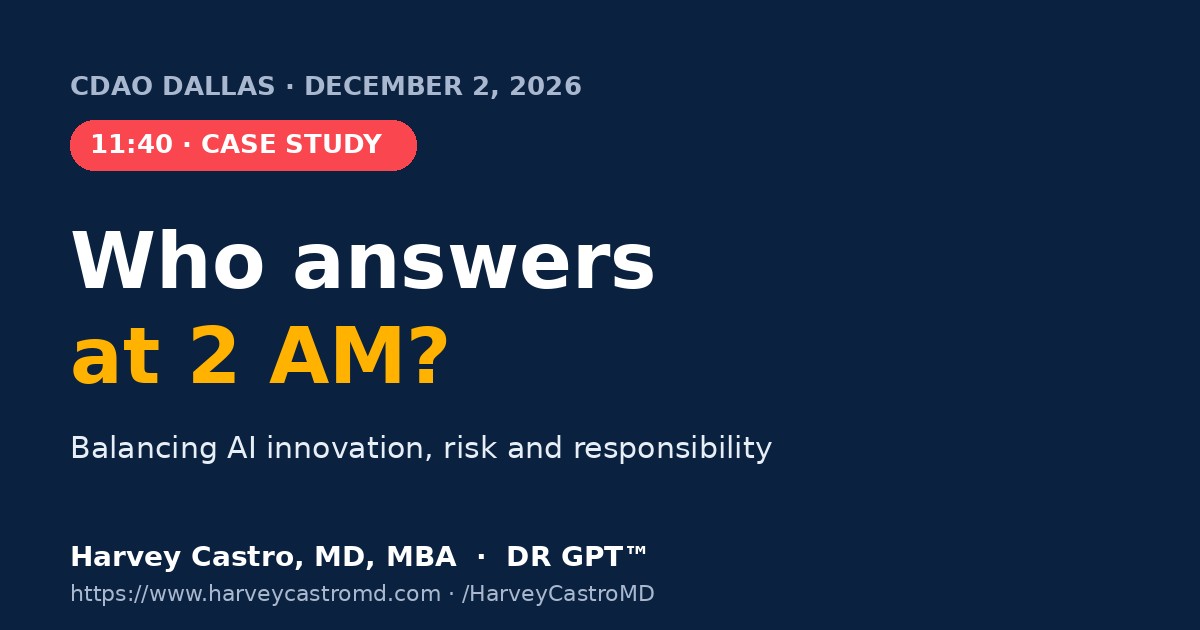
Wednesday, December 2, in Dallas
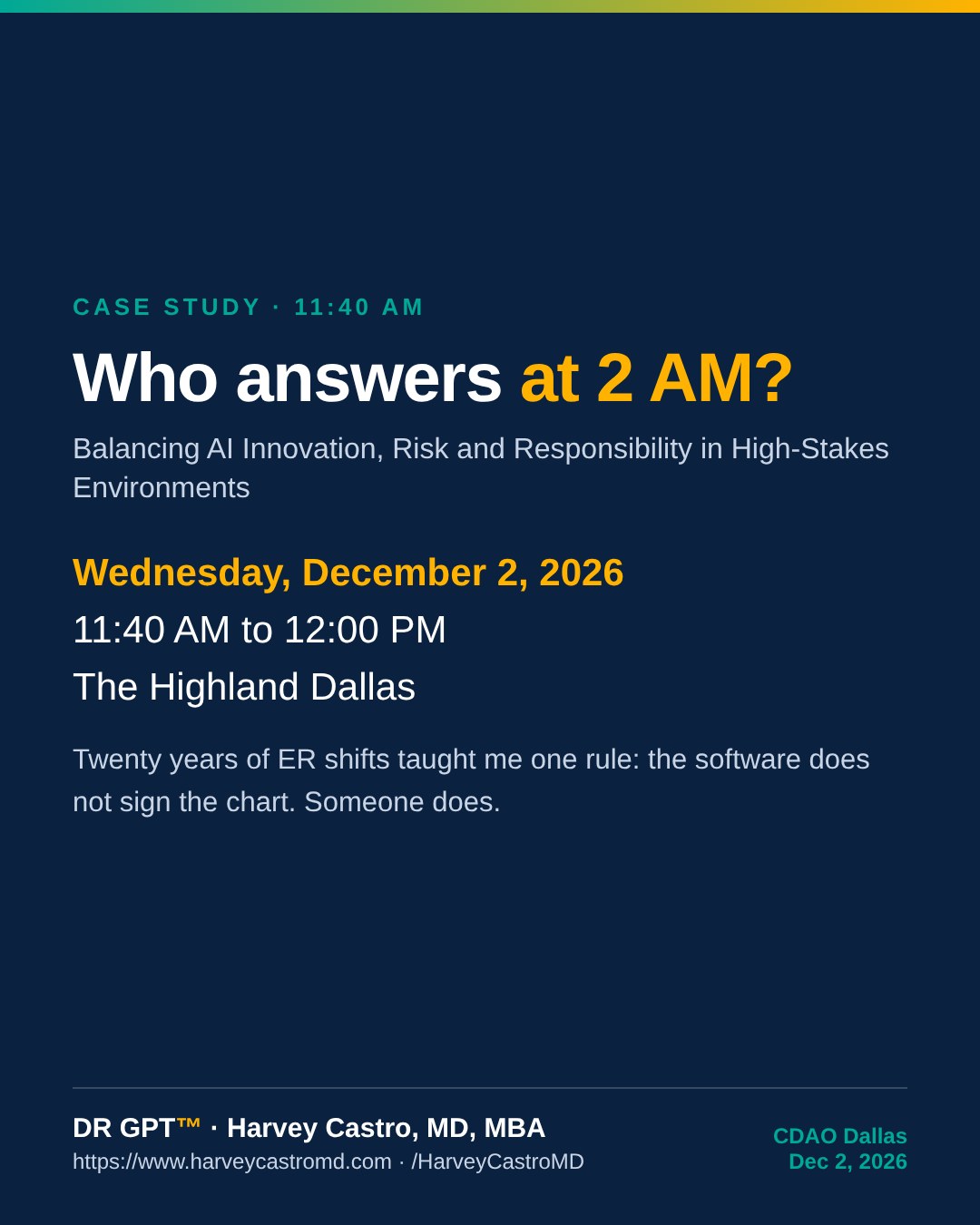
At 11:40 I’m teaching a 20-minute case study at CDAO Dallas, Corinium’s summit for chief data and AI officers. The question: what does the emergency department teach every industry about deploying AI on decisions that are hard to undo?
If you scanned the QR code on my slides, you’re in the right place. Below are the session, the number behind it, my three gates before go-live, a reading list, and graphics you can share.
Free downloads: the one-page take-home sheet (PDF) and my slides (PDF).
Audience guide
Seven sections: the session, the evidence, a checklist, and graphics you can share.
Balancing AI Innovation, Risk and Responsibility in High-Stakes Environments
Lessons from AI in the emergency department, for leaders in every industry: safety, trust, compliance, and who stays accountable when a model touches a decision you cannot undo.
From the Corinium programme. Times and rooms can change on the day.
That number measures a model. Not your hospital.
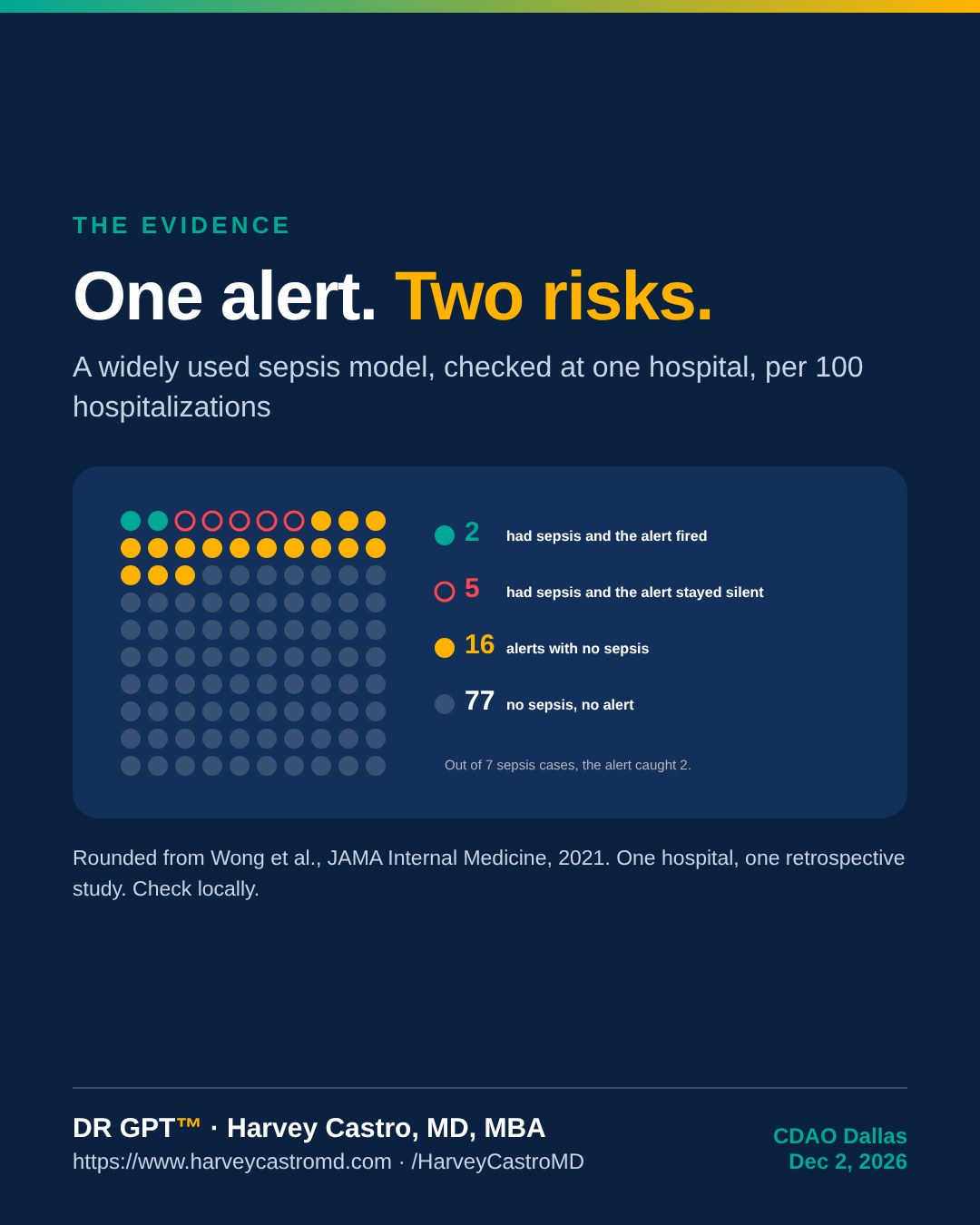
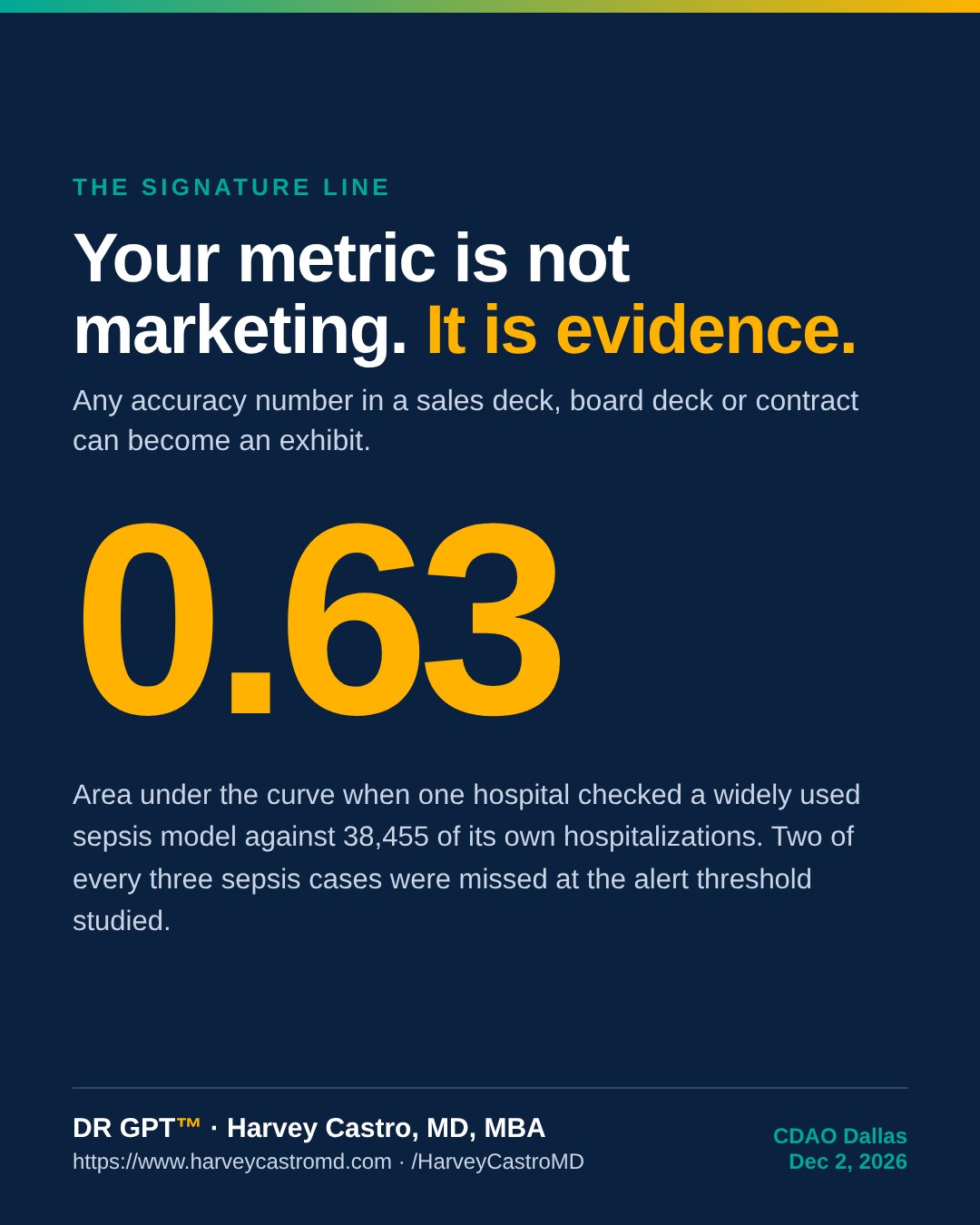
When Michigan Medicine checked a widely used sepsis prediction model against 38,455 of its own hospitalizations, the area under the curve was 0.63. At the alert threshold studied, sensitivity was 33%: two of every three sepsis hospitalizations were missed.
Eighteen of every 100 hospitalizations were flagged, and about two of those had sepsis. Roughly eight alerts were checked for each real case.
What to watch for in any AI pitch
A performance number travels only as far as the data behind it. Ask where it was measured, on whom, and what happened to the people it missed.
Your metric is not marketing. It is evidence.
In September 2024 the Texas Attorney General settled with a Dallas health AI company over an advertised hallucination rate of under 1 in 100,000, which the office alleged was likely inaccurate. The company denied wrongdoing.
Since January 1, 2026, Texas law lets the same office ask AI deployers for their purpose, data, performance metrics, monitoring and safeguards.
The lesson for every CDAO
Any accuracy number in a sales deck, board deck or contract can become an exhibit. Treat it like a clinical claim: sourced, dated and tested on your own population.
How strong is the sepsis evidence?
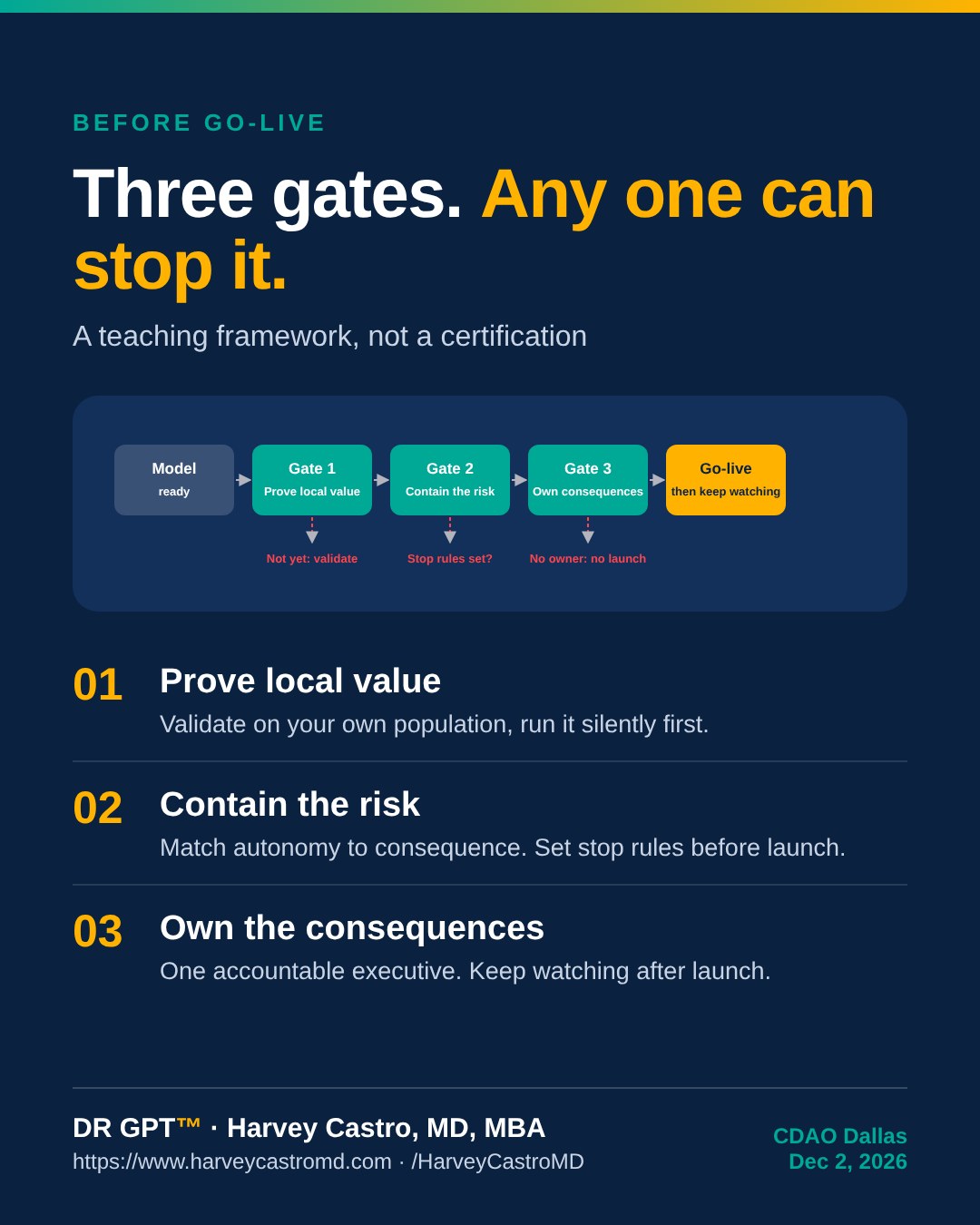
Three gates before go-live
- Prove local value.Define the decision, validate on your own data, compare with today's workflow, and run the model silently first.
- Contain the risk.Match autonomy to consequence. Give reviewers time, context and the power to stop it. Set stop rules before launch.
- Own the consequences.Name one accountable executive, ask vendors for usable evidence, test who benefits and who does not, and keep watching after launch.
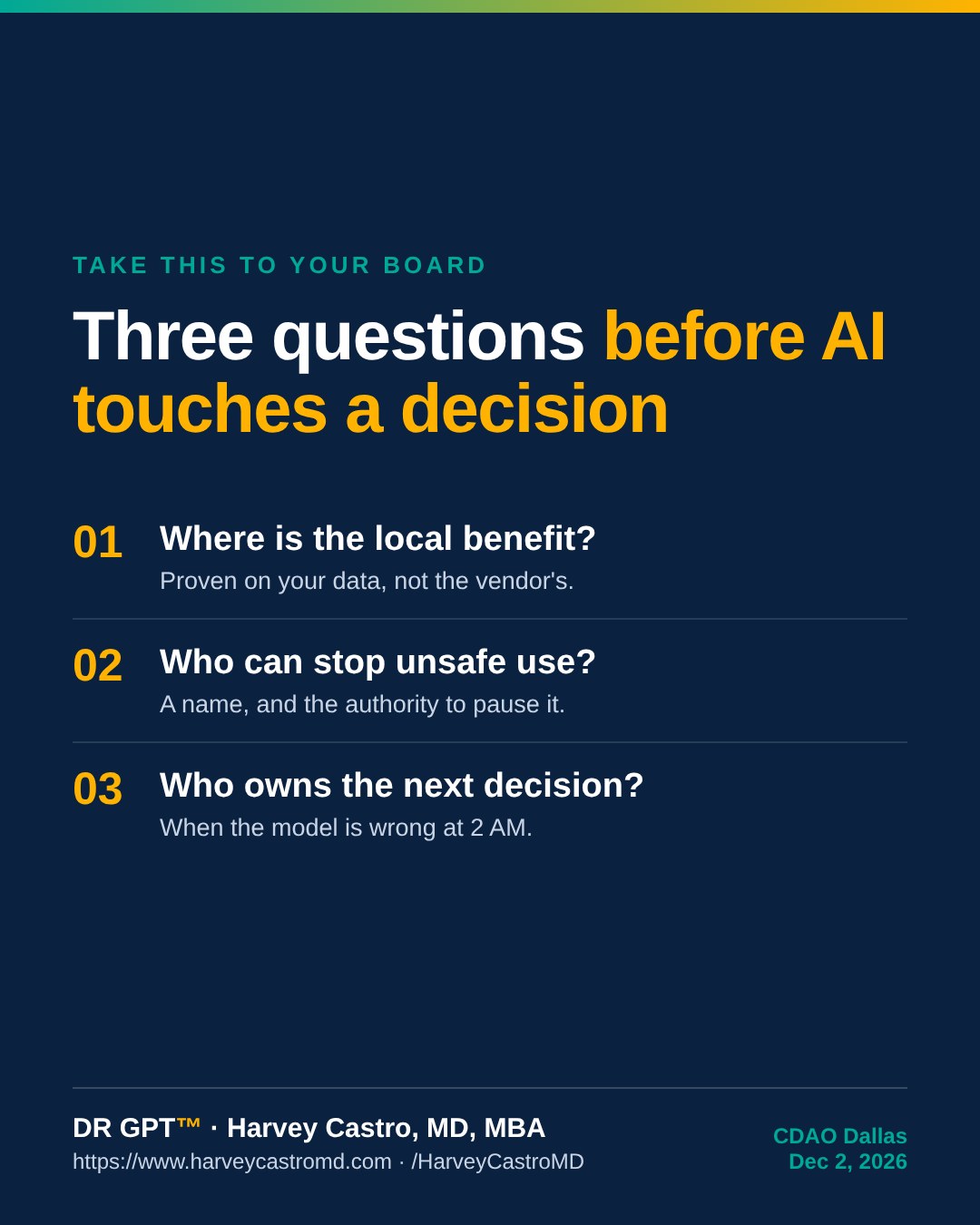
Three questions for your board
- Where is the local benefit?
- Who can stop unsafe use?
- Who owns the next decision?
A teaching checklist informed by NIST and WHO guidance. Not a certification, legal advice or medical advice.
Seven questions you can ask any AI claim
One alert at 2 AM
A model flags 400 accounts overnight as high risk. The on-call analyst can review 40 before the morning run. The vendor’s accuracy figure came from another company’s data, and nobody wrote down who may pause the model.
- Signal.Was it validated on a population like yours?
- Decision.Who chooses which 40 get reviewed?
- Action.What happens to the 360 nobody checks?
- Accountability.If it is wrong, who notices, and when?
Your turn: where in this story does ownership disappear? Tell me on LinkedIn.
Start with the evidence
Five sources behind this session. Each answers a different question, and none of them is a certification.
External validation of a widely implemented proprietary sepsis prediction model
Wong et al., JAMA Internal Medicine, 2021
Checked a widely used model against 38,455 hospitalizations at one academic center. AUC 0.63.
Keep in mind: One hospital, one retrospective study. It tells you to check locally, not that all AI fails.
Read the sourceTexas AG settlement with a health AI company
Texas Attorney General, September 2024
The first settlement of its kind over advertised accuracy of a generative AI product in hospitals.
Keep in mind: A settlement, not a court finding. The company denied wrongdoing.
Read the sourceTexas Responsible AI Governance Act
Texas Attorney General
In effect since January 1, 2026. Lets the Attorney General request a deployer’s purpose, data, metrics, monitoring and safeguards.
Keep in mind: A summary page, not legal advice. Read the statute with counsel.
Read the sourceNIST AI Risk Management Framework
NIST, 2023
Four functions, Govern, Map, Measure and Manage, for managing AI risk across the life cycle.
Keep in mind: Voluntary. It tells you what to manage, not what a regulator will accept.
Read the sourceEthics and governance of artificial intelligence for health
World Health Organization, 2021
Six principles for AI in health, including accountability and inclusiveness.
Keep in mind: Written for health systems and governments, not a technical standard.
Read the sourceTake it with you
Free to share. Open any image full size, then save it. Please tag me so I can thank you.
Open full size
Open full size
Open full size
Open full size
Open full size
A caption you can copy
Three gates before AI touches a decision you cannot undo.
https://www.harveycastromd.com/blog-posts/cdao-dallas-2026-high-stakes-ai
#CDAODallas #AIGovernance #HealthcareAI
My three sessions at CDAO Dallas
Balancing AI Innovation, Risk and Responsibility in High-Stakes Environments
You are here
Governance That Works: What Evidence Would You Hand a Regulator Today?
Read the guide →
4:00 · Panel · ModeratingThe Blind Spots Nobody Owns: What Data, AI & Security Teams Discover Too Late
Read the guide →
Planning a 2027 event?
My keynote “Who answers for the AI at 2 AM?” looks at enterprise AI through the eyes of an emergency physician. Watch the speaker reel and see the keynotes, or check availability.
Session details are from the Corinium CDAO Dallas programme, checked November 23, 2026. The three gates are a teaching framework, not a certification. The 2 AM case is fictional. This post is educational and is not medical, legal or regulatory advice.