CDAO Dallas 2026 panel: What evidence would you hand a regulator?
The CDAO Dallas governance panel I am moderating: the panelists, why Texas is the place to ask, an AI evidence folder to start this week, a reading list, and graphics you can share.

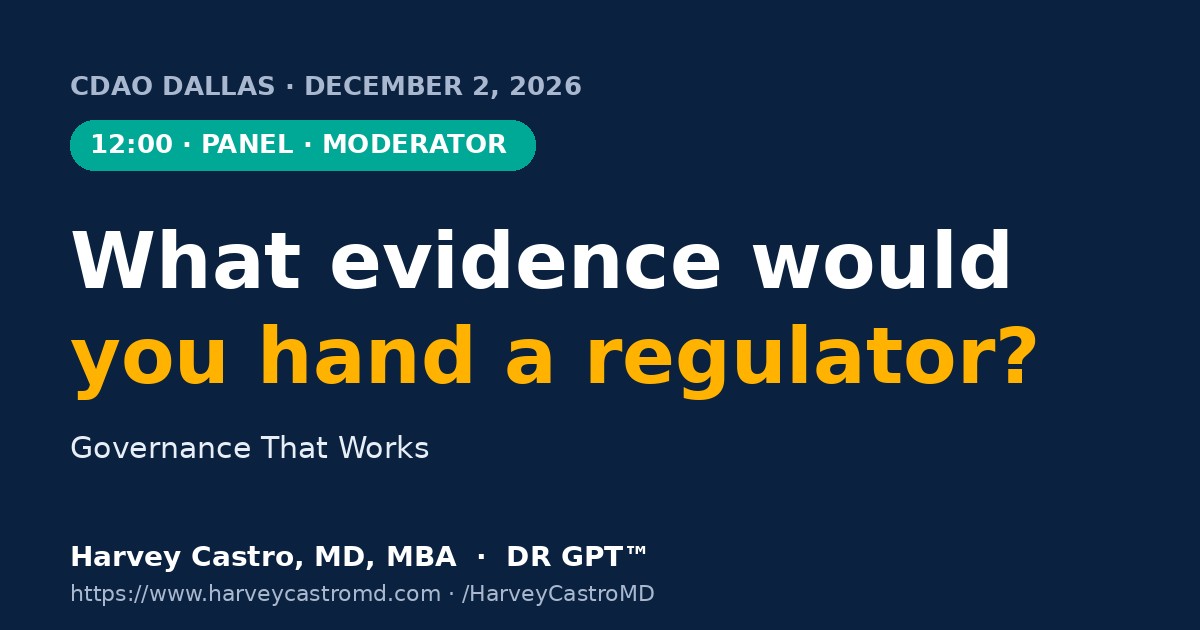
Wednesday, December 2, at noon
Right after my case study, I’m moderating a 30-minute panel at CDAO Dallas on the evidence behind AI governance. If the Texas Attorney General or your auditor asked today, what could you hand over?
Below are the session, the panel, why the question is urgent, an evidence folder to start this week, a reading list, and graphics you can share.
Free download: the one-page take-home sheet (PDF).
Audience guide
Seven sections: the session, the panel, the evidence folder, and graphics you can share.
Governance That Works: What Evidence Would You Hand a Regulator Today?
Three practitioners from public health data, payer engineering and healthcare data architecture. My job is to keep one question in the room: could you prove it tomorrow?
From the Corinium programme. Times and rooms can change on the day.
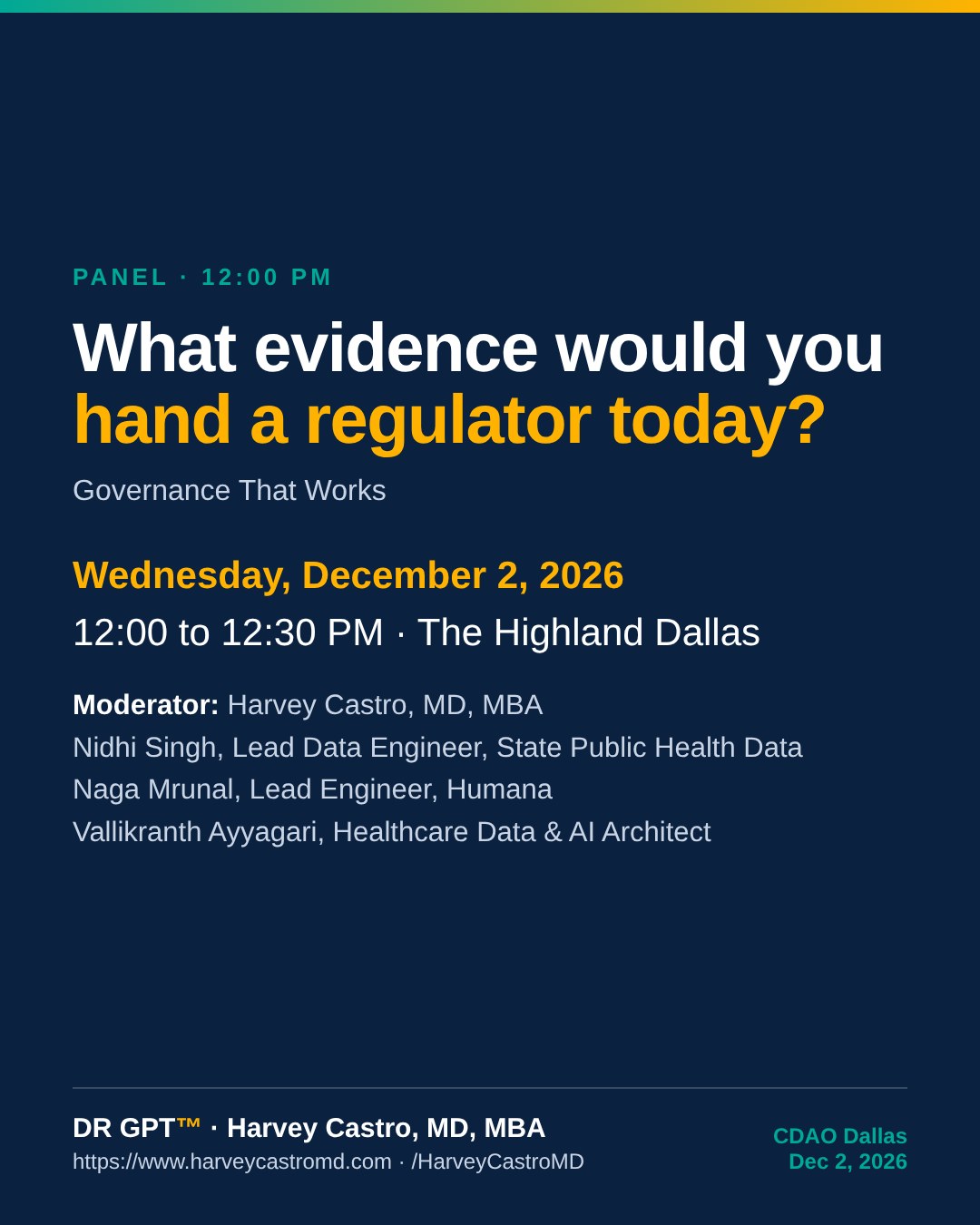
Four seats. Four angles.
Each seat sees governance from a different place: the bedside, public health data, the payer, and the architecture underneath.
Harvey Castro, MD, MBA
Emergency physician and healthcare AI strategist, DR GPT™
Nidhi Singh
Lead Data Engineer, State Public Health Data
Naga Mrunal
Lead Engineer, Humana
Vallikranth Ayyagari
Healthcare Data & AI Architect
Roles follow the Corinium programme. Angle labels describe each field, not any panelist’s views. Panelists speak only for themselves.
How we got here
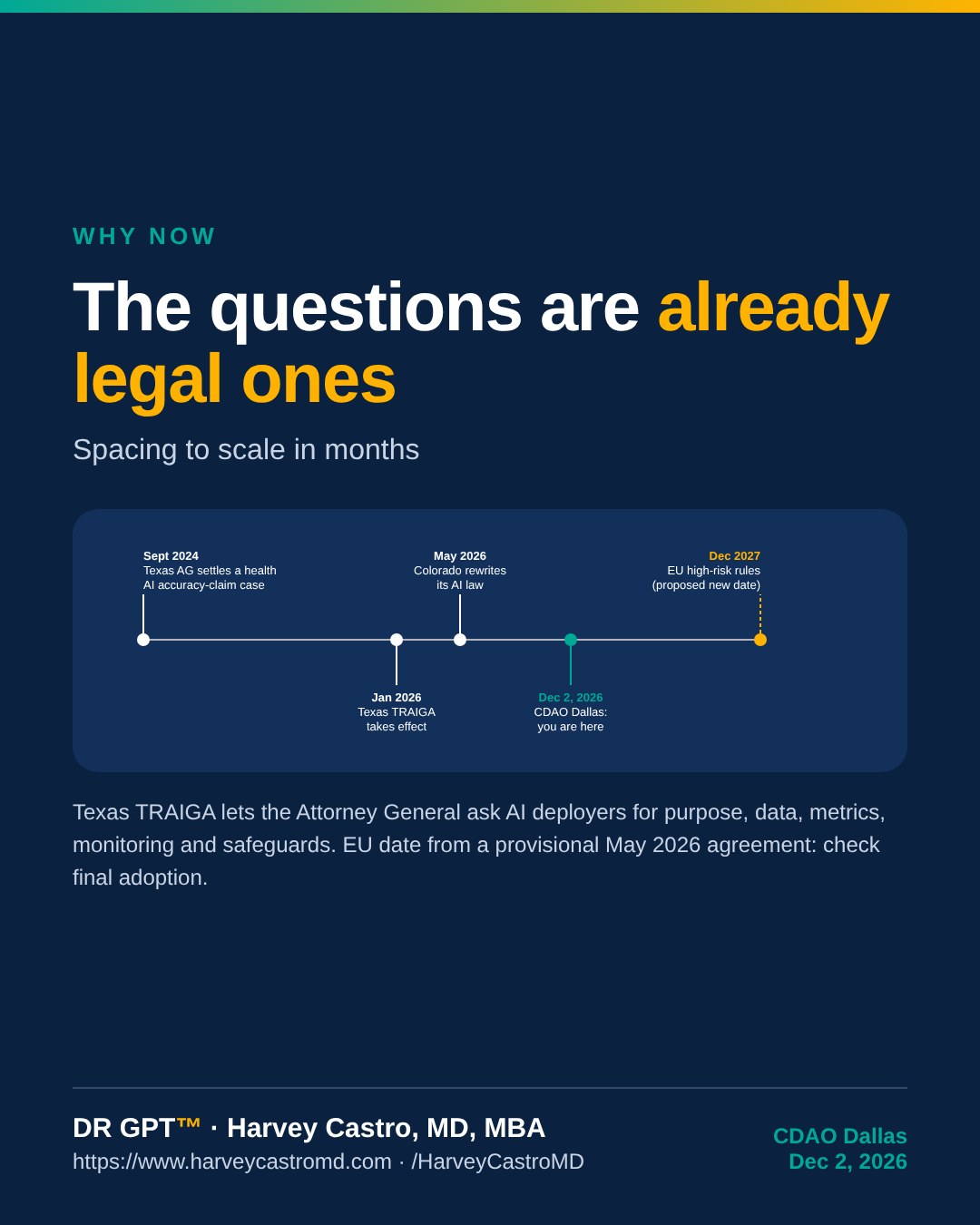
Why Texas is the right place to ask
Since January 1, 2026, the Texas Responsible AI Governance Act lets the Attorney General ask AI deployers for their system’s purpose, data, performance metrics, monitoring and safeguards. The office has exclusive enforcement, and penalties can reach $200,000 per violation.
Three questions I’m bringing to the stage
- Evidence.If the Texas Attorney General or your auditor asked today, what could you hand over, and how does the NIST AI Risk Management Framework anchor it?
- Automation.How do you turn that evidence into controls that run on their own across systems and agents, and make you faster, not slower?
- Priorities.What must be in place before 2027 audit, board and regulatory scrutiny, what can wait, and who signs off on each?
Six questions to ask of any governance program
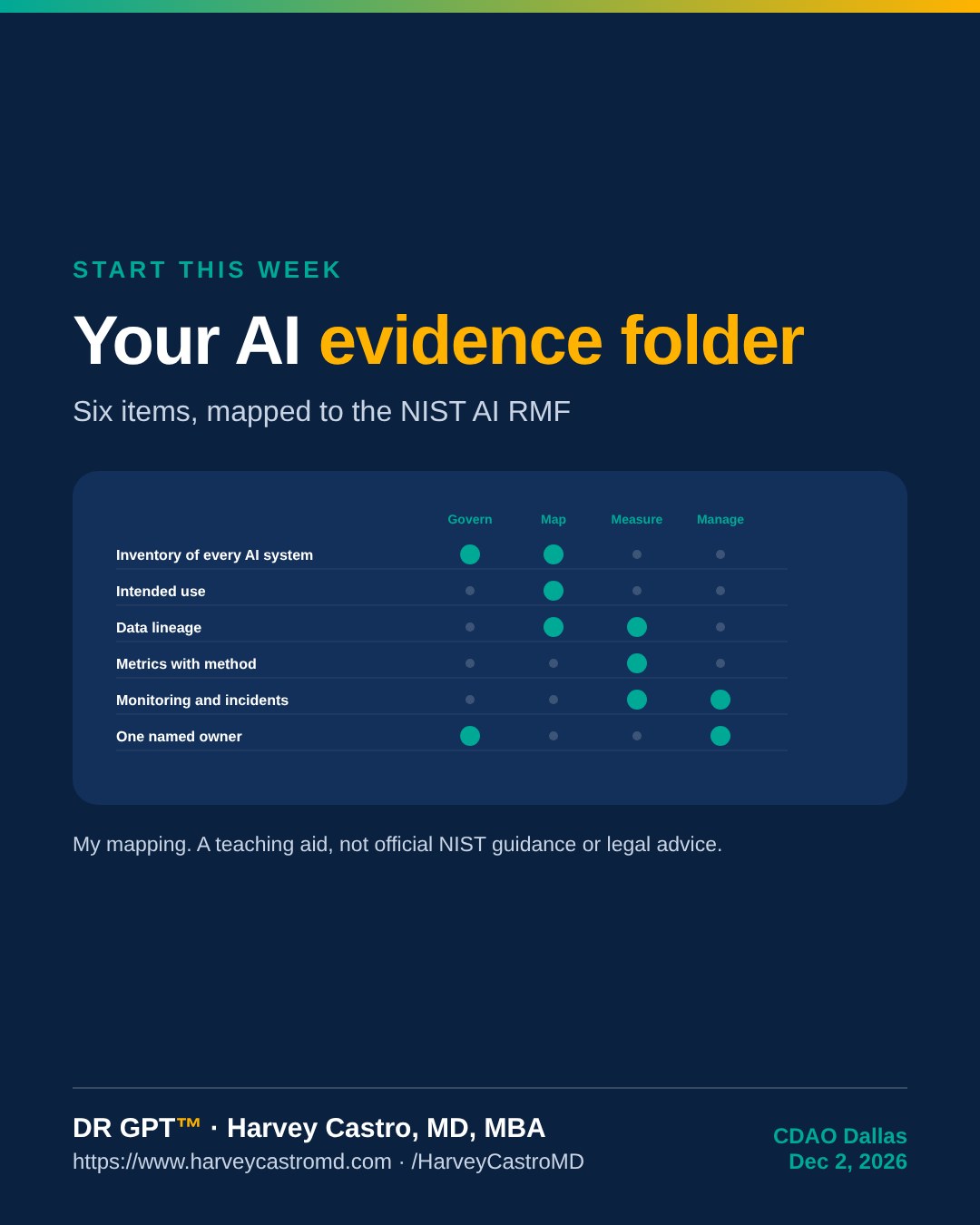
An evidence folder to start this week
- Inventory.Every AI system in production, including features vendors switched on.
- Intended use.Purpose, users and the decisions each system touches.
- Data lineage.Where training and input data came from.
- Metrics with method.Each performance number and how it was measured.
- Monitoring and incidents.Drift checks, overrides and what happened when it failed.
- One owner.A named person who signs off for each system.
Start with the evidence
Five sources for the conversation. A framework tells you what to manage. Only the law tells you what a regulator can ask for.
Texas Responsible AI Governance Act
Texas Attorney General
In effect since January 1, 2026. Lets the Attorney General request a deployer’s purpose, data, metrics, monitoring and safeguards.
Keep in mind: A summary page, not legal advice. Read the statute with counsel.
Read the sourceNIST AI Risk Management Framework
NIST, 2023
Four functions, Govern, Map, Measure and Manage, for managing AI risk across the life cycle.
Keep in mind: Voluntary. It tells you what to manage, not what a regulator will accept.
Read the sourceGenerative AI Profile (NIST AI 600-1)
NIST, July 2024
Applies the AI RMF to generative AI risks such as confabulation and data privacy.
Keep in mind: Voluntary guidance, like the framework it extends.
Read the sourceEU Artificial Intelligence Act
Regulation (EU) 2024/1689
The EU’s risk-based AI law, with duties for high-risk systems.
Keep in mind: A provisional May 2026 agreement proposes moving high-risk dates to December 2027. Check final adoption.
Read the sourceThe State of AI in Emergency Medicine 2027
Edited by Harvey Castro, MD
41 emergency medicine and AI leaders answer five questions, including who answers when AI gets it wrong.
Keep in mind: Contributor views, coded by me. Not a random survey.
Read the sourceTake it with you
Free to share. Open any image full size, then save it. Please tag me so I can thank you.
A caption you can copy
https://www.harveycastromd.com/blog-posts/cdao-dallas-2026-governance-panel
#CDAODallas #AIGovernance #DataGovernance
My three sessions at CDAO Dallas
Balancing AI Innovation, Risk and Responsibility in High-Stakes Environments
Read the guide →
Governance That Works: What Evidence Would You Hand a Regulator Today?
You are here
The Blind Spots Nobody Owns: What Data, AI & Security Teams Discover Too Late
Read the guide →
Planning a 2027 event?
My keynote “Who answers for the AI at 2 AM?” looks at enterprise AI through the eyes of an emergency physician. Watch the speaker reel and see the keynotes, or check availability.
Session details are from the Corinium CDAO Dallas programme, checked November 23, 2026. Panelists speak only for themselves. This post is educational and is not legal or regulatory advice.